
Your New Chapter Awaits: Aromatherapy for Empty Nest Syndrome and Rediscovering Yourself (2025)

Table of Contents
When the House Falls Silent – A New Chapter Begins
There’s a unique kind of quiet that descends when the last child leaves home. It’s a silence that can feel heavy, echoing with years of laughter, slammed doors, and the constant, bustling energy of a family in motion. This transition, often labeled “Empty Nest Syndrome,” is so much more than a cliché; it’s a profound and deeply personal journey that can bring a complex whirlwind of emotions—grief, pride, loneliness, and even a confusing sense of freedom.
If you’re riding this emotional rollercoaster, please know that what you are feeling is completely valid. You are not just missing your children; you are navigating the loss of a primary role, the rhythm of your days, and a piece of your identity.
But within this quiet, there is also a sacred space waiting to be filled—not with the noise of the past, but with the sound of your own soul, perhaps for the first time in decades. This is where the gentle, powerful practice of aromatherapy comes in. It is not a cure for your feelings, but a compassionate companion, a tool to help you process the grief, ground yourself in the present, and courageously begin the beautiful work of rediscovering who you are now.
This journey of using aromatherapy for empty nest syndrome is about using the language of scent to navigate this new landscape, to comfort your heart, and to slowly, lovingly, redefine your world. If this concept resonates and you feel called to a structured, soul-level exploration of this practice, our course, Aromatherapy for Your Soul: A Nurturing Midlife Guide to Emotional Balance, is designed to be your guiding light.
Think of essential oils as more than just pleasant scents; think of them as emotional first aid, bottled from nature. They offer a way to access and soothe parts of your heart that words cannot reach. When you inhale the grounding scent of Cedarwood, it can feel like a steadying hand on your shoulder. When the joyful aroma of Orange fills the room, it can spark a flicker of the playfulness you may have set aside. This is your time. This is your chapter.
And it can be one of the most transformative periods of your life. Let’s explore how you can use these fragrant allies to navigate the waves of emotion, create a new sanctuary in your home, and ultimately, write a new story for yourself—one filled with purpose, peace, and rediscovered joy.
More Than a Cliché: Understanding the Emotional Waves of Empty Nest Syndrome
To truly heal and move forward, we must first honor and understand the emotional terrain we are crossing. Dismissing these feelings as “just a phase” does a disservice to the profound life shift you are experiencing. Let’s gently unpack the layers of this transition, because in naming them, we take away some of their power to overwhelm us.
The Many Faces of Grief: Acknowledging Loss of Purpose and Identity
For years, perhaps decades, your identity was deeply intertwined with being “Mom.” Your schedule, your priorities, and your daily purpose were largely defined by the needs of your children. When they leave, that role undergoes a dramatic change. The grief you feel is real. It’s not just for the absence of your children, but for the loss of that central, day-to-day purpose. You might feel untethered, asking yourself, “Who am I now, if not a full-time mother?”
This is a core identity crisis, and it’s completely normal. It’s essential to allow yourself to feel this grief without judgment. Cry if you need to. Acknowledge the empty chair at the dinner table. This isn’t about dwelling in sadness, but about giving yourself permission to mourn the closing of a beautiful, demanding chapter. This honest acknowledgment is the first and most crucial step toward building something new and equally meaningful. This journey of using aromatherapy for empty nest syndrome begins with this compassionate acknowledgment, creating space for healing.
The Unexpected Void: From Chaos to Quiet and How It Impacts Your Nervous System
The sudden shift from a noisy, chaotic, and constantly demanding household to one of profound quiet is not just an emotional adjustment; it’s a physiological one. Your nervous system has been conditioned for years to a certain level of background “noise”—both literal and figurative. The sudden absence of this can leave your system feeling off-balance, almost like a form of sensory deprivation. This can manifest as anxiety, restlessness, an inability to relax, or a feeling that you should be doing something. The quiet can feel loud with its own absence.
This is why so many women find themselves rattling around the house, unable to settle. Understanding that this is a nervous system response, not a personal failing, is empowering. It means we can use tools, like aromatherapy, to consciously and gently retrain our nervous system to recognize this new quiet not as a void, but as a space for peace and possibility.
The Hidden Opportunity: Framing This as a Time for Sacred Self-Rediscovery
After acknowledging the very real grief and nervous system shock, we can begin to gently turn our gaze toward the hidden gift within this transition. For the first time in a long time, your time, energy, and attention are your own. This is a sacred opportunity—a blank page upon which you can write a new story. What have you always wanted to do but put on hold? What parts of yourself did you set aside to care for your family?
This is not about replacing your role as a mother; that love is eternal. It’s about expanding your identity to include you again. It’s about rediscovering the woman you are, with all her wisdom, experience, and untapped potential. This is the ultimate goal of using aromatherapy for empty nest syndrome: to support you as you courageously meet this woman, get to know her again, and build a life that reflects who you are now. It’s a journey back to yourself, and it can be one of the most enriching adventures of your life.
The Soul-Science of Scent: Why Aromatherapy is Perfect for This Transition
In this time of profound change, we need tools that speak the language of the heart while calming the body. Aromatherapy is uniquely suited for this task because it operates at the intersection of biology and emotion, science and soul. It offers a direct, gentle, and effective way to navigate the complex feelings of this transition. Let’s explore the beautiful mechanics of how scent can become your most trusted ally.
Scent as an Anchor: How Fragrance Can Ground You in the Present Moment
When grief for the past or anxiety about the future feels overwhelming, the most powerful thing you can do is find your way back to the present moment. This is where scent becomes an incredible anchor. Unlike our other senses, smell is immediate and undeniable. You can close your eyes to avoid seeing something, or plug your ears to avoid hearing, but a scent fully envelops you. By consciously choosing a calming, grounding essential oil—like the deep, woody aroma of Cedarwood or the earthy sweetness of Sandalwood—and taking a few deliberate breaths, you are pulling your awareness away from the swirling thoughts in your head and into the physical reality of your body, right here, right now.
This simple act of inhalation tells your amygdala (the brain’s fear center) that you are safe. It’s a way of planting your feet firmly on the ground when you feel emotionally untethered. Using aromatherapy for empty nest syndrome in this way creates a portable touchstone of calm that you can return to anytime you feel swept away by a wave of emotion.
Rewiring Neural Pathways: Using Scent to Create New, Positive Memories and Associations
For years, your home has been filled with specific smells associated with family life—perhaps the scent of baked goods, clean laundry, or your child’s favorite shampoo. These scents are powerfully linked to memories. The empty nest can make the absence of these familiar smells feel particularly sharp. The wonderful news is that you can use this same powerful connection to your advantage. You can consciously use essential oils to create new neural pathways and positive associations.
Every time you diffuse an uplifting blend of Orange and Ylang Ylang while pursuing a new hobby, or use a calming Lavender spray on your pillow before a restful night’s sleep, you are building a new scent-memory library. You are teaching your brain to associate your home not only with memories of your children but also with new experiences of peace, creativity, and joy that belong solely to you. This is a proactive and empowering way to reshape your emotional landscape.
The Direct Line to Emotion: A Simple Explanation of the Olfactory-Limbic System Connection
The reason scent is so effective for emotional work boils down to a simple biological fact: your sense of smell has a direct hotline to your emotional brain. When you inhale an essential oil molecule, it travels up your nose and directly to the olfactory bulbs. These bulbs are extensions of your brain’s limbic system—the command center for emotions, memories, and arousal. This is the only place where your central nervous system has direct contact with the outside environment. This means that a scent doesn’t get processed by the thinking part of your brain first; it goes straight to the emotional core.
This is why a smell can trigger a vivid memory or a sudden feeling before you’ve even had a chance to identify what it is. When you use a calming oil, you are sending a “calm down” message directly to the source of your emotions. When you use an uplifting oil, you are sending a “cheer up” signal on the fastest pathway possible. This direct line is what makes aromatherapy for empty nest syndrome so uniquely powerful—it allows you to comfort and support your emotional self in a way that bypasses the need for complex thinking or analysis, meeting you exactly where you are.
Your Aromatherapy Toolkit for the Empty Nest Journey
Now that we understand the profound connection between scent and emotion, it’s time to meet your new support team. The following essential oils have been carefully chosen for their specific abilities to address the core emotional challenges of the empty nest transition. Think of them not as mere substances, but as plant spirits, each with a unique gift to offer you as you navigate grief, seek solid ground, and eventually, open your heart to new beginnings.
Essential Oils for Grieving and Letting Go
This first group of oils is for honoring the very real sense of loss. They are not about rushing you through your grief, but about providing comfort and support as you process it.
- Frankincense (Boswellia carterii): The Soul Stabilizer for Deep Emotions
Frankincense has been used in spiritual and religious ceremonies for millennia for a reason: it is profoundly grounding and centering. Its rich, balsamic, and slightly spicy aroma is known as a powerful tonic for the soul. When feelings of grief, sadness, or emptiness feel overwhelming, Frankincense can help to slow and deepen the breath, bringing a sense of spaciousness and peace to a constricted heart. It doesn’t erase the pain, but it helps you to observe it from a more stable, supported place, making the emotions feel more manageable. It is the ultimate oil for contemplative practices, meditation, and simply sitting with your feelings without being consumed by them. - Bergamot (Citrus bergamia): The Uplifting Light in the Darkness
Bergamot is a unique citrus oil, cold-pressed from the rind of a fruit that is a cross between a lemon and a bitter orange. What makes it so special for this journey is its dual ability to both uplift and calm. It is the oil of joyful serenity. While other citrus oils can be purely energizing, Bergamot has a subtle calming quality, thanks to its constituent linalool. It can gently lift the heavy cloak of sadness and anxiety while simultaneously soothing the underlying nervous tension. It’s like a ray of sunshine breaking through the clouds on a grey day—it doesn’t deny the clouds, but it reminds you that the light is still there. A note of caution: Bergamot is phototoxic, so avoid applying it to skin that will be exposed to direct sunlight.
Essential Oils for Grounding and Finding Your New Foundation
Once you have begun to process the initial waves of grief, these oils will help you feel more rooted and secure in your new reality, building a stable foundation from which to grow.
- Cedarwood (Cedrus atlantica): The Strength of the Roots
The aroma of Cedarwood is like walking through an ancient, peaceful forest. It is deeply grounding, evoking a sense of strength, stability, and resilience—like the mighty cedar tree itself. When you feel untethered, lost, or emotionally scattered, Cedarwood acts as an energetic anchor. It helps to quiet a racing mind, ease anxiety, and promote a sense of safety and containment. It is an excellent oil to use when you are feeling unmoored by the quiet of the house or are struggling to find your footing in this new chapter. - Sandalwood (Santalum album): The Quiet Contemplation
Sandalwood carries a warm, creamy, and woody scent that is deeply revered for its ability to quiet the mind and promote a state of meditative awareness. It is the oil of inner peace and introspection. While Cedarwood grounds you to the earth, Sandalwood grounds you to your inner self. It helps to ease mental chatter, worry, and feelings of regret, allowing you to connect with a deeper sense of peace and self-awareness. It is the perfect companion for journaling, yoga, or any practice that involves turning inward to listen to the whispers of your own soul.
Essential Oils for Joy, Creativity, and New Beginnings
When you feel ready to explore, these oils will support you in rediscovering joy, sparking creativity, and opening your heart to the possibilities that await.
- Orange (Citrus sinensis): The Spark of Joy and Playfulness
The bright, sunny, and instantly recognizable scent of Sweet Orange is pure, unadulterated joy in a bottle. It is an incredibly uplifting and comforting oil that can help to dissolve feelings of pessimism and heaviness. It encourages a lighthearted, optimistic outlook and reconnects you with a sense of playfulness that may have been dormant for years. Diffusing Orange in your home can instantly change the energy of a room, making it feel warmer, brighter, and more welcoming—a reflection of the new energy you are cultivating within yourself. - Ylang Ylang (Cananga odorata): The Opener of the Heart to New Experiences
With its intensely floral, sweet, and exotic aroma, Ylang Ylang is a powerful tonic for the heart. It is renowned for its ability to alleviate feelings of anger, frustration, and hurt, while simultaneously promoting feelings of joy, sensuality, and self-love. When your heart has been tenderized by the bittersweet experience of letting go, Ylang Ylang can help to gently open it back up to the world. It encourages you to receive pleasure, embrace new experiences, and fall in love with your own life again. It is the scent of courageous, open-hearted living.
To help you quickly reference these powerful allies, here is a summary table:
| Essential Oil | Primary Emotional Benefit | Best Used For |
|---|---|---|
| Frankincense | Soul-level grounding, peace, and comfort | Meditation, deep grief, feeling overwhelmed, spiritual connection |
| Bergamot | Uplifting yet calming, joyful serenity | Anxiety, sadness, low mood, needing a gentle emotional lift |
| Cedarwood | Grounding, strengthening, stabilizing | Feeling untethered, scattered, anxious, or insecure |
| Sandalwood | Quieting the mind, inner peace, introspection | Mental chatter, worry, meditation, journaling, connecting to self |
| Orange | Joy, optimism, playfulness, comfort | Low energy, pessimism, creating a warm and happy home atmosphere |
| Ylang Ylang | Heart-opening, joy, self-love, sensuality | A closed or hurting heart, lack of self-love, embracing new experiences |
This toolkit provides a foundation. As you grow more comfortable, you’ll learn to blend them intuitively for your unique needs. For a guided journey that helps you master these blends and integrate them into a profound daily practice, our course, Aromatherapy for Your Soul, offers deep, personalized support.
Creating Your “New Chapter” Aromatherapy Rituals
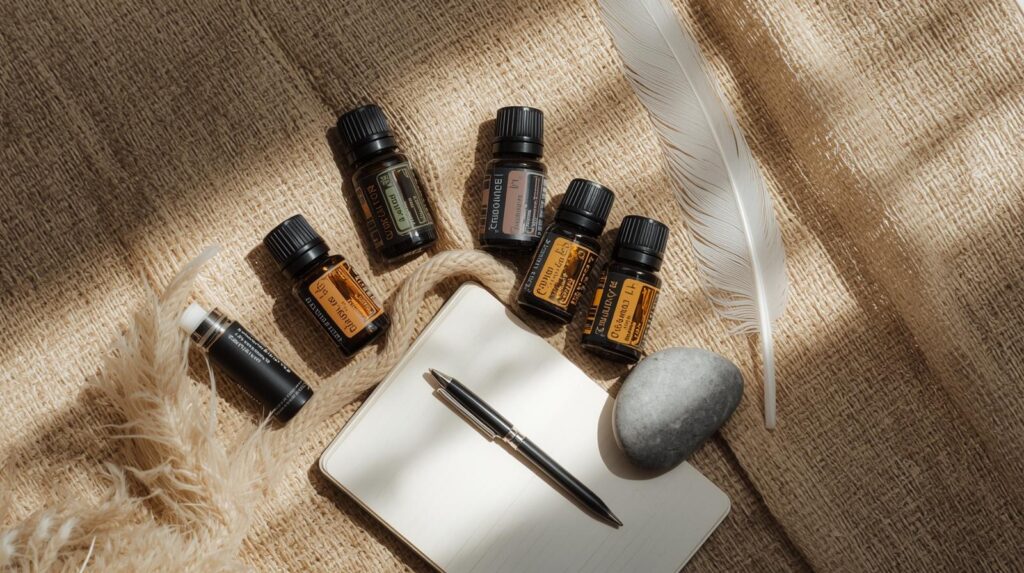
Knowledge of the oils is the first step; weaving them into the fabric of your day is where the true transformation occurs. Rituals provide structure, intention, and a sense of sacredness to ordinary moments. In the void left by the routines of motherhood, these new, self-created rituals become the architecture of your new life. They are loving promises you make to yourself each day. Let’s explore three foundational rituals designed to support you through the emotional landscape of the empty nest.
The “Morning Anchor” Diffusion Ritual: Starting the Day with Purpose and Calm
Mornings can be particularly challenging when the familiar hustle of getting everyone out the door is gone. This ritual is designed to gently claim the day as your own, setting a tone of purpose and calm intention. Instead of waking to a sense of emptiness, you’ll wake to a scent that you have chosen for your own well-being. As you prepare your morning tea or coffee, add a carefully chosen blend to your diffuser. A wonderful combination for this is 3 drops of Cedarwood for grounding and 2 drops of Orange for joyful energy.
The earthy-citrus aroma will fill your space, signaling to your mind and body that this is a new day with new possibilities. As you inhale, set a simple intention. It could be as straightforward as, “Today, I will be gentle with myself,” or “I am open to moments of joy.” This ritual takes less than a minute but powerfully frames the next 24 hours, helping you use aromatherapy for empty nest syndrome as a proactive tool for emotional stability.
The “Afternoon Reconnection” Personal Inhaler Blend: For Moments of Sudden Loneliness
The afternoon can often bring a wave of loneliness, especially during the hours you might have previously been preparing for your children to return home from school. This is when you need a quick, portable, and discreet tool to recenter yourself. A personal aromatherapy inhaler is perfect for this. Create a blend specifically for emotional reconnection. A supportive combination is 5 drops of Bergamot (for its uplifting and calming duality) and 5 drops of Frankincense (for soul-level comfort).
Add these to the cotton wick of an empty inhaler and assemble it. Keep this in your purse or pocket. When a wave of sadness or loneliness hits, simply remove the cap, hold the inhaler to one nostril, and close the other, taking 3-5 deep, slow breaths. This sends an immediate message of comfort and support directly to your limbic system, helping to soothe the sharp edge of the emotion and bring you back to the present moment. It’s a personal hug in a bottle, always available when you need it most.
The “Evening Release” Bathing Ritual: Letting Go of the Day and Embracing Rest
Evenings are for releasing the day’s accumulated emotions and preparing the nervous system for deep, restorative sleep. Transforming your bath into a sacred, aromatic sanctuary is one of the most nurturing practices you can adopt. This ritual is about physically and symbolically washing away the day and embracing the quiet of the night. Crucially, never add undiluted essential oils to your bathwater, as they can irritate the skin. Instead, mix 6-8 drops of your chosen blend into a tablespoon of full-fat milk, honey, or a carrier oil like Jojoba to disperse the oils safely.
A beautiful blend for this ritual is 3 drops of Lavender (for calm), 3 drops of Sandalwood (for quiet contemplation), and 2 drops of Ylang Ylang (to open the heart to self-love). As you soak in the warm, fragrant water, focus on your breath. With each exhale, visualize releasing any sadness, tension, or worry from the day. Allow the aroma to envelop you, creating a womb-like space of safety and comfort. This practice is a powerful way to end your day, showing yourself the same nurturing care you have so freely given to others for so long.
- Summary of Rituals:
- Morning Anchor: Diffuse grounding + uplifting oils (e.g., Cedarwood & Orange) to set a positive intention for the day.
- Afternoon Reconnection: Use a personal inhaler with balancing oils (e.g., Bergamot & Frankincense) for immediate emotional support.
- Evening Release: Take an aromatic bath with calming, heart-opening oils (e.g., Lavender, Sandalwood, Ylang Ylang) to release the day and prepare for rest.
These rituals are a starting point. They are designed to be adapted to your unique rhythm and needs. For a more extensive collection of rituals, meditations, and guidance on crafting a deeply personal practice, our course, Aromatherapy for Your Soul, provides a comprehensive and supportive framework for this very purpose.

Rediscovering You: Pairing Scent with Self-Discovery Practices
The empty nest provides a rare and precious opportunity: the gift of uninterrupted time and mental space to ask yourself, “Who am I now?” Aromatherapy can be a powerful catalyst in this process of self-discovery, moving beyond simple comfort and into the realm of active exploration. By intentionally pairing specific scents with introspective practices, you can access deeper layers of your consciousness, unlock creativity, and begin to define the contours of your new identity. Let’s explore how to weave scent into this journey of meeting yourself anew.
Journaling with Aroma: Using Prompts and Essential Oils to Uncover Your Desires
Journaling is a powerful tool for processing emotions and uncovering hidden desires, but staring at a blank page can be daunting. This is where scent can set the stage for profound inner work. Before you begin writing, choose an essential oil that supports introspection and openness, such as Sandalwood or Frankincense. Place a drop on your wrists, diffuse it nearby, or simply inhale it from the bottle. Take three deep breaths, allowing the aroma to calm your mind. Then, use a prompt to guide your writing.
Instead of asking, “What’s wrong?” try more forward-looking questions like: “What did I love to do before my life became about everyone else?” or “If I had no fears, what is one bold thing I would try?” or “What qualities do I admire in others that I would like to nurture in myself?” The scent acts as an anchor, keeping you present and open as you write, helping to bypass the inner critic and connect with your authentic voice. The practice of aromatherapy for empty nest syndrome, in this context, becomes a key that unlocks the door to your own inner wisdom.
Scent and Movement: Using Diffused Oils During Yoga or Stretching to Connect Mind and Body
For years, your body may have felt like a workhorse—a tool for getting things done and caring for others. Now is the time to reconnect with it as a source of pleasure, strength, and intuition. Pairing gentle movement with aromatherapy is a beautiful way to facilitate this mind-body reunion. As you unroll your yoga mat or prepare for a gentle stretching routine, diffuse an essential oil blend that supports your intention.
For a grounding, strengthening practice, use Cedarwood. For a practice focused on opening the heart and hips, use Ylang Ylang. For a calming, meditative flow, use Lavender. As you move and breathe, the scent will deepen the experience, creating a multi-sensory ritual. It helps you stay present in your body, notice sensations without judgment, and release stored emotional tension. This practice isn’t about a perfect pose; it’s about listening to what your body has to tell you and honoring its needs, perhaps for the first time in a long time.
The “Scent of Me” Experiment: Blending a Perfume that Reflects Your Current, Authentic Self
One of the most creative and empowering practices you can undertake is to create a personal perfume that represents who you are in this very moment. This is not about replicating a commercial fragrance; it’s about intuitively crafting a scent that speaks to your soul. Set aside some quiet time with your collection of essential oils and a small bottle of carrier oil like Jojoba. Smell each oil, not analytically, but intuitively. Which ones resonate with you today? Do you need the strength of Cedarwood, the joy of Orange, the peace of Sandalwood, or the heart-opening quality of Ylang Ylang?
Start with a single “heart” note that feels most like you, and then add others that complement it, drop by drop. Write down your recipe. This “Scent of Me” blend is a living, evolving creation. You can wear it as a personal fragrance, add it to your body oil, or simply inhale it as a reminder of your unique and beautiful essence. It is a powerful, non-verbal declaration of self. This creative process is a core part of the journey we explore in Aromatherapy for Your Soul, where we guide you in crafting not just blends, but a new, fragrant identity for this chapter of your life.
Crafting Your Sanctuary: Transforming Your Empty Nest into a Soul-Nourishing Space
Your home has been the heart of your family’s life for so long. Its energy is steeped in memories of the past. Now, it’s time to consciously shift that energy to support the person you are becoming. This isn’t about erasing the past, but about layering new meanings, new purposes, and new vibrations onto the space. Transforming your environment is a powerful, tangible act that signals to your subconscious mind that a new chapter has truly begun. Let’s explore how to use space and scent to create a sanctuary that nourishes your soul.
Reclaiming Space: Ritually Cleansing and Redecorating Your Child’s Old Room
This can be one of the most emotionally charged, yet ultimately liberating, steps. The empty room is a potent symbol of the transition. Leaving it as a shrine can keep you energetically stuck in the past. Instead, consider a ritual to honor the past while reclaiming the space for the present. Begin by physically cleaning the room—open the windows, let fresh air in, and clean thoroughly. As you do, you can diffuse a clearing blend like Frankincense and Orange to help shift the energy. Then, decide on a new purpose for the room that is entirely for you. It could become a:
- Yoga and Meditation Studio: A serene space for your practice.
- Creative Hobby Room: For painting, writing, sewing, or any passion project.
- Cozy Reading Nook: Filled with comfortable chairs and your favorite books.
- Guest Room: Reframed as a welcoming space for your friends and chosen community.
Repainting the walls, changing the bedding, or simply rearranging the furniture are powerful acts of reclamation. This process isn’t an act of erasure; it’s an act of integration and evolution. It tells the world, and more importantly, yourself, that you and your dreams are now a priority.
The Heart of the Home: Using Diffusers in Common Areas to Shift the Home’s Energy
The common areas of your home—the living room, kitchen, and den—once buzzed with collective family energy. Now, they can feel cavernous and quiet. Aromatherapy is your most effective tool for quickly and beautifully shifting the atmosphere in these spaces. By strategically placing diffusers, you can define the emotional tone of your home each day.
- In the Living Room: To create a warm, welcoming, and uplifting atmosphere, diffuse a blend of Orange and Ylang Ylang. This combination fosters joy and open-heartedness, making the space feel vibrant and alive with positive energy.
- In the Kitchen: The kitchen is often the emotional center of the home. To clear any residual energy of hectic family meals and create a fresh, clean slate, diffuse Lemon or Grapefruit. To make cooking for yourself a joyful ritual, try a comforting blend of Lavender and Bergamot.
- In Your Home Office or Creative Corner: To promote focus, clarity, and inspiration as you explore new projects or hobbies, diffuse Rosemary and Sandalwood. This combination grounds the mind while stimulating creative thought.
This conscious use of aromatherapy for empty nest syndrome allows you to become the architect of your home’s emotional landscape, ensuring it supports your well-being at every turn.
Creating a Personal Altar or Nook for Your Aromatherapy Practice
Finally, carve out a small, dedicated space that is solely for your spiritual and self-care practices. This doesn’t have to be large—a corner of a room, a windowsill, or a small table will do. This is your personal altar, a physical anchor for your new rituals. On it, you can place your diffuser, your collection of essential oils, a beautiful stone or crystal, a candle, a journal, and any other items that feel sacred and meaningful to you. This space serves as a daily visual reminder of your commitment to yourself.
It is a place where you can go to for a five-minute breathing exercise with your personal inhaler, to diffuse a calming oil before meditation, or to simply sit in quiet reflection. By creating this dedicated nook, you are physically manifesting the importance of your inner world and your journey of using aromatherapy for empty nest syndrome as a path to wholeness. For more inspiration on creating sacred space and daily rituals that fill your soul, our course, Aromatherapy for Your Soul, offers guided practices to deepen this transformative work.
A Message to Your Heart: You Are Not Alone on This Path
As we near the end of this guide, I want to speak directly to your heart. If you have read this far, it is because you are a seeker—you are looking for a way to not just endure this transition, but to move through it with grace and emerge transformed. Please hold this truth close: the complex tapestry of emotions you feel is a testament to your deep capacity to love, not a sign of weakness. The grief, the pride, the loneliness, and the flickers of excitement are all valid threads in this new story you are weaving. It is also important to address a feeling that many women experience but seldom voice: guilt.
If you find moments of relief or even joy in your newfound freedom, please do not feel guilty. This does not diminish your love for your children. It is a sign that your spirit is resilient and that your soul is ready to explore the landscape of your own life once again. You are not abandoning your role as a mother; you are expanding your identity to include the magnificent, multifaceted woman you have always been.
This path of rediscovery is one you walk for yourself, but you do not have to walk it in isolation. Seek out kindred spirits—other women who are navigating their own empty nests. Share your experiences, your struggles, and your small victories. Your journey is unique, but the feelings are universal, and there is immense comfort in shared understanding.
Remember, using aromatherapy for empty nest syndrome is a profound act of self-compassion. Each time you inhale a calming scent, create a new ritual, or reclaim a space in your home, you are sending a powerful message to your soul: “I see you. I hear you. And I am committed to nurturing you.” This journey back to yourself is the most important one you will ever take. And if you desire a map, a guide, and a community to walk beside you, we warmly invite you to join us in Aromatherapy for Your Soul: A Nurturing Midlife Guide to Emotional Balance. You are not alone.
Conclusion: Your Scented Path to a New Beginning
The quiet that once felt like a void is now revealing itself as a sacred space—a blank canvas waiting for the vibrant colors of your rediscovered spirit. The journey through the empty nest is not a single event, but a gradual unfolding, a gentle metamorphosis. It’s a path that asks for patience, self-compassion, and the courage to listen to the whispers of your own soul.
Aromatherapy for empty nest syndrome is far more than a coping mechanism; it is a beautiful, sensory language for this profound dialogue with yourself. It is the comforting hand on your shoulder during moments of grief, the steadying anchor when you feel untethered, and the joyful spark that ignites your curiosity for what lies ahead.
You have now been gifted a toolkit—not just of bottles and blends, but of rituals, understandings, and intentions. You have the power to transform your home from a place of memory into a sanctuary of presence, and to transform your identity from one rooted solely in the past to one that is blossoming in the present. Each time you choose a scent to support your mood, you are making an active choice to honor your emotional landscape. Each time you create a new ritual, you are building a life that is authentically, uniquely yours.
Remember, you are not leaving your old self behind; you are integrating all that you are—the devoted mother, the wise woman, and the curious explorer—into a more complete and radiant whole. This is your time to bloom.
Your journey back to yourself is the most important one you will ever take. Walk this path with kindness, with curiosity, and with the knowledge that you are worthy of every moment of peace and joy you cultivate. If you are ready to deepen this practice with guided support, a structured path, and a community of like-hearted women, we warmly invite you to join us in Aromatherapy for Your Soul: A Nurturing Midlife Guide to Emotional Balance. Your new chapter is waiting to be written, one fragrant breath at a time.
With warmth and support,
The Wellness Tune Team
Frequently Asked Questions (FAQ) About Aromatherapy for Empty Nest Syndrome
1. How long will it take for me to feel better?
There is no set timeline for emotional healing. Grief and rediscovery are not linear processes. Aromatherapy provides immediate comfort and grounding in the moment, which can make the journey feel more manageable. The long-term process of building a new life is gradual. Be patient and compassionate with yourself, celebrating small moments of peace and joy as they arise.
2. Can aromatherapy really help with such deep feelings of grief and loss?
Yes, but it’s important to have realistic expectations. Aromatherapy is not a magic wand that erases pain. It is a supportive tool that works on the nervous system and limbic brain to soothe the intensity of emotions, provide comfort, and create a container of safety in which you can process your feelings. It helps you carry the grief, making it less overwhelming.
3. What if I don’t know who I am without my children?
This is the central question of the empty nest, and it’s completely normal. The “who am I?” question can feel terrifying. Think of this not as a problem to be solved immediately, but as a thrilling, if daunting, adventure of discovery. Start small. Use the journaling prompts and scent experiments in this guide to gently explore your likes, dislikes, and curiosities without pressure. Your new identity will reveal itself piece by piece.
4. Is it normal to feel both sad and excited at the same time?
Absolutely. This is one of the most common experiences. It’s called ambivalence, and it’s a completely normal human response to major life transitions. You can deeply miss the past chapter while also being curious and hopeful about the new one. Allow both feelings to coexist without judgment.
5. I feel guilty for enjoying the quiet and the freedom. Is that wrong?
No, it is not wrong. It is a healthy and natural response. For years, your life has been dedicated to the demanding and noisy work of raising a family. Enjoying peace and personal space is a well-deserved reward. It does not mean you love your children any less; it means you are honoring your own needs as a human being.
6. Where is the best place to start with aromatherapy?
Start simply. Choose one ritual from this guide that resonates with you, such as the “Morning Anchor” diffusion or creating a personal inhaler. You don’t need a large collection of oils to begin. A single bottle of Lavender or Orange and a diffuser are a perfect, powerful starting point. The goal is consistency, not complexity.
7. Can I use these oils if I have no prior experience with aromatherapy?
Yes, absolutely. This guide is designed for beginners. The key is to start with the recommended dilutions for topical use (always using a carrier oil) and to follow the safety guidelines. Aromatherapy is an intuitive practice; trust your nose and what feels comforting to you.






Responses