
Your 5-Minute Morning Vagus Nerve Routine for a Calm, Focused, and Positive Day


Why Your Morning Sets the Tone for Everything
When Mornings Feel Like Running a Marathon Before Breakfast
Sarah’s alarm went off at 6:15 AM, and before her eyes were fully open, her heart was already racing with the mental checklist flooding her mind—emails to answer, the project deadline looming at work, her daughter’s permission slip she forgot to sign, her mother’s doctor’s appointment she needed to confirm, the grocery shopping she hadn’t done, and the nagging anxiety that she was forgetting something crucial. By the time she dragged herself out of bed fifteen minutes later after hitting snooze twice, she felt exhausted despite eight hours of sleep, her shoulders were already tight with tension, and the pit of anxiety in her stomach made the thought of breakfast nauseating despite knowing she needed to eat. This pattern repeated every single morning—waking up already stressed, rushing through her routine while her mind raced with worry, arriving at work or starting her day feeling like she’d already run a marathon before 9 AM, and spending the rest of the day trying unsuccessfully to shake the anxious, overwhelmed feeling that started the moment her alarm sounded. What Sarah didn’t know was that her mornings weren’t just unpleasant coincidences or proof she wasn’t a “morning person,” but rather a nervous system pattern that could be completely transformed with just five minutes of intentional vagus nerve activation each morning.
If you recognize yourself in Sarah’s story—if you wake up anxious, spend mornings feeling rushed and overwhelmed, start every day already depleted, or feel like you’re constantly playing catch-up from the moment you open your eyes—you’re experiencing what happens when your nervous system starts each day in sympathetic “fight or flight” activation rather than parasympathetic calm. Your morning nervous system state isn’t just about how you feel during breakfast; it sets the baseline tone for your entire day, influencing your stress resilience, emotional reactions, decision-making quality, energy levels, and even how well you sleep the following night in cascading effects that make tomorrow morning even harder if today started poorly. The overwhelming majority of women in their 40s, 50s, and beyond report waking up anxious or stressed rather than refreshed and peaceful, accepting this as normal aging, hormonal changes, or simply “how mornings are” when actually it reflects nervous system dysregulation that can be addressed through a simple, five-minute morning vagus nerve routine that resets your body’s stress response before the day even begins.

The Nervous System Truth About “Waking Up on the Wrong Side of the Bed”
The phrase “waking up on the wrong side of the bed” isn’t actually about which side of the mattress you roll out of, but rather a folk wisdom recognition that some mornings feel fundamentally different from others in ways that seem beyond your control, affecting your mood, patience, stress tolerance, and overall experience of the entire day that follows. The scientific truth behind this common saying is that your nervous system state upon waking—whether you emerge from sleep in parasympathetic calm or sympathetic activation—profoundly influences the neurochemical baseline for your waking hours, with cortisol (your stress hormone) rising naturally every morning but the degree and pattern of that rise depending significantly on your nervous system tone. When you wake in a calm parasympathetic state, cortisol rises gently to provide healthy alertness and energy without anxiety or overwhelm, but when you wake in sympathetic activation (which can happen due to stressful dreams, hormonal fluctuations, sleep disruption, or simply the habit pattern your nervous system has developed), cortisol spikes excessively creating the jittery, anxious, overwhelmed feeling that defines bad mornings.
Here’s the empowering truth most women never learn: you can intentionally shift your nervous system from sympathetic stress to parasympathetic calm within just five minutes using specific vagus nerve activation techniques, essentially hitting a “reset button” on your entire day before stress patterns have a chance to entrench. The vagus nerve—your body’s longest cranial nerve wandering from brainstem through chest and abdomen—serves as the primary control mechanism for your parasympathetic “rest and digest” system, and when activated properly through breathing, cold exposure, vocal exercises, gentle movement, and mental-emotional practices, it shifts your entire physiology from stressed to calm, from reactive to resilient, from overwhelmed to grounded. What makes a five-minute morning vagus nerve routine so powerful isn’t just that it helps you feel better during those five minutes, but that it establishes a calm nervous system baseline that makes you more resilient to stress throughout the entire day, essentially raising your stress tolerance threshold so that situations that would have triggered anxiety, overwhelm, or emotional reactivity when starting from a sympathetic baseline now feel manageable when starting from a parasympathetic foundation.
Why 5 Minutes Now Saves Hours of Stress Later
The objection that immediately arises when someone suggests adding anything to your morning is “I don’t have time”—and this reaction makes complete sense when mornings already feel rushed, overwhelming, and packed with non-negotiable responsibilities that leave zero margin for one more thing, especially something that sounds like optional self-care you can skip when busy. The counterintuitive truth is that the five minutes you invest in morning vagus nerve activation doesn’t steal time from your day but rather creates time by preventing the hours you typically lose to stress, anxiety, overwhelm, procrastination, emotional reactivity, and the general inefficiency of trying to function from a dysregulated nervous system. Think about how much time you waste on an anxious morning—scrolling social media to avoid starting tasks, staring at your closet unable to decide what to wear because decision-making feels impossible when anxious, re-reading the same email five times without comprehending it, snapping at family members and then feeling guilty, or simply sitting paralyzed by overwhelm unable to begin anything productive despite a long to-do list.
Research on productivity, decision-making, emotional regulation, and stress physiology consistently demonstrates that a calm, regulated nervous system operates with dramatically higher efficiency than a stressed, activated one—tasks take less time, decisions come more easily, emotional reactions are proportionate rather than explosive, and the general sense of ease versus struggle makes everything from getting dressed to handling work challenges require less energy and time investment. Five minutes of morning vagus nerve activation essentially puts you in a physiological state where the next 12-16 hours of your day run more smoothly, with better focus, clearer thinking, more stable emotions, and greater resilience, meaning you accomplish more with less effort and without the exhausting recovery time that follows stress-filled days. For comprehensive guidance implementing this transformative five-minute morning vagus nerve routine with expert instruction, video demonstrations, guided audio practices, and a supportive community of women experiencing the same morning transformation, Vagus Nerve Activation for Stress, Anxiety & Sleep provides everything you need to make this practice sustainable rather than another abandoned wellness experiment.
Signs you need a morning nervous system reset:
- You wake up already anxious or with your mind racing about the day ahead
- Mornings feel overwhelming and chaotic no matter how much you prepare the night before
- You hit snooze repeatedly because getting up feels impossibly hard
- Your patience is shortest in the morning (snapping at family, feeling irritable immediately)
- You need caffeine just to feel functional versus energized
- Decision-making feels overwhelming (what to wear, eat, do first all seem impossible)
- Physical tension (tight shoulders, clenched jaw, headache) starts before you even get out of bed
- You spend the entire day trying to shake the stressed feeling that started your morning
- Small problems feel like major crises when they happen early in the day
- You feel exhausted by lunchtime despite adequate sleep
The Science Behind Morning Nervous System Activation
Your Nervous System’s Natural Morning Pattern
Your nervous system follows an intricate 24-hour cycle influenced by circadian rhythms, hormonal fluctuations, and the transition between sleep and wakefulness, with the morning period representing a particularly vulnerable time when your body navigates the complex process of shifting from rest to activity, from unconsciousness to consciousness, from parasympathetic dominance during sleep to appropriate sympathetic activation for daytime functioning. During healthy sleep, your parasympathetic nervous system dominates throughout most of the night, allowing deep rest, cellular repair, memory consolidation, and the general restoration that makes sleep so essential for health and wellbeing. As morning approaches, your body begins a carefully orchestrated wake-up sequence approximately 1-2 hours before your actual wake time, with core body temperature rising gradually, melatonin (sleep hormone) declining, and cortisol beginning its natural morning surge called the cortisol awakening response (CAR) that provides the energy and alertness needed to transition from sleep to wakefulness.
In a well-regulated nervous system operating optimally, this morning transition happens smoothly—you wake feeling refreshed rather than anxious, alert but calm rather than jittery and overwhelmed, ready to engage with your day from a grounded, centered place rather than immediately reactive and stressed. However, when your nervous system is dysregulated from chronic stress, poor sleep, hormonal fluctuations (particularly common during perimenopause and menopause), past trauma, or simply the accumulated effects of living in our modern always-on culture, this morning transition goes awry in predictable ways. Instead of cortisol rising gently to healthy alertness levels, it spikes too high creating anxiety and overwhelm, or the sympathetic nervous system activates too aggressively leaving you feeling wired and tense, or your body struggles to fully wake creating the exhausted-but-wired feeling where you’re simultaneously depleted and unable to access genuine calm. The critical insight is that this morning nervous system pattern isn’t fixed or unchangeable but rather responds remarkably well to intentional intervention through the five-minute morning vagus nerve routine that essentially guides your nervous system through the wake-up transition in the way nature intended rather than allowing dysregulated patterns to dominate.
Cortisol, Adrenaline, and the Morning Stress Response
Cortisol—often called the “stress hormone” though it serves many essential functions beyond stress—naturally peaks in the morning as part of your body’s wake-up process, with the cortisol awakening response representing one of the most significant hormonal events of your entire day and setting the biochemical foundation for how you feel and function until evening. In optimal circumstances, cortisol rises by 50-75% in the 30-60 minutes after waking, providing the energy, focus, and motivation to begin your day while still allowing you to feel calm and capable rather than anxious and overwhelmed. This healthy cortisol rise works synergistically with other hormones and neurotransmitters to create alert, energized wakefulness—your blood sugar stabilizes, inflammation decreases, immune function optimizes, and you feel genuinely ready to engage with whatever your day holds. The problems arise when this cortisol awakening response becomes exaggerated or dysregulated, which happens commonly with chronic stress, sleep deprivation, anxiety disorders, and the hormonal chaos of perimenopause.
When cortisol spikes too high in the morning—rising far beyond the healthy 50-75% increase to double or triple resting levels—you experience the classic symptoms of morning anxiety and overwhelm: racing thoughts, physical tension, feeling jittery or on-edge, that pit-of-stomach anxious sensation, and the general sense that you’re facing threats rather than opportunities as you begin your day. This excessive cortisol then remains elevated throughout morning and often into afternoon, creating sustained stress that depletes your energy, impairs your immune function, disrupts your digestion, and leaves you exhausted by evening yet unable to sleep well because your cortisol pattern is so disrupted it doesn’t drop appropriately at night. Adrenaline and noradrenaline (also called epinephrine and norepinephrine) add to this morning stress response when your sympathetic nervous system activates too aggressively, flooding your system with these “fight or flight” chemicals that increase heart rate, raise blood pressure, shunt blood away from digestion toward muscles, and create the physiological state of emergency response when you’re actually just trying to get ready for work or make breakfast for your family.
The five-minute morning vagus nerve routine directly addresses this cortisol and adrenaline dysregulation by activating your parasympathetic nervous system, which counterbalances sympathetic activation and helps regulate the cortisol awakening response back toward healthy patterns rather than stress-driven spikes. When you practice specific vagus nerve activation techniques immediately upon waking—breathing exercises that shift autonomic balance, cold water exposure that triggers the dive reflex activating vagal pathways, vocal practices that stimulate throat vagal fibers, gentle movement that discharges physical tension, and gratitude that shifts your mental-emotional state—you essentially provide your body with the physiological signals that it’s safe to wake calmly rather than defensively. Over time with consistent practice, this morning intervention actually retrains your cortisol awakening response at a deeper level, with research showing that regular morning stress-reduction practices can normalize cortisol patterns within 4-8 weeks, creating mornings that naturally feel calmer even before you begin the routine because your body has learned a new, healthier wake-up pattern.
The Vagus Nerve’s Role in Starting Your Day Calm vs. Anxious
The vagus nerve serves as your body’s primary tool for shifting from sympathetic “fight or flight” activation to parasympathetic “rest and digest” calm, functioning like a brake pedal that slows down stress responses and allows your nervous system to return to baseline equilibrium after activation. When vagal tone—the strength and responsiveness of your vagus nerve—is high, you can handle morning stressors and transitions smoothly because your nervous system has robust capacity to self-regulate, quickly returning to calm after the natural arousal of waking or any stress that occurs during your morning routine. High vagal tone in the morning means that even if your cortisol rises somewhat higher than ideal or you encounter a stressor (spilled coffee, difficult email, argument with partner), you recover quickly rather than remaining activated for hours, essentially bouncing back to calm instead of spiraling into sustained anxiety and overwhelm that ruins your entire day.
Conversely, when vagal tone is low—which is extremely common in modern life due to chronic stress, inadequate sleep, sedentary lifestyles, inflammatory diets, and the general disconnection from our bodies and nature that characterizes contemporary existence—your morning becomes much more vulnerable to stress escalation and sustained activation. Low vagal tone means your brake pedal doesn’t work well, so once your nervous system activates (which happens naturally during the wake-up process), you struggle to downregulate back to calm, remaining in a semi-stressed state throughout your entire morning and often your whole day. This explains why some mornings feel fundamentally different from others even when external circumstances are similar—the difference is your vagal tone, which can fluctuate based on sleep quality, hormonal status, previous day’s stress, and whether you’ve done anything intentional to support it.
The transformative power of the five-minute morning vagus nerve routine lies in its ability to actively strengthen and activate your vagal tone right at the beginning of each day, essentially turning up the volume on your parasympathetic brake pedal before you need it to handle the stressors and demands that will inevitably arise. Each element of the routine—breathing, cold water, gargling, movement, gratitude—stimulates different vagal pathways through mechanical, physiological, or psychological mechanisms, creating comprehensive activation that shifts your autonomic nervous system from whatever state you woke in (often sympathetic-dominant if you’re dysregulated) toward parasympathetic calm that then persists throughout your morning and influences your entire day. For detailed instruction on each vagus nerve activation technique with proper form, progression protocols, and expert coaching on making this practice sustainable rather than another abandoned wellness attempt, Vagus Nerve Activation for Stress, Anxiety & Sleep provides comprehensive support that transforms your mornings and, through them, your entire life.
Why the First 30 Minutes Matter More Than You Think
The first 30 minutes after waking represent what researchers call the “golden window” for nervous system regulation, a period when your brain and body are most neuroplastic and responsive to interventions that can set your physiological and psychological tone for the entire day ahead. During this critical half-hour, your brain is transitioning between different states of consciousness, your hormones are in flux with cortisol rising and melatonin falling, your autonomic nervous system is shifting between parasympathetic sleep state and sympathetic daytime activation, and importantly, your habits and automatic behaviors are most malleable before you fully engage with the external world and its demands. What you do during these first 30 minutes—whether you immediately grab your phone and scroll anxiety-inducing news and social media, rush frantically through getting ready while mentally rehearsing your stressful day, or intentionally support your nervous system through the five-minute routine—literally shapes your biochemistry, brain wave patterns, stress hormone levels, and nervous system state in ways that persist for 12-16 hours afterward.
Research on morning routines, stress physiology, and nervous system regulation consistently demonstrates that how you spend the first 30 minutes after waking predicts stress levels, emotional reactivity, decision-making quality, productivity, and even sleep quality the following night with remarkable accuracy. People who begin their day with stress-inducing activities (checking work email, watching news, scrolling social media) or who rush through mornings without any intentional nervous system support show elevated cortisol throughout the day, greater emotional reactivity, poorer decision-making, and more difficulty winding down at night. Conversely, those who protect their first 30 minutes for nervous system regulation—whether through the five-minute vagus nerve routine, meditation, gentle movement, or other calming practices—show healthier cortisol patterns, better emotional regulation, improved cognitive function, and easier sleep onset. The mechanism behind this “golden window” effect relates to how your brain consolidates the transition from sleep to wakefulness, essentially asking “what kind of day is this?” based on the signals you provide in early morning, then optimizing your neurochemistry and nervous system state to match that anticipated experience.
How cortisol affects your morning mood and energy:
- Healthy cortisol rise: Provides steady energy, mental clarity, motivation, and calm alertness allowing productive engagement with your day
- Excessive cortisol spike: Creates anxiety, racing thoughts, jittery feeling, overwhelm, physical tension, and the sense of facing threats rather than opportunities
- Insufficient cortisol rise: Leaves you exhausted, foggy, unmotivated, struggling to wake fully despite adequate sleep duration
- Erratic cortisol pattern: Causes unpredictable energy and mood swings throughout the day, difficulty concentrating, and general sense of instability
- Delayed cortisol peak: Results in feeling terrible in morning but finally energized in evening when you should be winding down for sleep
- Flat cortisol curve: Indicates severe burnout or adrenal dysfunction, characterized by constant exhaustion without normal daily energy rhythm
The Compound Effect: Small Morning Changes, Massive Daily Impact
The five-minute morning vagus nerve routine might seem almost too simple to create meaningful change—just breathing, cold water, humming, gentle movement, and gratitude practiced briefly before your day begins—yet this simplicity belies the profound compound effect these small practices create through mechanisms that ripple through your entire physiology and psychology over the hours and days that follow. Think of your morning routine as setting the initial conditions in a complex system (your body and mind), where tiny differences in starting state create dramatically divergent outcomes as time progresses, similar to how a one-degree difference in the angle you launch a rocket creates a difference of thousands of miles in where it lands. When you start your day from a calm, parasympathetic baseline created by the five-minute routine, every subsequent interaction, decision, stressor, and experience unfolds differently than if you started from an anxious, sympathetic baseline—you respond rather than react, you have perspective rather than catastrophize, you recover quickly from setbacks rather than ruminating, and the accumulated effect of thousands of these small differences throughout a single day is massive.
The compound effect works in both directions—negative compounding when you skip morning nervous system care and allow stress patterns to dominate, positive compounding when you invest five minutes establishing calm that then influences the next twelve hours beneficially. Consider what happens in the negative compound scenario: you wake anxious, skip any calming practice, rush through morning feeling overwhelmed, snap at your family creating guilt and relationship tension, arrive at work already depleted, make a poor decision on an important project because your prefrontal cortex (decision-making center) isn’t functioning optimally under stress, receive critical feedback that triggers disproportionate emotional reaction because your nervous system was already activated, skip lunch because stress suppressed your appetite but then crash in afternoon, rely on caffeine and sugar to push through creating blood sugar instability, feel exhausted by evening but too wired to relax, sleep poorly because elevated cortisol all day prevented proper wind-down, and wake the next morning even more depleted starting the whole cycle again worse than before.
Now consider the positive compound scenario enabled by the five-minute morning vagus nerve routine: you wake and immediately practice breathing while still in bed establishing calm before even getting up, expose yourself to cold water triggering vagal activation and healthy alertness, practice gargling and humming while getting ready providing continued nervous system support, move gently releasing any physical tension from sleep, and set intention with gratitude creating positive mental-emotional state before engaging with the world. This calm baseline makes your morning interactions with family pleasant rather than tense, allows you to handle work challenges with perspective and problem-solving capacity rather than reactive panic, supports good decision-making because your prefrontal cortex functions optimally when calm, enables you to respond proportionately to feedback rather than catastrophizing, maintains healthy appetite and blood sugar creating stable energy, allows you to remain productive through afternoon without stimulant dependence, facilitates natural wind-down in evening because cortisol followed healthy daily pattern, supports restorative sleep creating recovery for tomorrow, and results in waking the next morning in better condition than today starting an upward spiral rather than downward.
Sympathetic Morning Start vs. Parasympathetic Morning Start:
| Aspect | Sympathetic Morning (Rushed/Stressed) | Parasympathetic Morning (5-Minute Routine) |
|---|---|---|
| Nervous System State | Fight-or-flight activated, defensive physiology, braced for threats | Rest-and-digest engaged, receptive physiology, open to possibilities |
| Cortisol Pattern | Spikes excessively high (150-200%+ increase), stays elevated all day, doesn’t drop properly at night | Rises healthily (50-75% increase), stabilizes at appropriate level, drops normally in evening |
| Mental State | Anxious, overwhelmed, racing thoughts, catastrophizing, negative bias | Calm, centered, clear thinking, balanced perspective, neutral-to-positive outlook |
| Energy Level | Jittery and wired initially, crashes hard mid-day, exhausted but can’t sleep | Sustained and stable throughout day, natural rhythms without dramatic swings |
| Stress Resilience | Low threshold – small triggers create big reactions, everything feels like crisis | High capacity – can handle challenges smoothly, perspective maintained under pressure |
| Decision Making | Impulsive and emotional, difficulty weighing options, analysis paralysis or snap choices | Clear and rational, can evaluate options calmly, confident in decisions |
| Physical State | Tension (shoulders, jaw, stomach), shallow breathing, tight muscles, digestive issues | Relaxed musculature, deep natural breathing, fluid movement, comfortable digestion |
| Emotional Regulation | Reactive and volatile, mood swings, irritability, patience exhausted quickly | Stable and responsive, proportionate emotions, patience and compassion accessible |
| Productivity | Scattered focus, procrastination, inefficiency, tasks take longer than necessary | Focused attention, motivated action, efficiency, time seems to expand |
| Social Interactions | Irritable with others, defensive, miscommunication, relationship friction | Patient and kind, open communication, connection comes easily |
Why Most Morning Routines Fail (And How This One Succeeds)
The 90-Minute Morning Routine Myth
The wellness industry has created an idealized vision of the “perfect morning routine” that includes 20 minutes of meditation, 30 minutes of yoga, 15 minutes of journaling, a nutrient-dense breakfast prepared from scratch, positive affirmations spoken in front of the mirror, reading inspirational books, and perhaps a morning walk in nature—adding up to 90 minutes or more of dedicated self-care time before the “real” day even begins. This fantasy morning routine looks beautiful in Instagram posts and lifestyle blogs, and for the tiny percentage of people with that kind of time and no competing responsibilities, it might even be achievable. For the vast majority of women—those managing careers, caring for children or aging parents, maintaining households, navigating relationships, and trying to meet the endless demands of modern life—a 90-minute morning routine isn’t just unrealistic, it’s laughable, creating a painful gap between the wellness ideal and actual reality that leaves you feeling inadequate and like you’re failing at self-care before your day even starts.
The 90-minute morning routine myth does more harm than good because it sets a standard so unrealistic that most women never even attempt it, deciding that if they can’t do the “full” routine properly, there’s no point in doing anything at all. This all-or-nothing thinking means that instead of implementing small, sustainable practices that would genuinely help, you do nothing while feeling guilty about it, creating a double burden of both missing out on the benefits of morning nervous system care AND carrying shame about not prioritizing your wellbeing. The cultural messaging around elaborate morning routines also implies that if you’re stressed, anxious, or struggling, it’s because you’re not doing enough for yourself—you need to wake up earlier, try harder, be more disciplined—when actually the problem isn’t your commitment level but rather that you’re being sold an approach designed for people with completely different life circumstances than yours.
What makes the 90-minute routine particularly pernicious is how it ignores the reality that most women are already exhausted, sleep-deprived, and overwhelmed, making “just wake up earlier” advice not only unhelpful but actively harmful. You don’t need less sleep to fit in more wellness activities; you need an approach that fits within your actual life, provides genuine benefit in the time you realistically have available, and works with your nervous system rather than adding more stress through unrealistic expectations. The five-minute morning vagus nerve routine succeeds where elaborate routines fail precisely because it acknowledges your reality—you have five minutes, probably not ninety—and delivers meaningful nervous system regulation within that constraint rather than requiring you to become a different person with a different life to access the benefits of morning self-care.
Why “Just Wake Up Earlier” Doesn’t Work
The standard advice when you claim you don’t have time for morning routines is to “just wake up earlier”—if you currently wake at 6:30, set your alarm for 5:30 and use that extra hour for self-care—as though time were the only issue and shifting your wake time earlier would magically create space for elaborate wellness practices. This advice fundamentally misunderstands both sleep physiology and the lived reality of most women’s lives. First, many women are already sleep-deprived, getting 6-7 hours when they need 7-9, making waking earlier mean sacrificing even more essential rest to do activities meant to improve wellbeing—the math doesn’t work when you rob sleep (which is foundational to health) to gain time for practices that can’t compensate for the damage insufficient sleep creates. Second, for women with young children, the idea that you could simply wake before your kids and have peaceful alone time assumes children will cooperate with this plan, when reality often means the baby wakes the moment you do, or the toddler somehow senses you’re awake and immediately needs attention, destroying any hope of uninterrupted practice time.
Third, and perhaps most importantly, “just wake up earlier” advice ignores circadian rhythm biology and individual chronotype differences—some people are genuinely not morning people due to genetic factors that determine when their brain naturally wants to wake and sleep, making early rising not just difficult but physiologically inappropriate for their body’s natural rhythms. Forcing yourself to wake at 5 AM when your body’s natural wake time is 7 AM doesn’t create optimal conditions for wellness practices; it creates grogginess, resentment, and the likelihood you’ll hit snooze or abandon the routine entirely because it feels like torture rather than self-care. Additionally, the cognitive resources required to maintain willpower and discipline are lowest when you first wake up, making early morning the worst time to try implementing elaborate new routines that require sustained motivation rather than simple, straightforward practices that work with your physiology.
The five-minute morning vagus nerve routine sidesteps all these problems because it doesn’t require waking earlier (though you can practice it whenever you wake), works regardless of chronotype or sleep duration, and is simple enough to implement even when cognitive resources are low. You practice it whenever your actual wake time is—whether that’s 5:30 AM or 8 AM—and because it only takes five minutes, you can fit it into your existing morning without sacrificing sleep, without needing your family to cooperate with extended alone time, and without requiring the discipline and motivation that elaborate routines demand. The routine succeeds where “wake up earlier” fails because it meets you where you are rather than requiring you to change your entire life structure to access nervous system support.
The 3 Essential Elements Missing From Most Morning Advice
Most morning routine advice fails because it focuses on what you should do (meditate, journal, exercise, eat healthy breakfast) without addressing the three essential elements that determine whether any new habit actually sticks: specificity, brevity, and nervous system logic. Specificity means having clear, unambiguous instructions for exactly what to do and when—not vague suggestions like “practice self-care” or “set intentions” but precise protocols like “breathe in for 4 counts, out for 6 counts, repeat 10 times.” Most morning routine advice is maddeningly vague, leaving you to figure out the details yourself, which works fine for highly motivated wellness enthusiasts but creates decision fatigue and abandonment for everyone else who needs simple, clear guidance about what specific actions to take. The five-minute morning vagus nerve routine provides complete specificity—minute one you do this exact breathing pattern, minute two you splash cold water on your face this many times, minute three you gargle with water for this duration—removing all ambiguity and decision-making that could create resistance or confusion.
Brevity means the practice is genuinely short enough to fit into your real life rather than requiring time you don’t have, with most people’s threshold for “doable” morning additions being around 5-10 minutes maximum before they start making excuses about why they can’t maintain the practice. Morning routine advice that suggests 45-90 minutes of activities fails the brevity test immediately for busy women, while the five-minute routine succeeds by being short enough that even on your most chaotic mornings, you can find five minutes—in bed before getting up, while brushing teeth, while coffee brews—without restructuring your entire morning. Brevity also relates to how long each individual component takes, with the routine designed so no single practice requires more than 60 seconds, creating a pace that feels dynamic rather than tedious and ensuring you never get bored or feel like time is dragging.
Nervous system logic—the element most commonly missing from morning routine advice—means structuring practices in the sequence and combination that actually creates physiological change rather than just doing random wellness activities because they sound healthy. Many morning routines suggest meditation followed by intense exercise followed by journaling, ignoring that this sequence makes no physiological sense (you can’t effectively meditate when anticipating intense exercise, and intense exercise activates rather than calms your nervous system making it counterproductive for morning anxiety). The five-minute morning vagus nerve routine is carefully sequenced according to nervous system logic: breathing first to establish initial calm baseline, cold water second to provide strong vagal activation and alertness, vocal practices third to maintain stimulation while releasing jaw tension, movement fourth to discharge any physical stress, and gratitude fifth to set positive mental-emotional state—each practice building on the previous one to create compound calming effects rather than random activities that might work against each other.
The 5-Minute Sweet Spot: Long Enough to Work, Short Enough to Stick
Five minutes represents the optimal duration for a morning practice that needs to be both effective and sustainable—long enough to create genuine physiological change through vagus nerve activation, but short enough that time constraints, lack of motivation, or life chaos can’t serve as legitimate excuses for skipping. Research on habit formation and behavior change shows that the easier and shorter you make a new behavior, the more likely it is to stick, with practices under 5-10 minutes showing dramatically higher adherence rates than those requiring 20+ minutes because the activation energy needed to begin feels manageable even on difficult days. When you tell someone to meditate for 30 minutes every morning, resistance immediately arises—”I don’t have 30 minutes, I’m too busy, maybe I’ll do it when life calms down”—but when you suggest five minutes, resistance dissolves because everyone has five minutes, even if they need to wake five minutes earlier or find five minutes while coffee is brewing.
The five-minute duration also hits a psychological sweet spot where the practice feels substantial enough to matter (unlike a 60-second practice that might feel too brief to count as “real” self-care) but not so long that it becomes boring, uncomfortable, or a test of willpower to complete. During the five-minute morning vagus nerve routine, you’re constantly moving between different practices—breathing, cold water, gargling, movement, gratitude—which keeps it engaging and prevents the mind-wandering or resistance that longer single practices often create. This variety within brevity means you get the nervous system benefits of multiple vagus nerve activation techniques without the time commitment of doing each one for 5-10 minutes individually, essentially getting a comprehensive practice compressed into the absolute minimum effective dose.
Perhaps most importantly, the five-minute duration makes the routine emotionally sustainable by preventing the burnout and resentment that builds when self-care feels like another burdensome obligation consuming scarce time and energy. When your morning routine takes 60-90 minutes, you might start with enthusiasm but eventually begin resenting the time it takes, feeling trapped by the commitment, and finally abandoning it entirely in a backlash against what was meant to help you. Five minutes never reaches that breaking point—it’s brief enough to feel like a gift to yourself rather than a burden, doable enough that you can maintain it through stressful periods when longer practices would be the first thing you cut, and effective enough that the benefits you experience motivate continued practice rather than needing willpower alone to sustain the habit. For structured support implementing this five-minute practice with expert guidance on technique, troubleshooting obstacles, and building sustainable consistency, Vagus Nerve Activation for Stress, Anxiety & Sleep provides comprehensive resources that ensure this routine becomes an effortless, automatic part of your morning rather than another wellness practice you abandon after a few weeks.
How This Routine Works With Your Real Life (Not Against It)
The five-minute morning vagus nerve routine succeeds where other morning practices fail because it’s designed around the reality of how most women actually live rather than requiring you to create ideal conditions that never materialize in real life. You can practice the entire routine without leaving your bedroom if necessary—breathing in bed, cold water in attached bathroom, gargling at the sink, gentle movement in bedroom space, gratitude while getting dressed—making it doable even when you can’t access separate meditation spaces, yoga studios, or peaceful outdoor environments that other routines require. The routine works whether you live alone with complete control over your morning or share space with partners, children, roommates, or pets who might interrupt—you simply adapt by closing the bathroom door for privacy during cold water and gargling, or practicing breathing while others sleep, making the routine flexible rather than fragile in the face of real-world circumstances.
Five reasons elaborate morning routines get abandoned:
- Time scarcity: Routines requiring 60-90 minutes don’t fit into actual mornings once you account for getting ready, preparing breakfast, caring for others, commuting, or other non-negotiable morning responsibilities
- Complexity exhaustion: Too many steps, decisions, or components create cognitive load that becomes overwhelming when you’re tired, stressed, or simply don’t have mental energy for elaborate sequences
- All-or-nothing perfectionism: Missing one day or one component feels like failure, triggering the impulse to abandon entirely rather than continuing imperfectly
- Lifestyle inflexibility: Routines that require specific equipment, locations, or circumstances fall apart when you travel, get sick, or life circumstances change
- Unrealistic expectations: Comparing your messy, imperfect practice to idealized wellness influencer content creates discouragement that undermines motivation and consistency
What makes the five-minute routine sustainable:
- Minimal time investment: Five minutes fits into any morning schedule without requiring you to wake earlier or sacrifice other essential activities
- No equipment needed: Everything can be done with just your body and access to running water (preferably cold)
- Location flexible: Practice anywhere—home, hotel, friend’s house, anywhere you wake up
- Interruptible: If someone needs you mid-routine, you can pause and return without losing benefit
- Modifiable: Each component can be adjusted for your circumstances while maintaining effectiveness
- Quick wins: Immediate benefits you can feel motivate continued practice without needing faith or delayed gratification
- Scaffolds onto existing habits: Links naturally to waking up and brushing teeth rather than requiring new time blocks
- Failure-proof: Missing a day doesn’t matter—just resume tomorrow without guilt or loss of progress
What Happens to Your Body During the 5-Minute Routine
The Physiological Cascade: What Each Minute Triggers
The five-minute morning vagus nerve routine creates a carefully orchestrated cascade of physiological changes that begin the moment you start the first breathing exercise and continue building throughout each sequential practice, with each minute triggering specific nervous system responses that prepare the foundation for the next minute’s practice in a progressive intensification of vagal activation. During minute one—wake-up breathing while still in bed—your diaphragm’s movement mechanically stimulates vagus nerve fibers running through your chest cavity, while the extended exhale pattern (breathing out longer than breathing in) directly activates parasympathetic pathways that begin shifting your autonomic nervous system from whatever state you woke in toward calm, regulated tone. This initial breathing simultaneously increases oxygen delivery to your brain addressing any morning grogginess or mental fog, signals to your body that you’re safe and can relax rather than needing to mobilize for threats, and establishes a calm baseline that makes the subsequent practices more effective than they would be if attempted from an activated, stressed starting point.
Minute two—cold water activation through face splashing, immersion, or cold shower finish—triggers the dive reflex, an ancient mammalian response that creates immediate, powerful vagal activation far stronger than breathing alone can achieve, essentially giving your vagus nerve an intense stimulation that shifts your entire autonomic balance dramatically toward parasympathetic dominance. The dive reflex activates when cold water contacts your face (particularly around eyes, nose, and forehead where trigeminal nerve receptors are densest), sending signals to your brainstem that trigger instantaneous vagal activation: your heart rate slows, blood vessels in your extremities constrict redirecting blood to core organs, and your entire nervous system shifts into a state of calm alertness that combines the energizing effect of cold exposure with the calming effect of parasympathetic activation. This cold water minute also provides a natural transition from the drowsy state of breathing in bed to the alertness needed for your day, functioning as a healthy “wake up” mechanism that’s more physiologically appropriate than immediately reaching for caffeine.
Minute three—gargling and humming—provides continued vagus nerve stimulation through direct mechanical activation of nerve fibers running through your throat and larynx, with the vigorous muscle contractions of gargling creating strong signals along vagal pathways while simultaneously releasing tension commonly held in jaw and throat areas that contribute to overall nervous system activation. The vibration created by humming stimulates vagus nerve fibers through a different mechanism than gargling, creating resonance throughout your skull and chest cavity that many people find deeply soothing while also serving as a bridge between the intense stimulation of cold water and the gentler practices that follow. Minute four—gentle movement including neck stretches, shoulder rolls, and optional simple yoga poses—addresses the physical dimension of nervous system regulation by releasing muscular tension that accumulates during sleep and that, if left unaddressed, keeps your nervous system in a semi-activated state even when you’ve calmed it through breathing and cold water.
The final minute—gratitude and intention setting—works at the mental-emotional level to complete the holistic nervous system reset, with gratitude practice specifically activating areas of your brain associated with positive emotion, social connection, and reward processing while simultaneously reducing activity in threat-detection regions that create anxiety and stress. Setting intention for your day (distinct from making anxious to-do lists) creates a sense of purpose and agency that supports calm, proactive engagement with whatever arises rather than the reactive, defensive stance that characterizes stressed mornings. By the end of these five sequential minutes, you’ve activated your vagus nerve through multiple complementary pathways—mechanical (breathing, movement), physiological (cold exposure, vocal vibration), and psychological (gratitude, intention)—creating comprehensive nervous system regulation that’s far more powerful than any single practice alone would achieve and that establishes a foundation of calm resilience supporting you through the hours ahead.
How Vagus Nerve Activation Affects Your Entire Day
The vagus nerve activation you create during the five-minute morning routine doesn’t just make those five minutes feel calm and then disappear once you finish practicing; rather, it establishes a baseline nervous system tone that influences your physiology, psychology, and behavior throughout the entire day in cascading effects that touch virtually every aspect of your functioning. Think of vagal activation like tuning a musical instrument at the beginning of a concert—once properly tuned, the instrument produces harmonious sounds throughout the entire performance, whereas an untuned instrument creates discord in every piece played no matter how skillfully the musician performs. Your nervous system operates similarly: when tuned through morning vagal activation, it responds to the day’s events with appropriate, proportionate reactions that serve you well, but when untuned (dysregulated), even minor challenges create disproportionate stress responses that make everything harder than it needs to be.
The autonomic nervous system baseline you establish in the morning affects your stress reactivity threshold—essentially how much stress is required to trigger your fight-or-flight response throughout the day. When you start from a calm, parasympathetic baseline created by the five-minute routine, your stress threshold is high, meaning it takes genuinely significant stressors to activate your stress response, and when activation does occur, you recover quickly back to baseline rather than remaining activated for hours. This high stress threshold means that the dozens of minor irritations and challenges that fill most days—traffic delays, difficult emails, disagreements with colleagues, technology problems, schedule disruptions—simply don’t trigger the stress cascade they would if you started from an already-activated sympathetic baseline where your threshold is low and everything feels like a threat requiring emergency response.
Beyond stress reactivity, morning vagal activation influences your cognitive function throughout the day through multiple mechanisms including improved prefrontal cortex activity (the brain region responsible for executive function, decision-making, planning, and emotional regulation), enhanced working memory allowing you to hold and manipulate information more effectively, and better attention control letting you focus on chosen tasks rather than getting pulled into distraction and rumination. The calm nervous system state created by morning vagal activation also optimizes your social engagement system—the set of neural circuits that allow you to connect authentically with others, read social cues accurately, communicate effectively, and maintain healthy boundaries—making your interactions throughout the day more positive and less likely to create the relationship friction and misunderstandings that occur when you’re operating from a stressed, defensive state.
Physiologically, the morning routine affects systems throughout your body for the entire day: digestion improves because parasympathetic activation is necessary for proper gut function and many people notice that chronic digestive issues improve dramatically once they establish consistent morning vagal tone; inflammation reduces because the vagus nerve serves as your body’s primary anti-inflammatory pathway, with higher vagal tone correlating with lower inflammatory markers throughout your system; immune function optimizes because parasympathetic tone supports healthy immune response while chronic sympathetic activation suppresses immunity; and even pain perception changes, with higher vagal tone associated with lower pain sensitivity and better pain tolerance making chronic pain conditions more manageable. For comprehensive guidance on maximizing these all-day benefits through proper technique, progressive protocols, and integration with other wellness practices, Vagus Nerve Activation for Stress, Anxiety & Sleep provides expert instruction and ongoing support ensuring you get the full transformative potential of this practice rather than just superficial benefits.
Brain Chemistry Changes: From Cortisol to Serotonin
The five-minute morning vagus nerve routine creates profound shifts in your neurochemical landscape, essentially changing the brain chemistry you operate from for the entire day in ways that influence mood, energy, motivation, stress resilience, and overall mental-emotional wellbeing. The most immediate neurochemical change is the regulation of your cortisol awakening response—instead of allowing cortisol to spike excessively high creating anxiety and overwhelm, the routine helps modulate cortisol rise to healthy levels that provide energy and alertness without stress and jitteriness. This cortisol regulation happens through vagal activation’s effects on your hypothalamic-pituitary-adrenal (HPA) axis, the system controlling stress hormone release, with strong parasympathetic tone essentially putting the brakes on excessive HPA activation and keeping cortisol within the optimal range for functioning rather than allowing it to reach levels that impair rather than support you.
Beyond cortisol, the routine influences serotonin—your primary mood-stabilizing neurotransmitter—through both direct and indirect mechanisms. The vagus nerve itself influences serotonin production and release, with higher vagal tone associated with higher serotonin levels and better serotonin receptor sensitivity, explaining why vagal activation creates the calm, content, optimistic mood that characterizes healthy serotonin function. The gut connection is particularly important here: approximately 95% of your body’s serotonin is produced in your gut, and the vagus nerve serves as the primary communication pathway between your gut and brain, meaning morning vagal activation that improves gut function also supports the serotonin production occurring in your digestive system. The gratitude practice in minute five provides an additional serotonin boost through psychological mechanisms, with research showing that actively focusing on things you’re grateful for increases serotonin production in brain regions associated with mood and emotional regulation.
The routine also affects dopamine—your motivation and reward neurotransmitter—through mechanisms including the sense of accomplishment and self-efficacy you feel from completing a beneficial practice, the immediate positive feedback your nervous system provides through feeling calmer and more grounded, and the cold water exposure in minute two which specifically stimulates dopamine release creating the alert, motivated feeling that many people describe after cold showers or ice baths. GABA—your primary calming neurotransmitter that quiets anxious thoughts and nervous system activation—increases through several of the routine’s components, particularly the breathing practices which enhance GABA activity in your brain, helping explain why extended exhale breathing creates such immediate anxiety relief. Finally, the routine influences endorphins (your body’s natural pain relievers and mood elevators) through the mild stress of cold water exposure, which triggers endorphin release as your body responds to the temporary discomfort, creating the euphoric feeling many people experience after finishing the cold water component.
The Ripple Effect Through Your Body Systems
While the primary target of the five-minute morning vagus nerve routine is your nervous system, the effects ripple through virtually every other system in your body because your nervous system doesn’t operate in isolation but rather controls and coordinates the functioning of all your organs, tissues, and physiological processes. Your cardiovascular system responds immediately to vagal activation with changes including decreased heart rate (vagal activation slows your heart), improved heart rate variability (the gold-standard measure of vagal tone and cardiovascular health), normalized blood pressure (parasympathetic tone helps regulate blood pressure that often runs high when sympathetic system dominates), and improved vascular tone meaning healthier, more responsive blood vessels. These cardiovascular changes aren’t just theoretical benefits but translate into reduced risk for heart disease, better exercise capacity and recovery, improved circulation to all tissues including your brain, and the general sense of cardiovascular ease rather than the pounding heart, chest tightness, or palpitations that characterize sympathetic dominance.
Your digestive system—which can only function properly when parasympathetic nervous system is active since “rest and digest” literally means your body needs to be in parasympathetic mode for optimal digestion—experiences dramatic improvements from morning vagal activation including better appetite regulation (neither suppressed appetite from stress nor stress-driven overeating), more efficient digestive enzyme production and nutrient absorption, healthier gut motility preventing both constipation and diarrhea, reduced inflammation throughout your digestive tract, and improved gut barrier function preventing the “leaky gut” that contributes to systemic inflammation and autoimmune issues. Many women notice that chronic digestive complaints they’ve struggled with for years—bloating, gas, irregular bowel movements, food sensitivities, stomach pain—improve or resolve entirely once they establish consistent morning vagus nerve activation, with the benefits accumulating over weeks and months as gut function normalizes.
Your endocrine system (hormone production and regulation) responds to vagal activation through improved communication between your brain and hormone-producing glands, better insulin sensitivity supporting healthy blood sugar regulation and reducing diabetes risk, more balanced sex hormone production and metabolism (particularly relevant for perimenopausal and menopausal women experiencing hormonal chaos), and optimized thyroid function which influences metabolism, energy, mood, and countless other processes. Your immune system strengthens because the vagus nerve serves as your body’s primary anti-inflammatory pathway, with higher vagal tone associated with lower levels of pro-inflammatory cytokines, better immune cell function allowing more effective response to infections and cancer cells, faster recovery from illness and injury, and reduced risk of autoimmune conditions where the immune system attacks your own tissues. Even your musculoskeletal system benefits through reduced muscle tension, better posture (chronic tension creates postural problems that vagal activation helps release), decreased pain sensitivity and better pain management, improved flexibility and range of motion, and faster recovery from exercise or physical work.
Body systems positively affected by morning vagus nerve activation:
- Cardiovascular: Lower resting heart rate, improved HRV, normalized blood pressure, reduced heart disease risk
- Digestive: Better enzyme production, healthy motility, reduced inflammation, improved nutrient absorption, comfortable digestion
- Immune: Lower systemic inflammation, stronger immune response, faster healing, reduced autoimmune risk
- Endocrine: Balanced cortisol, improved insulin sensitivity, optimized thyroid, better sex hormone metabolism
- Respiratory: Deeper breathing, better oxygen delivery, reduced asthma/breathing problems, improved lung capacity
- Nervous: Enhanced parasympathetic tone, reduced stress reactivity, better emotional regulation, improved cognition
- Musculoskeletal: Reduced chronic tension, less pain, better flexibility, improved posture, faster exercise recovery
- Reproductive: More regular cycles, reduced PMS, easier perimenopause transition, better sexual function
- Urinary: Reduced stress incontinence, better bladder control, less frequent nighttime urination
- Integumentary (skin): Improved complexion, reduced stress-related skin issues, better healing, healthy glow
Immediate vs. Cumulative Benefits
Understanding the timeline of benefits from the five-minute morning vagus nerve routine helps set realistic expectations and maintain motivation through the early days when you’re building consistency but haven’t yet experienced the profound transformations that emerge with sustained practice over weeks and months. Immediate benefits—those you can notice during or within minutes of completing the routine—include the subjective feeling of being calmer and more grounded after the breathing and cold water practices, physical relaxation as chronic muscle tension releases during the movement minute, mental clarity replacing the grogginess or anxiety many people wake with, a sense of accomplishment and self-efficacy from completing a beneficial practice for yourself, and the energized-yet-calm state that characterizes healthy parasympathetic tone rather than the wired-and-tired feeling of sympathetic dominance. These immediate benefits provide crucial positive reinforcement that motivates continued practice even before the deeper cumulative benefits emerge.
Short-term benefits appearing within the first week of consistent practice include mornings that feel noticeably easier and less overwhelming than before starting the routine, improved ability to handle morning stressors without becoming completely derailed, better mood stability throughout the day with fewer dramatic swings from calm to anxious or irritable, increased energy that feels sustained rather than the jittery caffeine-driven energy followed by crashes, and often improvements in sleep quality as the morning routine helps regulate your circadian rhythm and cortisol pattern supporting easier sleep onset the following night. By week two or three, you’ll likely notice changes that others comment on—coworkers mentioning you seem calmer, partners or children noticing you’re less irritable in mornings, friends asking if something’s different because you appear more relaxed and happy—providing external validation that the practice is creating observable transformation beyond just internal experience.
Long-term cumulative benefits that build over 1-3 months of consistent practice represent the true transformative power of this routine and include: genuine neuroplastic changes in your brain as neural pathways supporting calm, regulated responses strengthen while pathways supporting anxiety and reactivity weaken; significantly improved vagal tone measurable through heart rate variability if you track it; transformation of your baseline stress response so that you simply don’t get as stressed about things that would have overwhelmed you previously; emotional resilience allowing you to navigate challenges, setbacks, and difficult experiences with perspective and recovery capacity you didn’t have before; improved physical health markers including normalized blood pressure, better digestion, stronger immune function, and reduced chronic pain; enhanced relationships as your increased calm and emotional regulation create more positive interactions with everyone in your life; and the general sense that you’ve become a different person—calmer, happier, more capable, more like who you want to be—rather than just managing symptoms of stress and anxiety through willpower.
Immediate Effects vs. Long-Term Benefits:
| Benefit Timeline | What You’ll Notice | Why It Happens | Importance |
|---|---|---|---|
| During Practice (0-5 min) | Calmer breathing, physical relaxation, present-moment awareness | Direct vagal activation from each practice component | Provides immediate positive reinforcement |
| Immediately After (5-30 min) | Mental clarity, grounded feeling, reduced morning anxiety, energized calm | Shift from sympathetic to parasympathetic nervous system state | Makes the day’s start feel fundamentally different |
| Throughout Day (Hours) | Better stress resilience, stable mood, clear thinking, sustained energy | Morning baseline affects entire daily nervous system tone | Transforms how you experience and respond to daily life |
| After 1 Week | Mornings feel easier, less reactive to stress, colleagues notice difference | Neural pathways beginning to strengthen, habit forming | Early success builds motivation for continued practice |
| After 1 Month | Automatic practice, significant anxiety reduction, better sleep, emotional stability | Vagal tone measurably improving, neuroplastic changes occurring | Transformation becomes undeniable to self and others |
| After 3 Months | New baseline normal, life feels different, effortless resilience, health improvements | Nervous system fundamentally retrained, sustained benefits | Lasting change rather than temporary symptom management |
| Long-Term (6+ months) | Transformed relationship with stress, profound wellbeing, optimal health markers | Complete nervous system retraining, compound benefits across all systems | The person you’ve become, not just what you do |
For structured support experiencing both immediate and cumulative benefits through proper technique, progressive protocols that deepen your practice over time, expert troubleshooting when challenges arise, and a community celebrating your transformation alongside you, Vagus Nerve Activation for Stress, Anxiety & Sleep provides comprehensive resources ensuring you achieve the full potential of this practice rather than giving up before the profound long-term benefits emerge.
The Complete 5-Minute Morning Vagus Nerve Routine (Step-by-Step)
Quick Overview: Your 5 Minutes Mapped Out
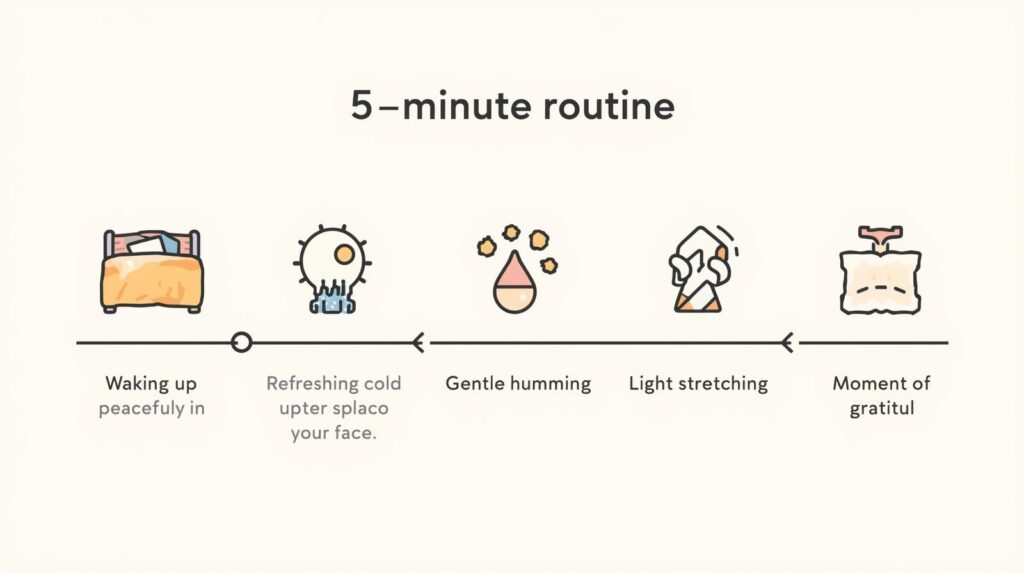
The complete five-minute morning vagus nerve routine consists of five distinct one-minute practices, each targeting your nervous system through different mechanisms—breathing, cold exposure, vocal activation, movement, and mental-emotional grounding—sequenced in an order that builds progressively from gentle to more intense stimulation and back to calm, creating a complete arc of activation and integration that leaves you energized yet peaceful, alert yet grounded, ready for your day yet deeply centered. The beauty of this routine lies in its simplicity and specificity: you don’t need to make any decisions about what to practice or how long to spend on each element, you simply follow the one-minute structure moving from breathing to cold water to gargling/humming to movement to gratitude, with each minute clearly defined and easy to complete even when you’re half-asleep or your mind is foggy from just waking. This eliminates the decision fatigue and overwhelm that cause most morning routines to fail, replacing ambiguity with clear action steps that become automatic after just a few days of practice.
The routine works whether you have exactly five minutes or slightly more—if you’re truly rushed, complete each practice for 60 seconds then move immediately to the next, but if you have an extra minute or two, you can extend the practices you find most beneficial (many people naturally extend the breathing or cold water components once they experience how good they feel). The flexible-yet-structured nature means the routine adapts to your reality rather than requiring perfect conditions: practice in your bedroom, bathroom, or wherever you find yourself in the morning, modify components based on your living situation (using a bowl of cold water if you don’t have access to a sink, practicing quieter humming if you need to avoid waking others), and simply do your best with whatever your circumstances allow, trusting that even imperfect practice provides far more nervous system benefit than skipping entirely because conditions aren’t ideal.
What You’ll Need (Spoiler: Almost Nothing)
One of the most powerful aspects of the five-minute morning vagus nerve routine is that it requires virtually no equipment, props, apps, or special circumstances—just your body, access to cold water (which virtually everyone has from a bathroom or kitchen tap), and willingness to invest five minutes in your nervous system wellbeing before the demands of your day begin. You don’t need a yoga mat, meditation cushion, special clothing, workout equipment, supplements, or any of the products wellness industry typically insists are essential for self-care, making this practice accessible regardless of your budget, living situation, or whether you’re at home or traveling. The only genuine requirement is cold water for minute two, and even this is flexible—tap water that feels cold to you works fine, you don’t need ice water or special cold therapy equipment, though you can certainly use ice water or cold packs if you want more intense stimulation.
Optional items that can enhance the routine but aren’t necessary include a timer or phone alarm to track minutes if you want precision rather than estimating (though after a few days you’ll develop an intuitive sense of how long each minute takes), a small container or bowl if you prefer cold water face immersion over splashing at the sink, and perhaps comfortable clothing that allows easy movement though many people practice in pajamas or whatever they slept in without any issues. The minimalist equipment requirements mean you can practice the five-minute morning vagus nerve routine anywhere you wake up—home, hotel, friend’s house, vacation rental, hospital room, anywhere—without needing to pack special items or access particular facilities, making the routine sustainable through travel, life changes, and any circumstances that would derail practices dependent on specific equipment or locations.
Where and When to Practice
The ideal time to practice the five-minute morning vagus nerve routine is immediately upon waking or within the first 15-30 minutes of your day, before you’ve engaged with external demands like checking your phone, reading news, or diving into work and family responsibilities that can trigger stress responses you’re trying to prevent through morning nervous system regulation. Practicing while still in bed or immediately after getting up (before brushing teeth, before breakfast, before anything else) ensures you establish calm nervous system tone before encountering any potential stressors, essentially creating a buffer of resilience that protects you as you move into the potentially activating experiences of your morning. Many women find that practicing before their brain is fully awake actually makes the routine easier because they haven’t yet engaged the analytical mind that creates resistance or self-consciousness about practices like humming or cold water exposure that can feel awkward when you’re fully conscious and self-aware.
Location-wise, the routine works beautifully as a bedroom-to-bathroom sequence: minute one (breathing) in bed before you even get up, minute two (cold water) at bathroom sink when you first go to bathroom after waking, minute three (gargling and humming) also at bathroom sink right after cold water, minute four (movement) in bedroom or bathroom depending on space available, and minute five (gratitude and intention) wherever you’re getting dressed or preparing for your day. This natural flow through spaces you’re already using during your morning routine means you’re not adding extra locations or steps but rather layering nervous system practices onto the existing geography of your morning, making the routine feel integrated rather than separate and added-on. If you share sleeping or bathroom space with others, you might need slight modifications like closing bathroom door for privacy during vocal practices, or moving cold water to kitchen sink if bathroom is occupied, but the routine’s flexibility allows these adjustments without losing effectiveness.
The Ideal Sequence and Why It Matters
The specific sequence of the five-minute morning vagus nerve routine—breathing first, cold water second, vocal practices third, movement fourth, gratitude fifth—isn’t arbitrary but rather carefully designed according to nervous system logic that creates compound effects where each practice prepares your body for the next and amplifies the benefits of what came before. Starting with breathing while still in bed provides the gentlest entry point, meeting you in the semi-conscious state you’re in upon waking and creating initial parasympathetic activation without requiring you to move your body or engage with anything outside yourself, essentially easing you into nervous system regulation from the safest, most comfortable starting place. This breathing minute also oxygenates your brain and body addressing any morning grogginess, establishes awareness of your breath which you’ll maintain throughout the routine, and creates a foundation of calm that makes the more intense cold water practice in minute two feel tolerable rather than shocking.
Cold water comes second rather than first because attempting intense vagal stimulation through cold exposure when you’re still drowsy and your nervous system hasn’t been gently awakened through breathing can feel too abrupt and potentially trigger resistance that makes you want to skip the practice. With breathing having established initial parasympathetic tone, your nervous system is primed to respond well to the strong vagal activation cold water provides, essentially doubling the effectiveness of cold exposure compared to doing it “cold” without any preparation. The dive reflex triggered by cold water creates such strong parasympathetic activation that you want it early in the routine when its effects can influence all the subsequent practices, rather than saving it for last where you’d miss the compound benefits. Gargling and humming in minute three maintain the vagal stimulation while your body is recovering from the intensity of cold water, providing continued nervous system input through a different pathway (throat mechanical stimulation and vocal vibration) that feels pleasantly stimulating rather than overwhelming.
Movement in minute four addresses the physical dimension after you’ve worked with breath (physiological), cold water (physiological), and voice (mechanical/vibrational), releasing any muscular tension that remains and incorporating your whole body into the practice rather than just head and throat. Saving movement for minute four rather than earlier also makes practical sense since you’re likely getting out of bed and moving around anyway by this point in your morning, making the movement minute flow naturally from already being upright and active. Gratitude and intention in minute five provide the final integrating element, completing the arc from physical/physiological practices to mental/emotional grounding that sends you into your day with not just a calm nervous system but also a positive, purposeful mindset. This psychological element works best after the physical practices have already shifted your nervous system state, because gratitude is easier to access authentically when you’re calm rather than anxious, making the sequence of physical-then-mental more effective than attempting gratitude first when anxiety might make it feel forced or hollow.
Setting Yourself Up for Success
Several simple preparation steps the night before dramatically increase the likelihood you’ll actually complete the five-minute morning vagus nerve routine rather than hitting snooze and skipping it, essentially removing friction and barriers that create resistance when you’re tired and unmotivated in early morning. Set a specific alarm time and label it something meaningful like “5-Minute Calm” or “Morning Reset” so when it goes off you immediately remember your intention rather than just thinking “time to wake up” and potentially forgetting about the routine. Place any items you might want (timer, bowl for cold water, comfortable clothes for movement) within easy reach the night before, removing the need to search for anything when you’re groggy. Tell yourself before sleep, “When I wake, I’ll breathe for one minute before getting up,” programming your subconscious mind with the specific first action you’ll take, which research shows significantly improves follow-through compared to vague intentions about “doing self-care tomorrow.”
Commit to practicing the routine for just seven consecutive days initially rather than making an open-ended forever commitment that can feel overwhelming and lead to abandonment when one morning goes poorly—this week-long commitment feels manageable and creates enough repetition for the routine to start becoming habitual rather than requiring constant decision-making and willpower. For comprehensive support establishing this practice with guided instruction, accountability structures, expert troubleshooting, and a community of women implementing the same routine who can offer encouragement and share their experiences, Vagus Nerve Activation for Stress, Anxiety & Sleep provides everything needed to transform this five-minute morning vagus nerve routine from interesting concept into sustainable daily practice that genuinely changes your mornings and, through them, your entire life.
Complete 5-Minute Morning Vagus Nerve Routine Overview:
| Minute | Practice | Location | What You Do | Primary Benefit | Difficulty |
|---|---|---|---|---|---|
| 1 | Wake-Up Breathing | In bed (still lying down) | Breathe in 4 counts, out 6 counts; repeat 10 times | Set calm baseline, oxygenate brain, gentle nervous system activation | Easy |
| 2 | Cold Water Activation | Bathroom sink | Splash very cold water on face 15-20 times, focusing on eyes/forehead | Instant strong vagal activation via dive reflex, healthy alertness | Easy-Moderate |
| 3 | Gargling & Humming | Bathroom sink | Gargle water 30 seconds, then hum favorite tune 30 seconds | Vocal vagal stimulation, throat/jaw tension release | Easy |
| 4 | Gentle Movement | Bedroom/bathroom | 6 simple stretches (neck, shoulders, spine, gentle twists) | Physical tension release, whole-body integration | Easy |
| 5 | Gratitude & Intention | Anywhere comfortable | Name 3 things you’re grateful for, set one intention for the day | Mental-emotional grounding, positive mindset, purposeful engagement | Easy |
Minute 1 – Wake-Up Breathing: Setting Your Nervous System Baseline
Why You Practice Before Getting Out of Bed
The first minute of the five-minute morning vagus nerve routine happens before you even leave your bed, capitalizing on the unique physiological and psychological state you’re in during the transition from sleep to wakefulness when your nervous system is most receptive to gentle regulation and before external demands activate stress responses. Practicing breathing while still lying down meets you exactly where you are in this semi-conscious state rather than requiring you to mobilize energy you don’t yet have, making it far more likely you’ll actually complete this crucial first step compared to practices requiring you to get up, go somewhere, or do something active before you’re ready. The horizontal position also enhances diaphragmatic breathing—your diaphragm moves more freely and efficiently when you’re lying down versus sitting or standing, meaning you get deeper, more effective breaths with less effort, creating stronger vagal activation from the same breathing pattern.
Psychologically, practicing breathing before getting out of bed establishes an important boundary that this time belongs to you before the day’s demands begin, creating a sacred pause between sleep and activity where you consciously choose how you want to enter your waking hours rather than immediately reacting to whatever external pressures exist. This minute in bed also prevents the common pattern of waking anxious with your mind immediately racing about everything you need to do, checking your phone for messages that might create stress, or jumping into action before giving your nervous system time to fully transition from sleep state. By dedicating minute one to breathing, you’re essentially telling your nervous system “we have time, we’re safe, we can wake up gently and calmly rather than being thrown into activation,” which sets a completely different tone than the rushed, stressed wake-up pattern most people default to when they skip this foundational practice.
The physiological benefits of breathing before getting vertical include giving your cardiovascular system time to adjust to the change in position that happens when you go from lying to standing (preventing the dizziness or lightheadedness some people experience with rapid position changes), allowing your blood pressure to normalize gradually rather than spiking when you jump out of bed, and ensuring your brain receives adequate oxygen before you start making decisions or engaging in complex tasks that require cognitive function. Many women report that they used to wake with headaches or grogginess that completely disappeared once they started the practice of breathing in bed for one minute before rising, attributing this change to better oxygenation and gentler nervous system transition that the breathing provides.

The Exact Breathing Pattern to Use
The specific breathing pattern for minute one of the five-minute morning vagus nerve routine is extended exhale breathing, where you breathe in for a shorter count than you breathe out, typically using a ratio of 4:6 (inhale for 4 counts, exhale for 6 counts) or 3:6 (inhale for 3, exhale for 6) depending on your lung capacity and what feels comfortable rather than strained. This extended exhale pattern activates your parasympathetic nervous system directly because the vagus nerve responds to the mechanical movement of your diaphragm during exhalation, with longer exhales creating more sustained vagal stimulation than shorter ones, essentially telling your body “it’s safe to relax, we’re not in danger” through the physiological language of breath. The specific counts matter less than maintaining the principle that your exhale is noticeably longer than your inhale—if 4:6 feels too challenging initially, start with 3:5 or even 2:4, gradually extending as your lung capacity improves over days and weeks of practice.
Breathe through your nose for the inhale and either through your nose or mouth for the exhale depending on what feels most natural and effective—nose breathing for both parts provides additional benefits including filtering and warming air, but mouth exhaling allows easier complete emptying of lungs which some people find helpful for achieving the longer exhale duration. Focus on diaphragmatic breathing where your belly expands on inhale and contracts on exhale rather than chest breathing where only your upper chest moves, placing one hand on your chest and one on your belly to ensure you’re breathing correctly with minimal chest movement and obvious belly expansion. This belly breathing provides stronger vagal stimulation because your diaphragm—which the vagus nerve directly innervates—moves through its full range of motion creating mechanical stimulation along the nerve fibers, whereas shallow chest breathing barely moves the diaphragm and thus provides minimal vagal activation despite using the same breathing pattern.
Step-by-Step Wake-Up Breathing Protocol:
- Remain lying down in whatever position you slept in or roll to your back if that’s more comfortable for breathing
- Place one hand on your chest, one on your belly to monitor your breathing pattern and ensure diaphragmatic movement
- Take 2-3 natural breaths without controlling anything, simply noticing your current breathing rhythm
- Begin extended exhale pattern: Breathe in through your nose for a count of 4 (or 3 if 4 feels too long)
- Pause briefly at the top of your inhale (1-2 seconds, not a held breath that creates strain)
- Exhale slowly through your nose or mouth for a count of 6, completely emptying your lungs without forcing
- Pause briefly at the bottom of your exhale before beginning the next inhale
- Repeat this cycle 10 times (which takes approximately 60 seconds at this pace)
- Return to natural breathing for 2-3 breaths before opening your eyes or getting up
- Notice how you feel compared to when you first woke—calmer, more grounded, more ready for your day
What to Do With Your Mind During Breathing
Your mind will inevitably wander during the breathing minute—thinking about your day ahead, reviewing yesterday’s events, making to-do lists, worrying about problems, or simply drifting into random thoughts—and this mind-wandering is completely normal and doesn’t mean you’re doing the practice wrong or that it won’t work. The key isn’t achieving perfect mental stillness (which is essentially impossible for most people and not actually necessary for vagal activation), but rather gently redirecting your attention back to the sensations of breathing whenever you notice you’ve drifted into thought, using the breath as an anchor that grounds you in present-moment physical experience rather than mental storytelling about past or future. You might redirect your attention 5, 10, or 20 times during the one-minute practice, and each redirection is actually the practice itself—the moment of noticing you’ve wandered and choosing to return to breath awareness is where the nervous system training happens, not in some fantasy state of uninterrupted focus.
Some women find it helpful to count their breaths (one on the inhale, two on the exhale, three on next inhale, continuing to ten then starting over) as a way to keep the mind engaged with the practice rather than allowing complete free-range thinking that inevitably turns to worry or planning. Others prefer focusing on the physical sensations of breathing—the cool air entering your nostrils on inhale, the expansion of your belly as air fills your lungs, the gentle contraction as you exhale, the warm air leaving your body, the pause between breaths where everything is still and quiet. Some simply repeat a word or phrase silently with each breath (breathing in “I am,” breathing out “calm” or breathing in “let,” breathing out “go”) creating a simple mantra that occupies the verbal thinking mind while the breath does its work on your nervous system.
What you want to avoid is getting frustrated or self-critical when your mind wanders, judging yourself as “bad at meditation” or thinking the practice won’t work because you can’t focus, essentially creating additional stress through harsh self-talk about a practice meant to reduce stress. Approach mind-wandering with curiosity and gentleness—”oh, there’s my mind planning again” or “interesting how I went from breathing to worrying about work”—then simply return attention to breath without making it mean anything about your worth or the practice’s effectiveness. The breathing affects your vagus nerve through mechanical and physiological pathways that work regardless of whether your mind is perfectly focused, meaning you get nervous system benefits even when your mental experience feels scattered and chaotic, so trust that the practice is working at the physiological level even when the psychological experience doesn’t match your expectations of how meditation “should” feel.
Common Mistakes and How to Avoid Them
The most common mistake people make with wake-up breathing is trying too hard to breathe “perfectly” with exact counts, complete stillness, and absolute focus, creating tension and strain that defeats the entire purpose of using breath to activate your parasympathetic calm response. Breathing should feel easy and natural, not like work or a test you might fail—if you’re struggling to maintain the 4:6 count or feeling breathless and stressed, you’re working too hard and need to shorten the counts or breathe more naturally until your lung capacity improves. Similarly, forcing your belly to expand through muscular effort rather than allowing natural diaphragmatic movement creates the illusion of proper breathing without the actual physiological benefits, so focus on releasing belly tension and allowing natural expansion rather than actively pushing your belly out which engages incorrect muscles.
Another frequent mistake is breathing too rapidly, rushing through the ten cycles in 30 seconds because you’re impatient or anxious to get to the next part of your morning, when slower breathing with complete inhales and exhales provides far stronger vagal activation than quick shallow breaths even if the exhale-to-inhale ratio is technically correct. If you’re finishing the ten breaths in less than 45 seconds, you’re almost certainly breathing too fast—slow down, allow each breath its full natural duration, and trust that even though it feels like you’re doing less by slowing down, you’re actually creating more powerful nervous system effects through the deeper, more complete breathing. Some people also make the mistake of holding their breath at the top of the inhale or bottom of the exhale for extended periods (5+ seconds), thinking this creates additional benefits, when actually breath-holding activates sympathetic nervous system and can trigger anxiety in some people, so keep any pauses very brief (1-2 seconds maximum) or eliminate them entirely if they create any sense of strain or panic.
Tips for making wake-up breathing automatic:
- Link to alarm going off: Let the alarm sound be your cue to begin breathing before even opening your eyes
- Keep one hand on belly: Physical reminder maintains diaphragmatic breathing and prevents reverting to chest breathing
- Count on fingers: Tap fingers against leg or bed as you count breaths, providing tactile engagement
- Use same count daily: Consistency with 4:6 or 3:6 ratio helps it become automatic rather than requiring decision-making
- Practice before sleep too: Evening breathing in bed makes morning practice familiar rather than completely new
- Set phone timer for 60 seconds: If you’re unsure about timing, let technology handle it so you can focus on breathing
- Tell yourself “one minute”: Remind yourself it’s truly just 60 seconds so impatience doesn’t make you rush
- Notice physical changes: Pay attention to how different you feel after versus before, reinforcing the practice’s value
- Start before judging: Begin breathing before your analytical mind can create resistance or excuses
- Forgive imperfect practice: Some breathing is infinitely better than no breathing because you’re waiting for perfect conditions
What You Should Feel After Minute 1
After completing one minute of wake-up breathing, most people notice several distinct changes from how they felt immediately upon waking, though the specific sensations vary based on your starting state and individual nervous system patterns. You’ll likely feel calmer and more grounded, with the racing thoughts or anxious anticipation about your day that may have been present when you first woke having quieted significantly, replaced by a sense of being present in your body and the current moment rather than lost in mental storytelling about the future. Physical tension you might not have even been aware of—tight shoulders, clenched jaw, held breath, braced abdomen—often releases during the breathing minute, leaving you feeling physically softer and more relaxed even though you haven’t moved from bed.
Mental clarity improves noticeably as oxygen delivery to your brain increases through the deeper breathing, with the grogginess or mental fog that often characterizes the first minutes after waking giving way to alert awareness that feels crisp and clear rather than the jittery, overstimulated alertness that caffeine creates. Your energy shifts from depleted and heavy to gently energized, ready to engage with your day from a place of adequacy rather than the deficiency feeling that makes mornings difficult when you skip this nervous system preparation. Some people describe feeling “more like myself” after the breathing minute, as though the practice helps them reconnect with their core sense of self that gets buried under stress, anxiety, and the various roles and masks daily life requires.
The breathing minute also establishes momentum and commitment for completing the rest of the five-minute morning vagus nerve routine—having successfully completed minute one while still in bed, you’ve already invested in your nervous system wellbeing and are more likely to follow through with the remaining four minutes rather than abandoning the routine entirely. For expert guidance on breathing technique with video demonstrations ensuring proper form, progressive protocols that deepen your practice as you build capacity, and troubleshooting support when challenges arise, Vagus Nerve Activation for Stress, Anxiety & Sleep provides comprehensive instruction on this foundational practice and all other elements of the morning routine, ensuring you get maximum benefit from each minute rather than just going through the motions without understanding the mechanics of what creates genuine nervous system transformation.
Minute 2 – Cold Water Activation: The Instant Vagus Nerve Trigger
The Science of the Dive Reflex
The dive reflex—also called the mammalian diving reflex—represents one of the most ancient and powerful physiological responses in our evolutionary heritage, shared by all mammals and triggered automatically when cold water contacts your face, particularly around the eyes, forehead, and nose where trigeminal nerve receptors are most densely concentrated. This reflex evolved millions of years ago to protect marine mammals during deep dives, instantly shifting their physiology to conserve oxygen, slow heart rate, and prioritize blood flow to vital organs, essentially putting the body into a state of metabolic efficiency and calm alertness that allows survival in challenging conditions. When you splash cold water on your face or immerse it in cold water, your brainstem receives signals from those trigeminal receptors indicating “face is in cold water,” which it interprets as “we’re diving underwater” regardless of whether you’re actually swimming, triggering the same powerful parasympathetic nervous system activation and vagal stimulation that the dive reflex creates in seals, dolphins, and whales.
The vagus nerve activation from the dive reflex is immediate and dramatic—your heart rate slows within seconds (sometimes dropping 10-25 beats per minute or more), blood vessels in your extremities constrict redirecting blood to your core organs including brain and heart, your breathing pattern shifts toward slower deeper breaths, and your entire autonomic nervous system pivots from whatever state it was in toward strong parasympathetic dominance. This isn’t a subtle effect requiring faith or belief to work; it’s a hardwired physiological response that happens automatically in every human being regardless of whether you understand the mechanism or even know it’s occurring, making cold water exposure one of the most reliable and powerful vagus nerve activation techniques available. Research measuring vagal tone through heart rate variability shows that cold water face exposure creates larger, faster increases in parasympathetic activity than almost any other intervention including breathing exercises, meditation, or yoga, with the effects measurable on instruments within 30-60 seconds of cold water contact.
Beyond the immediate dive reflex, cold water exposure also stimulates your vagus nerve through the mild stress it creates, triggering beneficial hormonal responses including release of norepinephrine (which increases alertness and mood), endorphins (your body’s natural pain relievers and mood elevators), and other neurochemicals that create the energized-yet-calm state many people experience after cold showers or ice baths. This combination of immediate vagal activation through the dive reflex plus secondary neurochemical effects makes cold water uniquely powerful for morning routine purposes—it simultaneously calms your nervous system through parasympathetic activation while energizing you through the alertness hormones, giving you the healthy awakeness you need for your day without the jittery anxiety that caffeine often creates. The cold water minute essentially provides a natural, physiological wake-up that works with your body’s biology rather than against it.
Three Cold Water Options (Choose What Works)
The beauty of including cold water in the five-minute morning vagus nerve routine is that you can choose from three methods of varying intensity—face splashing, face immersion, or cold shower finish—allowing you to select the approach that fits your comfort level, living situation, and desired strength of effect without one method being objectively “better” than others since all activate the dive reflex and provide vagal stimulation. Face splashing represents the gentlest, most accessible option requiring only a bathroom or kitchen sink with cold tap water, making it ideal for beginners, people with cold sensitivity, those who can’t tolerate more intense cold exposure, or mornings when you want vagal activation without the challenge of fuller cold immersion. Simply splash very cold tap water from the sink onto your face 15-20 times over the course of 60 seconds, focusing on getting cold water on your forehead, around your eyes, over your nose and cheeks where trigeminal receptors are densest, creating repeated dive reflex triggers that activate your vagus nerve progressively throughout the minute.
Face immersion provides stronger, more sustained vagal activation by maintaining continuous cold water contact rather than the intermittent stimulation of splashing, using a bowl, sink, or basin filled with very cold tap water plus ice if you want more intensity. Bend over the bowl or sink, take a breath, close your eyes, and submerge your entire face in the cold water for 10-30 seconds (start with shorter duration and build as tolerance improves), lift out to breathe normally for 10-20 seconds, then submerge again, repeating 2-4 times during the 60-second practice. This method creates powerful dive reflex activation because the sustained cold water contact provides continuous trigeminal nerve stimulation, but it requires slightly more setup (filling bowl with water) and some people find the sensation of face submersion uncomfortable or anxiety-provoking initially, making it better suited for those who’ve built tolerance through splashing or who are comfortable with water on their face.
Cold shower finish represents the most intense option, providing whole-body cold exposure that activates the dive reflex (when cold water hits your face) plus additional benefits from cold water on your entire skin surface including increased circulation, enhanced immune function, improved resilience to stress, and the profound sense of accomplishment and vitality many people report after cold showers. Simply complete your normal warm shower, then turn the water to cold (starting with cool and progressing to colder as you build tolerance) and remain under the cold water for 30-90 seconds, ensuring cold water contacts your face to trigger the dive reflex while also exposing your chest, back, and limbs to the invigorating cold. This method requires no additional time beyond your existing shower, making it extremely practical for people who shower every morning anyway, but the intensity can feel overwhelming if you attempt it without building tolerance through gentler methods first, so most women benefit from starting with face splashing for 1-2 weeks before progressing to cold shower finish.
Three Cold Water Methods Compared:
| Method | How It Works | Intensity Level | Best For | Time Required | Pros | Cons |
|---|---|---|---|---|---|---|
| Face Splash | Splash cold tap water on face 15-20 times from bathroom/kitchen sink | Gentle | Beginners, cold-sensitive, those wanting accessible practice | 60 seconds | No setup needed, can do anywhere with sink, easy to start | Less intense than other methods, may not wake you as fully |
| Face Immersion | Submerge face in bowl of cold water 2-4 times, holding 10-30 sec each | Moderate | Those wanting stronger effect, comfortable with face in water | 60 seconds | Powerful sustained dive reflex, controllable intensity | Requires filling bowl, some find submersion uncomfortable |
| Cold Shower Finish | End regular shower with 30-90 sec cold water on whole body including face | Strong | Advanced practitioners, those showering daily anyway, maximum benefit seekers | 30-90 seconds | Most powerful effects, fits into existing shower routine, whole-body benefits | Can feel overwhelming, requires building tolerance gradually |
Exact Technique for Maximum Benefit
Regardless of which cold water method you choose—splashing, immersion, or shower finish—certain technique elements maximize vagal activation and minimize discomfort, ensuring you get the full nervous system benefits while making the practice tolerable enough that you’ll actually maintain it daily rather than dreading it so intensely you start skipping. For face splashing, use the coldest tap water available (let it run a few seconds to get maximally cold before beginning), cup water in your hands and throw it forcefully against your face rather than gentle dabbing, and prioritize getting water directly on your forehead, around and over closed eyes, and across your nose and upper cheeks where trigeminal receptors trigger the strongest dive reflex. Splash rhythmically—cup water, splash face, cup more water, splash again—maintaining a steady pace that keeps your face continuously wet rather than allowing it to dry between splashes, essentially creating sustained cold exposure despite the intermittent nature of splashing.
For face immersion, fill your bowl or basin with the coldest tap water available plus ice cubes if you want additional intensity (start without ice and add it later as tolerance builds), position yourself comfortably over the container (you might want to kneel or sit on a stool rather than standing bent over which becomes uncomfortable), take a full breath before submerging, then plunge your entire face into the water up to your hairline or even slightly beyond, keeping your eyes closed and exhaling slowly through your nose if water duration extends beyond 15-20 seconds. The key is committing fully to each submersion rather than timidly dipping your face in and immediately withdrawing—the dive reflex activates most powerfully with complete face contact, so submerge decisively, hold for the full duration you’ve chosen (10-30 seconds depending on tolerance), then lift out calmly rather than gasping dramatically which can create anxiety around the practice.
For cold shower finish, the most sustainable approach involves gradual temperature transition rather than shocking yourself with immediate freezing water that might trigger such strong resistance you abandon the practice entirely—turn the temperature from hot toward cold slowly over 10-20 seconds, allowing your body to adjust as the water cools, eventually reaching the coldest setting your shower provides or the coldest you can tolerate while still maintaining calm breathing. Start with cold water hitting your feet and legs, then gradually move under the shower so cold water contacts your torso, then finally your face where the dive reflex triggers, essentially easing into full-body cold exposure rather than throwing yourself into overwhelm. Breathe slowly and deeply throughout rather than gasping or holding your breath (breath-holding activates sympathetic nervous system countering the parasympathetic effects you’re trying to create), and actively relax your muscles which want to tense against the cold—softening into the sensation rather than bracing against it paradoxically makes cold exposure more tolerable while also enhancing vagal activation since muscle tension indicates sympathetic activation that you’re trying to override.
Face Splash Detailed Steps:
- Turn on cold tap water and let it run 5-10 seconds to reach coldest temperature
- Cup both hands together creating a bowl shape that holds adequate water
- Fill hands with cold water scooping directly from the stream
- Throw water forcefully at your face aiming for forehead, eyes, nose area
- Immediately cup more water and splash again without pausing
- Continue rhythmic splashing for 15-20 repetitions over 60 seconds
- Keep eyes closed to prevent water irritation and make practice more meditative
- Breathe normally throughout rather than holding breath or gasping
- Notice the sensations of cold, the initial shock, the gradual adjustment, the alertness emerging
- Pat face dry when complete and notice your energy and mental state
Face Immersion Detailed Steps:
- Fill bowl or sink with coldest tap water, adding ice cubes if desired
- Position yourself comfortably over the bowl (sitting or kneeling preferred)
- Take a full breath to prepare for submersion
- Plunge entire face into cold water decisively, eyes closed
- Hold for 10-30 seconds (start with shorter duration, build gradually)
- Lift face out calmly and breathe normally for 10-20 seconds
- Repeat submersion 2-4 times during the 60-second practice
- Maintain relaxed posture rather than tensing against cold
- Breathe slowly between submersions to maintain parasympathetic state
- Pat face dry and notice the profound calm alertness you feel
Cold Shower Finish Detailed Steps:
- Complete regular warm shower as usual for washing
- Begin turning temperature toward cold gradually over 10-20 seconds
- Start with feet/legs in the cooling water first
- Progress to torso once legs have adjusted
- Finally move under so cold water hits your face
- Remain for 30-90 seconds breathing deeply and steadily
- Relax muscles that want to tense against the cold
- Exhale slowly releasing tension with each breath
- Turn water off when practice time completes
- Dry off noting the energized-yet-calm state you’ve created
What Cold Water Feels Like (And Why That’s Good)
Cold water exposure, especially when you’re new to the practice, feels uncomfortable—there’s no denying the initial shock when cold water hits your warm face, the instinctive recoil your body wants to make away from the unpleasant sensation, the gasping breath that tries to emerge, and the voice in your head insisting this is terrible and you should stop immediately. This discomfort is completely normal, expected, and actually part of what makes cold water so beneficial for nervous system training beyond just the vagal activation from the dive reflex. When you choose to remain with temporary discomfort rather than immediately seeking comfort—breathing calmly through the cold sensation, keeping your face in the water despite wanting to withdraw, maintaining slow deep breaths rather than gasping—you’re training your nervous system’s capacity to tolerate stress without becoming overwhelmed or reactive, essentially building resilience that extends far beyond the cold water practice itself into how you handle all of life’s uncomfortable moments.
The initial shock of cold water triggers a sympathetic activation—your body mobilizing energy to deal with what it perceives as a threat—but then the dive reflex overrides this activation with powerful parasympathetic stimulation, creating a unique experience where you feel both energized (from the sympathetic surge) and calm (from the vagal activation), essentially getting the benefits of both nervous system branches working in healthy coordination. This is why people describe feeling “alive,” “awake,” “clear,” “energized yet peaceful” after cold water exposure—you’re experiencing optimal autonomic balance rather than being stuck in pure sympathetic stress or pure parasympathetic shutdown. With repeated practice over days and weeks, the initial shock diminishes as your nervous system adapts and learns that this cold sensation, while uncomfortable, isn’t actually dangerous and will end quickly, creating increased stress tolerance that generalizes to other challenging situations.
Safety considerations and modifications for cold water practice:
- Start gradually: Begin with cool water and shorter duration, progressively increase intensity as tolerance builds
- Never force: If cold water triggers panic, anxiety, or feels genuinely harmful rather than just uncomfortable, back off to gentler approaches
- Medical conditions: Consult doctor before cold exposure if you have cardiovascular disease, uncontrolled high blood pressure, Raynaud’s phenomenon, or cold urticaria
- Pregnancy: Generally safe for healthy pregnancies but discuss with healthcare provider to ensure no contraindications
- Breathing always: Maintain calm breathing throughout; if you’re gasping or can’t breathe, the cold is too intense
- Listen to body: Some days your nervous system may be more sensitive; adjust intensity accordingly rather than forcing
- Warm up after: If you feel uncomfortably cold after practice, warm up with layers or movement; don’t remain cold
- Skip if sick: When fighting infection, cold exposure may add stress your immune system doesn’t need
- Mental health considerations: For those with severe anxiety or trauma, cold water can trigger panic; practice only if it feels safe
Modifications for Sensitive Systems
If standard cold water exposure feels too overwhelming, numerous modifications allow you to access dive reflex benefits while working within your nervous system’s current capacity, gradually building tolerance rather than forcing yourself through overwhelm that creates aversion and practice abandonment. Cool water instead of cold provides genuine benefits—you don’t need ice water to activate the dive reflex, just water noticeably cooler than body temperature, so start with lukewarm water and progressively cool it over weeks until you reach cold without ever forcing yourself into panic-inducing intensity. Shorter duration represents another gentler approach: even 5-10 seconds of cold water contact activates the dive reflex and provides vagal stimulation, so begin with very brief exposure (three quick splashes instead of twenty, ten-second face immersion instead of thirty) and gradually extend duration as your nervous system adapts and you build confidence that the discomfort is temporary and manageable.
Cold compress or ice pack applied to your face provides an alternative to water that some people find more tolerable, especially those who dislike getting their face wet or who don’t have easy access to running water in their morning location. Simply hold a cold, damp washcloth or ice pack against your forehead and around your eyes for 30-60 seconds, creating the same trigeminal nerve stimulation and dive reflex activation as water immersion without the messiness or sensation of water running down your face and neck. Some women also find that combining cold water with other elements makes it more pleasant—splashing while humming or breathing deeply, playing energizing music, or setting a timer so you know exactly when the discomfort will end rather than wondering how long you need to continue. For expert support implementing cold water practice with proper progression protocols, troubleshooting when challenges arise, and modifications for specific situations or sensitivities, Vagus Nerve Activation for Stress, Anxiety & Sleep provides comprehensive guidance ensuring this powerful technique becomes an enjoyable part of your morning rather than a dreaded practice you eventually abandon because it feels too difficult without proper instruction and support.
Minute 3 – Gargling & Humming: Vocal Vagal Stimulation
Why Your Throat Is a Direct Vagus Nerve Access Point
Your throat contains some of the most accessible and responsive vagus nerve fibers in your entire body, with the nerve traveling directly through your neck and larynx (voice box) where vocal cord movement, swallowing, and throat muscle contractions create direct mechanical stimulation that activates vagal pathways immediately and powerfully. This anatomical reality makes vocal practices—gargling, humming, singing, chanting, even loud talking or laughing—uniquely effective for vagus nerve activation because you’re literally vibrating and contracting muscles that the vagus nerve innervates, creating signals that travel directly to your brainstem and trigger parasympathetic nervous system activation. Unlike breathing or cold water which activate the vagus nerve through indirect pathways (diaphragm movement or dive reflex), throat-based practices create direct nerve stimulation similar to how massaging a muscle creates sensation that travels along the nerves within that muscle, except in this case the “muscle massage” happens through vocal vibration and forceful muscle contraction during gargling.
The vagus nerve’s throat fibers also connect to areas of your brainstem controlling your social engagement system—the neural circuits allowing you to connect authentically with others, communicate effectively, and regulate emotions through social connection. This explains why practices like singing in groups, humming while cooking, or even just talking with friends create such profound stress relief and mood improvement—you’re activating vagal pathways that simultaneously calm your nervous system and enhance your capacity for connection and positive emotional states. In our modern isolated lives where many people spend hours daily without speaking to anyone (working alone, commuting alone, living alone), throat-based vagal activation provides crucial stimulation that our ancestors received naturally through constant social interaction and verbal communication, essentially replacing what’s missing from contemporary existence through intentional vocal practice.
The Gargling Protocol (Until Your Eyes Water)
Gargling represents perhaps the most direct, powerful, and scientifically validated throat-based vagus nerve activation technique, with research showing that vigorous gargling creates measurable increases in parasympathetic tone and heart rate variability within minutes of practice. The key to effective gargling for vagal activation isn’t the gentle, minimal throat movement you might use when gargling mouthwash, but rather forceful, sustained contraction of throat muscles creating intense stimulation—you’re aiming for gargling vigorous enough that your eyes begin to water, which serves as the biological indicator that you’ve achieved adequate vagal stimulation through the strong throat muscle engagement. This “gargle until your eyes water” standard might sound strange, but it’s based on the physiological reality that the intensity of throat muscle contraction directly correlates with vagal nerve activation, meaning gentle gargling provides minimal benefit while vigorous gargling creates the strong parasympathetic shift you’re seeking.
The gargling protocol for minute three of the five-minute morning vagus nerve routine takes 30-45 seconds of your one-minute vocal practice period, using regular tap water (not mouthwash which creates burning sensation that distracts from the practice) and focusing on creating the loudest, most vigorous bubbling sound possible through maximum throat muscle engagement. Fill your mouth with water (not too much that you can’t create the throat constriction needed for gargling, but enough that you have adequate liquid to work with), tilt your head back slightly so water pools at the back of your throat, then forcefully push air from your lungs up through the water while constricting your throat muscles, creating the characteristic gargling sound that should be loud, aggressive, and sustained for 15-30 seconds before you need to spit out the water and repeat with a fresh mouthful.
Gargling Protocol (5-6 Steps):
- Fill mouth with tap water (approximately 2-3 tablespoons, enough to gargle but not so much you can’t create throat constriction)
- Tilt head back slightly allowing water to pool at back of throat without swallowing
- Begin forceful exhalation pushing air from lungs up through the water
- Engage throat muscles strongly creating maximum constriction and vibration
- Maintain vigorous gargling for 15-30 seconds or until you need to breathe/spit
- Spit water out and immediately repeat with fresh water for second round
- Continue for 30-45 seconds total (typically 2-3 rounds of gargling)
- Gauge intensity: Your eyes should water slightly—if they don’t, you’re not gargling vigorously enough
Humming Techniques for Nervous System Calm
Humming creates vagal stimulation through a different mechanism than gargling—rather than forceful muscle contraction, humming creates sustained vibration throughout your throat, face, and skull that stimulates vagus nerve fibers while simultaneously creating a meditative, soothing quality that many people find deeply calming. The vibration from humming resonates through the bones of your face and skull creating a gentle internal massage effect that releases tension commonly held in jaw, face, and neck muscles, while the extended exhale required to sustain a hum (similar to the breathing practice in minute one) adds additional parasympathetic activation through the breath-vagus connection. Unlike gargling which can feel awkward or uncomfortable, most people find humming naturally pleasant and even enjoyable once they overcome any self-consciousness about making noise, making it a more sustainable long-term practice for those who struggle with the intensity or strangeness of vigorous gargling.
The humming portion of minute three takes 15-30 seconds following your gargling practice, serving as a gentler transition that maintains vagal stimulation while creating a very different sensory and emotional experience. You can hum any sound that feels comfortable—a simple “mmmmm” sustained for the length of your exhale, a favorite melody or tune, the “om” sound traditional in meditation practices, or varying pitches moving up and down in musical scales. The specific sound matters far less than creating continuous vibration through your throat and face for the duration of your hum, keeping the sound going for 5-10 seconds per exhale, breathing in through your nose, then humming again on the next exhale. Many people discover through experimentation that certain pitches or sounds create more pleasant sensations or feel more calming than others—lower pitches tend to create vibration felt more in the chest and throat, higher pitches vibrate more in the face and head—so feel free to explore and settle on whatever feels best to you personally.
Humming Variations to Explore:
- Single sustained tone: Hum one comfortable pitch for entire exhale, repeat consistently
- Musical scales: Hum up and down a scale (do-re-mi-fa-sol-fa-mi-re-do) creating variety
- Favorite melody: Hum a song you love, connecting positive emotions with vagal activation
- Om chanting: Traditional “ommmmm” sound creating deep resonance in chest and throat
- Bee breath (Bhramari): Hum while covering ears with fingers, amplifying internal vibration sensation
- Varying volume: Start soft and gradually increase volume, or pulse between loud and soft
- High-low alternation: Hum high pitch, then low pitch, feeling different vibration locations
- Siren sound: Slide continuously from low to high and back creating dynamic movement
Combining Gargling and Humming
The power of minute three comes from combining both gargling and humming within the 60-second practice window, creating complementary vagal stimulation through intense muscle contraction (gargling) followed by gentler vibration (humming) that together provide more comprehensive throat-based activation than either practice alone would achieve. This combination also creates a psychological progression from challenging to soothing—gargling requires effort, feels slightly uncomfortable, and demands you push past any self-consciousness about making loud gargling sounds, while humming feels easier, more pleasant, and naturally calming, essentially rewarding you for completing the harder practice by following it immediately with something that feels good. The transition from gargling to humming within minute three trains your nervous system’s ability to shift between states—from activation to calm, from intense to gentle, from challenging to nurturing—which mirrors the flexibility you want to develop in your overall stress response where you can activate when needed but also return to calm rather than getting stuck in one state.
Practically, you’ll spend approximately 30-45 seconds gargling (two or three rounds of 15-20 second gargles with brief pauses to spit and refill) followed by 15-30 seconds of humming, using the remaining time to transition from bathroom sink where you’ve been gargling into wherever you’ll practice minute four movement. Some people prefer doing all their gargling first then all their humming, while others alternate (gargle once, hum once, gargle again, hum again), so experiment to discover what feels best and creates the smoothest flow for you. The key is completing both practices within the minute rather than spending the entire time on just one, ensuring you get the benefits of both forceful contraction and gentle vibration rather than over-emphasizing one approach at the expense of the other.
What to Do If You Can’t Make Noise (Quiet Alternatives)
If your living situation makes loud gargling impractical—sleeping partners or family members you’d wake, thin walls in apartments, roommates who’d be disturbed, or any circumstance where vigorous throat sounds would create problems—several quiet alternatives provide vagal stimulation through throat activation without the noise that standard gargling creates. Silent gargling uses the exact same throat muscle engagement and contraction as regular gargling but without actual water or sound—simply go through the motions of gargling, engaging your throat muscles forcefully and creating the sensation of gargling even though you’re not making any sound, which still activates vagal nerve fibers through the mechanical muscle movement even without the auditory component. This silent version provides approximately 60-70% of the benefit of actual gargling, making it an excellent compromise when noise is prohibited but you still want throat-based vagal activation.
Gentle humming with closed mouth creates minimal sound that usually won’t disturb others even through walls or closed doors, making it usable even in shared living situations where loud practices would be inappropriate. Hum very softly so the sound is barely audible beyond your own head, focusing on feeling the vibration in your throat and face rather than creating volume, which still activates vagus nerve fibers through the vibration mechanism even when sound production is minimal. Some people also practice humming into a pillow which muffles the sound while allowing you to hum at normal volume, getting full vagal benefit without disturbing others. Tongue exercises provide another completely silent throat-based alternative: press your tongue against the roof of your mouth, move it in circles, stick it out forcefully, or perform lion’s breath (opening mouth wide, sticking tongue out and down toward chin) which all engage throat and jaw muscles connected to vagal pathways without creating any sound that could disturb others.
Tips for making vocal practices enjoyable rather than awkward:
- Practice alone initially: Build comfort and skill before attempting around others who might increase self-consciousness
- Close bathroom door: Create privacy that allows uninhibited practice without worrying about being heard or seen
- Reframe as self-care: Remind yourself this is medicine for your nervous system, not vanity or silliness
- Use humor: Laugh at yourself making weird sounds—laughter itself activates vagus nerve and reduces self-consciousness
- Make it playful: Experiment with different sounds, pitches, and intensities rather than rigidly following “rules”
- Notice benefits immediately: The calm you feel after vigorous gargling makes the awkwardness worthwhile
- Remember everyone does it: This is human physiology, not something weird or unique to you
- Start with humming: If gargling feels too strange initially, hum for the full minute until comfort grows
- Combine with tooth brushing: Gargle as part of your oral hygiene routine making it feel more normal
- Focus on sensation not sound: Pay attention to how it feels in your throat rather than how it sounds externally
For comprehensive guidance on vocal vagal activation techniques with video demonstrations showing proper form, audio examples of different humming variations, expert troubleshooting for challenges, and community support from women practicing these same techniques who can share what works for them, Vagus Nerve Activation for Stress, Anxiety & Sleep provides structured instruction ensuring you get maximum benefit from this powerful practice while working through any self-consciousness or discomfort that initially makes vocal practices feel awkward or challenging to maintain consistently.
Minute 4 – Gentle Movement: Body-Based Nervous System Reset
Why Movement Matters for Morning Vagus Activation
While the first three minutes of the five-minute morning vagus nerve routine activate your nervous system primarily through physiological mechanisms—breath, cold water, vocal vibration—minute four addresses the physical body directly through gentle movement that releases muscular tension, promotes circulation, integrates your whole body into the morning practice, and completes the holistic nervous system reset by ensuring your physical state matches the calm parasympathetic tone you’ve created through the previous practices. Sleep, regardless of quality, often leaves you with physical stiffness and tension particularly in neck, shoulders, and back due to hours spent in static positions, and this muscular tightness sends signals to your nervous system indicating stress or threat even when no psychological stressor exists, essentially keeping you in semi-activated sympathetic state through purely physical mechanisms. By releasing this physical tension through intentional movement, you remove a significant source of nervous system activation that would otherwise undermine the calm you’ve established through breathing, cold water, and vocal practices.
Movement also serves as a bridge between the stillness of practices one through three and the activity of your upcoming day, providing a gradual transition that prepares your body for the physical demands ahead while maintaining the parasympathetic tone you’ve cultivated. The specific movements recommended for minute four—neck stretches, shoulder rolls, gentle spinal movements, and optional simple yoga poses—all involve areas of your body where vagus nerve fibers travel or where tension commonly accumulates, making these targeted stretches particularly effective for both vagal activation and physical comfort. Your neck contains vagus nerve branches traveling from brainstem down through cervical vertebrae toward chest and abdomen, so neck stretches create gentle stimulation along these pathways, while shoulder and upper back movements release tension in the trapezius and other muscles that commonly hold stress and that, when tight, restrict breathing and create postural patterns associated with anxiety and defensiveness.
The 6 Essential Morning Stretches (60 Seconds Total)
The movement minute of the five-minute morning vagus nerve routine consists of six simple, accessible stretches that require no equipment, no fitness level, and no special space beyond enough room to extend your arms and gently move your body—essentially movements anyone can perform regardless of age, flexibility, or physical limitations that might prevent more demanding exercise. These six stretches take approximately 10 seconds each for a total of 60 seconds, though you can extend any that feel particularly beneficial or spend less time on those that don’t serve your body well on a given morning. The key is continuous gentle movement throughout the entire minute rather than holding static positions, creating flow and fluidity that feels more like a moving meditation than a stretching routine, keeping your attention engaged with physical sensations rather than allowing your mind to wander back into mental planning or worry about your upcoming day.
The 6 Essential Morning Stretches:
- Neck Side Bend: Slowly tilt your head toward right shoulder, hold for 5 seconds feeling gentle stretch along left side of neck, return to center, then tilt toward left shoulder, stretching right side—releases tension in trapezius and sternocleidomastoid muscles, stimulates vagal pathways through neck
- Neck Rotation: Gently turn your head to look over right shoulder as far as comfortable, hold 5 seconds, return to center, turn to look over left shoulder—increases cervical mobility, releases rotational tension common from sleeping, creates gentle vagal stimulation
- Shoulder Rolls: Roll both shoulders backward in large circles for 5 rotations, then forward for 5 rotations—releases shoulder and upper back tension, improves posture, opens chest for better breathing
- Arm Reaches: Reach both arms overhead as if stretching toward ceiling, hold for 3 seconds, then sweep arms down and behind you opening chest, repeat 2-3 times—lengthens spine, releases shoulder tension, creates full-body integration
- Gentle Spinal Twist: Stand or sit with hands on waist, gently rotate torso to right looking behind you, hold 5 seconds, return to center, rotate left—releases spinal tension, massages internal organs, stimulates vagal fibers along spine
- Cat-Cow (or Standing Alternative): If space allows, perform 3-4 rounds of cat-cow on hands and knees (arching and rounding spine with breath), or perform standing version with hands on thighs—creates spinal wave motion, combines movement with breath, integrates full body

Neck and Shoulder Release Sequence
Given that neck and shoulder tension represents one of the most universal physical manifestations of stress, affecting nearly everyone who experiences chronic anxiety, work stress, or the accumulated tension of modern life spent hunched over computers, phones, and steering wheels, the movement minute can focus primarily on this area if you discover these stretches provide the most relief and nervous system benefit. A dedicated neck and shoulder release sequence expands on stretches 1-3 from the essential six, spending the full 60 seconds on targeted movements that systematically address every angle and muscle group in your neck and shoulder complex, creating comprehensive release of the chronic holding patterns that restrict your breathing, compress nerves and blood vessels, create headaches and pain, and signal to your nervous system that you’re perpetually braced for threat.
Begin with gentle neck circles: slowly roll your head in a complete circle to the right 2-3 times, then reverse direction for 2-3 circles to the left, moving slowly enough that you can feel exactly where tightness or restriction exists rather than forcing through discomfort. Follow with neck resistance exercises: place your right hand against right side of your head, gently press your head into your hand while using hand to resist the movement (creating isometric contraction without actual movement), hold 5 seconds engaging muscles, release and repeat on left side—this technique releases deep neck tension through the contract-relax principle while also building strength in often-weak neck stabilizer muscles. Complete the sequence with shoulder shrugs: inhale while lifting shoulders toward ears as high as possible, hold breath and shoulders up for 3-5 seconds, then exhale forcefully while dropping shoulders down and releasing all tension, repeat 3-4 times—this exaggerated tension-and-release pattern teaches your nervous system the difference between held tension and true relaxation while also physically discharging stress that’s accumulated in shoulder muscles.
Additional neck and shoulder variations:
- Ear to shoulder stretch: Tilt head to right bringing ear toward shoulder, use right hand to gently increase stretch, hold 10-15 seconds, switch sides
- Chin tucks: Pull chin straight back creating “double chin,” hold 5 seconds, release—strengthens deep neck flexors, releases forward head posture
- Shoulder blade squeezes: Pull shoulder blades together behind you, hold 5 seconds, release—opens chest, releases upper back tension
- Cross-body arm stretch: Bring right arm across chest, use left arm to gently pull right arm closer, hold 10 seconds, switch—releases shoulder and upper back
- Wall angels: Stand with back against wall, slide arms up and down wall like making snow angel—releases shoulders, improves posture
- Doorway chest stretch: Place hands on doorframe, step forward feeling stretch across chest—releases pectoral tightness that restricts breathing
Optional: Simple Yoga Flow
For mornings when you have slightly more time or energy, or once the five-minute routine feels automatic and you want to expand the movement component, a simple yoga flow provides comprehensive full-body movement while maintaining the gentle, accessible quality essential for sustainable morning practice. This optional flow takes 2-4 minutes rather than the standard 60 seconds, meaning you’d extend your total morning routine to 7-9 minutes, which still qualifies as brief and practical while providing enhanced physical and nervous system benefits. The flow consists of sun salutation variations simplified and slowed to create meditative, breath-synchronized movement rather than the more vigorous vinyasa-style yoga that might feel too demanding for early morning or too activating when your goal is nervous system calm rather than workout intensity.
Begin in mountain pose (standing tall with feet together, arms at sides, breathing deeply), then sweep arms overhead while inhaling, exhale while folding forward into standing forward fold with knees bent as needed to protect hamstrings and lower back, inhale to halfway lift (flatten back with hands on shins), exhale back to forward fold, bend knees and slowly roll up to standing one vertebra at a time, sweep arms overhead and return to mountain pose—repeat this sequence 2-3 times, moving slowly and synchronizing each movement with either an inhale or exhale to create breath-movement coordination that enhances vagal activation. Add gentle warrior poses if you want additional grounding and strength: from mountain pose, step right foot back into warrior I (front knee bent, back leg straight, arms overhead), hold for 3 breaths, transition to warrior II (open hips and arms to sides), hold 3 breaths, return to mountain and repeat on left side—these standing poses build heat and energy while maintaining the calm, centered quality appropriate for morning nervous system regulation.
Making Movement Feel Good, Not Like Exercise
The crucial distinction for minute four of the five-minute morning vagus nerve routine is that this movement practice should feel nurturing, restorative, and genuinely pleasant rather than effortful, challenging, or like work—you’re not trying to get a workout or push your body toward fitness goals but rather releasing tension, creating ease, and integrating your physical self into the morning nervous system reset in ways that feel good and supportive. This means moving at whatever pace feels comfortable (usually slower than you think you need), respecting your body’s limitations and tight areas rather than forcing through discomfort or trying to achieve particular stretching goals, listening to subtle sensations of release and ease as guidance for what movements to emphasize, and allowing the practice to vary day-to-day based on what your body needs rather than rigidly following a prescribed sequence regardless of how you feel.
Some mornings you’ll discover that neck stretches feel incredible and you want to spend the entire minute releasing neck tension, while other mornings your shoulders or back call for more attention, and occasionally you might feel energized enough for the fuller yoga flow while other days the simplest six stretches feel like exactly enough—all these variations are perfectly appropriate and in fact represent ideal responsiveness to your body’s changing needs rather than robotic adherence to rules. The movement minute succeeds when you finish feeling more comfortable in your body, more grounded and present, more ready to move into your day with physical ease rather than tension and restriction, and ideally with a slight smile on your face from the simple pleasure of gentle movement rather than grimacing through painful stretches or dreading your morning routine because the movement component feels like punishment.
Movement principles for nervous system benefit:
- Slow and mindful: Move half the speed you think you should, noticing subtle sensations rather than rushing through
- Follow pleasure: Emphasize movements that feel good, skip or modify those that don’t serve you well
- Breathe continuously: Never hold breath during stretches; maintain slow deep breathing throughout
- No pain: “No pain, no gain” does NOT apply here; discomfort means back off, ease means continue
- Gentleness wins: Gentle sustained stretch releases tension better than forceful aggressive stretching
- Listen to your body: Your body knows what it needs; trust its wisdom over external instructions
- Vary daily: Different days require different movements; flexibility in practice serves nervous system better than rigidity
- Make it yours: Adapt, modify, add, remove movements to create practice that truly serves you
- Smile if possible: Movement should feel good enough to create genuine positive feelings, not just tolerance
- Integration intention: You’re integrating body and nervous system, not achieving flexibility goals
For detailed video demonstrations of all movement variations, expert guidance on modifications for different body types and limitations, progressive sequences that build from basic to more comprehensive practices, and support troubleshooting physical challenges that arise during movement practice, Vagus Nerve Activation for Stress, Anxiety & Sleep provides comprehensive resources ensuring your movement minute genuinely serves your nervous system and body rather than becoming another source of stress or obligation that undermines the routine’s effectiveness and sustainability.
Minute 5 – Gratitude & Intention: Mental-Emotional Grounding
The Vagus Nerve-Gratitude Connection
The final minute of the five-minute morning vagus nerve routine shifts from physical and physiological practices to mental-emotional work, completing the holistic nervous system reset by addressing the psychological dimension that profoundly influences your autonomic state throughout the day ahead. Gratitude practice activates your vagus nerve through mechanisms distinct from breathing, cold water, vocal stimulation, or movement—specifically by engaging brain regions associated with positive emotion, social connection, reward processing, and meaning-making while simultaneously reducing activity in threat-detection areas like the amygdala that drive anxiety and stress responses. When you actively focus on things you’re genuinely grateful for, your brain releases neurochemicals including serotonin (mood stabilizer), dopamine (motivation and reward), and oxytocin (connection and bonding), creating a biochemical state that reinforces parasympathetic nervous system activation and makes it easier for your vagus nerve to maintain healthy tone throughout the hours following your practice.
Research using functional MRI brain imaging shows that gratitude practice creates measurable increases in vagal tone within minutes, with effects persisting for hours after the practice ends and strengthening with consistent daily repetition over weeks and months. The mechanism involves the prefrontal cortex—your brain’s executive control center—which becomes more active during gratitude practice and sends inhibitory signals to the amygdala and other threat-response regions, essentially telling your nervous system “we’re focusing on good things, there’s no need for defensive activation right now.” This top-down regulation of your stress response through conscious attention and positive focus represents a different pathway to nervous system calm than the bottom-up physiological approaches of the first four minutes, and combining both approaches creates more comprehensive, resilient parasympathetic activation than either strategy achieves alone.
Simple Gratitude Practice (No Journaling Required)
Many gratitude practices you encounter in wellness spaces involve elaborate journaling protocols requiring 10-20 minutes of writing detailed descriptions of everything you’re grateful for, creating beautiful gratitude lists, or maintaining ongoing gratitude journals that become another item on your to-do list generating guilt when you fall behind. The gratitude practice in minute five of the five-minute morning vagus nerve routine requires none of this—no writing, no journaling supplies, no extended time commitment, just 30-45 seconds of mentally acknowledging three specific things you’re genuinely grateful for in this moment, allowing yourself to feel the appreciation rather than just intellectually listing items you “should” be grateful for without any authentic positive emotion. This stripped-down, purely mental approach makes the practice sustainable and accessible even on your busiest, most stressed mornings when writing in a journal feels impossible or like one more obligation you don’t have time for.
The key to effective gratitude practice for nervous system benefit is specificity and genuine feeling rather than vague, rote recitation of generic gratitudes that don’t actually create positive emotional states. Instead of mentally saying “I’m grateful for my family, my health, and my home” (which feels hollow and doesn’t activate the neural pathways you’re targeting), identify three specific, concrete things you can appreciate right now in this moment: “I’m grateful for how soft these blankets feel against my skin, for the morning light coming through my window creating beautiful shadows on the wall, and for the fact that my body just carried me through this five-minute routine even though I woke up tired.” This specificity and present-moment focus creates genuine appreciation you can actually feel in your body—a slight softening in your chest, a small smile, a sense of warmth or expansion—which indicates you’ve activated the neural circuitry that supports vagal tone rather than just going through intellectual motions without physiological impact.
Step-by-step gratitude practice for minute five:
- Find comfortable position: Sit or stand wherever you are after completing movement, taking a moment to settle
- Take one deep breath: Inhale fully, exhale completely, creating present-moment awareness
- Identify first gratitude: Bring to mind something specific you genuinely appreciate right now
- Feel it in your body: Notice the physical sensation of appreciation (warmth, softening, expansion)
- Identify second gratitude: Another specific thing you’re grateful for in this moment
- Feel the appreciation: Again notice bodily sensations rather than just thinking about gratitude
- Identify third gratitude: Final specific appreciation, something that creates genuine positive feeling
- Breathe with gratitude: Take one more deep breath while holding all three appreciations in awareness
- Allow natural smile: If a smile arises naturally from feeling gratitude, allow it without forcing
Setting Daily Intention vs. Making To-Do Lists
Following the 30-45 seconds of gratitude practice, the remainder of minute five focuses on setting a single clear intention for your day—not creating an exhaustive to-do list of everything you need to accomplish (which activates stress response rather than supporting nervous system calm), but rather identifying one quality, value, or way of being you want to embody as you move through whatever arises. An intention is fundamentally different from a goal or task list: goals focus on external achievements and concrete outcomes (finish project, make sales call, clean house), while intentions focus on internal states and how you engage with whatever you’re doing (remain calm under pressure, treat myself with compassion, stay present with my family, respond rather than react). This distinction matters tremendously for nervous system purposes because intention-setting activates your prefrontal cortex’s capacity for conscious choice and self-determination without triggering the pressure and potential for failure that goal-setting creates, essentially supporting parasympathetic tone rather than undermining it.
Your daily intention should be brief enough to remember easily and broad enough to apply across different situations throughout your day, functioning as a touchstone you can return to whenever you notice yourself becoming stressed, reactive, or disconnected from how you want to be. Examples of effective daily intentions include: “I intend to take three conscious breaths before responding when I feel triggered,” “I intend to notice and appreciate small moments of beauty throughout my day,” “I intend to treat my body with kindness regardless of how productive I am,” “I intend to speak my truth even when it’s uncomfortable,” “I intend to ask for help when I need it instead of pushing through alone.” Notice how these intentions focus on your internal experience and choices rather than external circumstances you can’t control, creating agency and empowerment rather than the helplessness that comes from setting goals dependent on factors beyond your influence.
How to set powerful daily intentions:
- Start with “I intend to…”: This phrasing creates commitment while maintaining flexibility versus rigid “I will…”
- Focus on one thing: Multiple intentions dilute focus and become to-do list disguised as intention work
- Make it about you: Intention should address your behavior, not others’ (“be patient” not “make my partner understand”)
- Choose what matters today: Intention should address your current challenges not generic aspirations
- Keep it simple: 5-10 words maximum so you can remember and return to it throughout your day
- Make it positive: Frame as what you want to do rather than what you want to avoid or stop
- Allow imperfection: Intention is direction not destination; you’ll drift and that’s normal, just return to it
How to Do This Without It Feeling Forced
Many people struggle with gratitude practice because it can feel forced, performative, or hollow—going through the motions of listing things you “should” be grateful for without any genuine positive feeling, essentially lying to yourself about appreciation you don’t actually feel, which creates more stress and disconnection rather than supporting nervous system calm. The antidote to forced gratitude is permission to appreciate small, simple, immediate things rather than feeling pressure to be grateful for big, important things you intellectually know you should appreciate but emotionally don’t connect with in this moment. You don’t need to force gratitude for your health if you woke up with a headache, your job if you’re dreading work today, or your relationship if you’re currently frustrated with your partner—instead, find three tiny, genuine appreciations accessible right now: “I’m grateful my coffee is the perfect temperature, that my cat is purring next to me, and that I remembered to buy my favorite yogurt yesterday.”
This permission to appreciate mundane, simple things paradoxically creates more powerful nervous system benefits than attempting to generate profound gratitude for major life circumstances you’re ambivalent about. Small, genuine appreciations activate the same neural pathways and vagal tone improvements as big dramatic gratitudes, while also being far more accessible and sustainable for daily practice since you can always find something small to genuinely appreciate even on terrible days when the big things in your life feel challenging or neutral. Additionally, practicing gratitude for simple immediate things trains your brain to notice positive aspects of your experience throughout the day rather than fixating exclusively on problems and challenges, essentially developing a more balanced, realistic perspective that sees both difficulties and good things rather than the negativity bias that characterizes anxious, stressed nervous systems.
Examples of genuine, accessible daily gratitudes:
- Physical comfort: Soft pillow, warm shower, comfortable clothes, pleasant temperature, full stomach
- Sensory pleasure: Beautiful light, birdsong, delicious smell, favorite song, soft texture
- Small conveniences: Working wifi, hot water, clean laundry, car starting, charged phone
- Body appreciation: Lungs breathing automatically, heart beating steadily, legs carrying you, hands working
- Simple kindnesses: Stranger’s smile, friend’s text, partner making coffee, coworker’s help
- Nature’s gifts: Sunshine, trees outside window, flowers blooming, rain nourishing earth, stars visible
- Personal capacity: Getting out of bed despite not wanting to, choosing healthy food, completing this routine
- Moments of ease: Traffic light turning green, finding parking spot, no line at store, task easier than expected
Closing Your 5 Minutes With Power
The final 10-15 seconds of minute five—after you’ve identified three gratitudes and set your daily intention—provide opportunity to consciously complete the five-minute morning vagus nerve routine with a powerful closing gesture that consolidates everything you’ve practiced and prepares you to carry this calm, grounded state into your day. Take one final deep breath (longer exhale than inhale maintaining the parasympathetic activation you’ve built), place your hand over your heart if this gesture feels meaningful to you (creating physical connection with yourself), and silently acknowledge your commitment to your nervous system wellbeing: “I’ve given myself this time, I’ve established calm in my body and mind, I’m ready for my day from this grounded place.” This brief closing creates a clear endpoint to the practice preventing it from bleeding into your day without definition, marks the transition from dedicated nervous system care back to daily activities, and functions as a moment of self-acknowledgment and appreciation for showing up for yourself even when it would have been easier to skip the routine and rush straight into your morning demands.
Some women find it meaningful to physically mark the transition—standing up if they’ve been sitting, opening their eyes if they’ve had them closed, taking a step forward, opening a door, or some other small gesture that creates a clear boundary between practice time and activity time. Others prefer setting an explicit intention for maintaining the calm they’ve created: “I’m taking this nervous system state with me into my shower, my breakfast, my commute, my workday.” For comprehensive support integrating the complete five-minute morning vagus nerve routine into sustainable daily practice with expert guidance on each component, troubleshooting challenges that arise, progressive protocols that deepen your practice over time, and community connection with other women experiencing transformation through this simple morning practice, Vagus Nerve Activation for Stress, Anxiety & Sleep provides everything you need to make this routine not just something you try briefly but a lifelong practice that genuinely changes how you experience mornings and, through them, your entire life.
How to Build the 5-Minute Routine Into Your Existing Morning
Linking to Habits You Already Have
The most powerful strategy for making the five-minute morning vagus nerve routine sustainable rather than another abandoned wellness practice is habit stacking—attaching each new component of the routine to existing habits you already perform automatically every morning without conscious decision-making or willpower. Your brain has already established neural pathways for behaviors you do consistently (waking to alarm, going to bathroom, brushing teeth, making coffee), and when you link new practices to these established triggers, they piggyback on existing automation rather than requiring separate motivation and memory to maintain. Minute one (breathing) links naturally to your alarm going off—when you hear the alarm, instead of immediately getting out of bed or checking your phone, you remain lying down and breathe for 60 seconds before rising, essentially inserting the practice into the micro-pause that already exists between sleeping and starting your day.
Minute two (cold water) stacks perfectly onto going to the bathroom and washing your face or hands, activities virtually everyone does within the first 15-30 minutes of waking—you’re already at the sink with water running, so instead of just splashing warm water, you turn it to cold and intentionally activate the dive reflex through 60 seconds of vigorous splashing or brief face immersion. Minute three (gargling and humming) connects to brushing your teeth or your first drink of water, both morning habits most people have established, making it natural to gargle with water for 30 seconds then hum for 30 seconds right after brushing or while preparing your morning beverage. Minute four (movement) fits seamlessly into the process of getting dressed, stretching your body while selecting clothes and preparing your appearance for the day, or immediately after using the bathroom before you leave that space. Minute five (gratitude and intention) links to any transitional moment in your morning—while coffee brews, while waiting for shower to heat up, while your computer boots, while sitting at breakfast—using time that already exists rather than creating new dedicated blocks.
The Best Time to Practice (Before or After Certain Activities)
While the five-minute morning vagus nerve routine can technically happen anytime during your morning hours, certain timing sequences create more sustainable practice and stronger nervous system benefits than others based on how the routine components interact with other morning activities and how human psychology and physiology respond to different timing patterns. The ideal sequence for most people is: wake → breathe in bed (minute 1) → get up → bathroom/cold water (minute 2) → gargle/hum (minute 3) → movement while getting ready (minute 4) → gratitude/intention (minute 5) → shower/coffee/breakfast/normal morning continues. This flow maintains the progression of the routine while integrating smoothly into natural morning movements rather than requiring you to stop and start multiple times or practice all five minutes in one location before transitioning to other activities.
Practicing before checking your phone, email, news, or social media protects your nervous system from the activation that often comes from immediately engaging with external information that triggers stress, comparison, worry, or reactivity before you’ve established your own calm baseline. Many people discover that their mornings transform completely when they commit to “no phone until after the five-minute routine,” creating a sacred boundary that prioritizes their nervous system over external demands and preventing the common pattern of waking calm then immediately destroying that peace through anxiety-inducing content consumption. Similarly, practicing before caffeine allows you to establish genuine calm and natural alertness through vagal activation rather than relying on stimulants that can increase anxiety and jitteriness, though if you’re someone who absolutely needs coffee to function, you can practice while it’s brewing or right after your first cup rather than trying to delay caffeine so long that withdrawal creates more stress than benefit.
Habit-stacking strategies for each routine minute:
- Minute 1 (Breathing): Alarm goes off → breathe before getting up; OR partner/child wakes you → breathe while still in bed before engaging with them
- Minute 2 (Cold Water): After first bathroom visit → cold water at sink; OR during shower → cold shower finish; OR while washing face → use cold water
- Minute 3 (Gargling/Humming): After brushing teeth → gargle with water then hum; OR while making coffee → gargle/hum while waiting for brew
- Minute 4 (Movement): While getting dressed → stretch between putting on clothes; OR after bathroom → move in bedroom space before leaving
- Minute 5 (Gratitude): Coffee brewing → set intention while waiting; OR sitting with breakfast → gratitude before eating; OR commute → intention in car
- Complete routine: Wake → 5 minutes → phone/email; OR Wake → bathroom → 5 minutes → shower; OR Wake → 5 minutes → make breakfast
What to Do About Kids, Partners, and Pets
Real life includes other beings who don’t care about your nervous system practices and who have their own needs and unpredictable behaviors that can completely derail even the most well-planned five-minute routine—children waking earlier than expected and demanding immediate attention, partners talking to you when you’re trying to practice, pets wanting food or to go outside, babies crying, toddlers appearing at your bedside, teenagers needing rides, aging parents calling with urgent questions. The key to sustainable practice despite these realities is flexibility combined with clear boundaries rather than perfectionism that abandons the routine entirely when circumstances aren’t ideal. Some mornings you’ll complete the full five minutes uninterrupted in your preferred sequence, other mornings you’ll practice in fragments scattered throughout your morning (breathe for one minute while kids are still sleeping, cold water during your shower while they eat breakfast, movement and gratitude while getting them ready for school), and occasionally you might only manage 2-3 minutes before chaos erupts and you simply accept that partial practice is infinitely better than no practice.
Setting boundaries with family members about your morning practice doesn’t require long explanations or their perfect cooperation, just clear communication and consistency: “I need five minutes in the morning before I’m available—please don’t talk to me or ask for things during that time unless it’s an emergency.” Children old enough to understand timers can learn that when the timer is running, mom is taking care of her nervous system and will be available after the beep. Partners can agree to handle morning responsibilities for the five minutes while you practice (you do the same for them at another time if they want their own practice window). Pets learn remarkably quickly when trained consistently that food comes after your practice, not during, reducing the interruptions they create. For parents with very young children who can’t wait five minutes, the breathing minute can happen while nursing or bottle feeding, cold water while baby plays in bouncy seat nearby, movement while holding baby, creating adapted practice that acknowledges your current life reality rather than waiting for ideal circumstances that might not arrive for years.
Making It Non-Negotiable Without Becoming Rigid
The psychological challenge of establishing the five-minute morning vagus nerve routine as consistent practice involves finding the balance between commitment that makes it non-negotiable versus rigidity that creates stress and eventual abandonment when perfection becomes impossible to maintain. “Non-negotiable” means you’ve decided this practice matters enough that you’ll do it regardless of how busy your morning feels, how little you slept, how unmotivated you feel, or what competing demands arise—essentially treating the five minutes with the same priority you give to brushing your teeth or taking essential medication rather than as optional self-care you can skip whenever life gets hard. This commitment creates the consistency necessary for nervous system retraining and habit formation, preventing the common pattern of practicing when you feel motivated then abandoning when motivation wanes, which never allows you to experience the cumulative benefits that emerge from sustained practice.
However, non-negotiable doesn’t mean rigid adherence to exact timing, perfect execution, or identical practice regardless of circumstances—flexibility within commitment allows the routine to adapt to your life’s natural variations while maintaining the essential element of showing up daily in some form. Non-negotiable flexibility might look like: always doing at least the breathing minute even when you only have one minute total, practicing the full routine but in different order or locations based on what your morning allows, choosing the cold water method appropriate to your circumstances (splashing when you can’t shower, cold shower when you have more time), adapting movement to your energy level (gentle stretches on exhausted mornings, fuller flow when energized), or simply accepting that some days you’ll practice imperfectly and that’s completely fine because you showed up rather than skipping entirely. This flexible commitment prevents the all-or-nothing thinking that destroys most wellness practices when perfectionism meets reality and you decide that if you can’t do it “right,” you won’t do it at all.
Your First Week: What to Expect
The first week of implementing the five-minute morning vagus nerve routine will likely feel awkward, effortful, and require conscious attention and decision-making rather than flowing smoothly and automatically—this is completely normal and expected for any new practice, and it doesn’t mean you’re doing it wrong or that it won’t eventually become easy and automatic with continued repetition. Days 1-2 typically involve high motivation from novelty and excitement about trying something new, making the routine feel relatively easy to complete even though the specific practices might feel unfamiliar or uncomfortable (cold water shock, self-consciousness about humming, uncertainty about whether you’re breathing correctly). Days 3-4 often bring the first wave of resistance as novelty wears off but habit hasn’t yet formed, creating the temptation to skip or rush through the routine, negotiate with yourself about whether you really need to do this, or start making excuses about why today isn’t a good day to practice—this is the critical point where commitment matters more than motivation.
Days 5-7 represent the breakthrough period where you start noticing genuine benefits—mornings feeling easier, anxiety less overwhelming, colleagues or family commenting that you seem calmer, the routine beginning to feel slightly more automatic and less like work. The key to successfully navigating the first week is lowering your standards for what counts as successful practice: any attempt is success during week one regardless of how perfectly you execute each component, how long you actually practice, or how dramatically different you feel afterward. Simply showing up and going through the motions—even if breathing feels forced, cold water feels terrible, humming feels silly, movement feels stiff, and gratitude feels hollow—is laying the neural foundation for the automatic, beneficial practice that will emerge with continued repetition over weeks two, three, and beyond.
Sample morning schedules with routine integrated:
| Morning Type | Current Wake Time | Full Morning Flow | Where Routine Fits | Total Time Added |
|---|---|---|---|---|
| Early Riser (Alone) | 5:30-6:00 AM | Wake → breathe in bed → bathroom/cold water → gargle/movement → gratitude → shower → coffee/breakfast → work prep | Seamlessly integrated into first 5-10 minutes, before any other activities | 0-5 min (some overlaps existing routine) |
| Rush Hour Parent | 6:00-6:30 AM | Alarm → breathe 1 min → bathroom/cold water → gargle while making kids’ breakfast → movement while getting dressed → intention while packing lunches → shower → kids to school | Woven into existing tasks, happening simultaneously with parenting duties | 5 min (mostly during existing activities) |
| Working Professional | 6:30-7:00 AM | Wake → breathe → bathroom/cold water → shower with cold finish → gargling while making coffee → movement/stretching → gratitude with breakfast → commute | Cold water becomes shower finish, rest happens during existing morning prep | 3-5 min additional |
| Night Owl/Late Waker | 7:00-8:00 AM | Wake → breathe in bed longer (helps wake up) → bathroom/cold water (replaces coffee for alertness) → gargle while waiting for coffee → movement energizes → intention → breakfast → work | Routine serves as healthy wake-up mechanism instead of immediately needing caffeine | 5 min (but saves time by reducing grogginess) |
| Chaotic Mornings | 6:15 AM (varies) | Wake → breathe while still in bed → bathroom → whatever happens (kids/pets/chaos) → grab cold water/gargling/movement in fragments whenever possible → set intention during commute | Fragments scattered throughout morning chaos, accepting imperfect practice | 2-5 min in pieces |
For comprehensive support building the five-minute morning vagus nerve routine into sustainable daily practice with accountability systems, expert troubleshooting for obstacles specific to your life circumstances, community connection with other women navigating similar integration challenges, and progressive protocols that deepen your practice as it becomes more automatic, Vagus Nerve Activation for Stress, Anxiety & Sleep provides structured guidance ensuring this practice becomes a permanent, transformative part of your morning rather than another wellness experiment you abandon after a few weeks when initial enthusiasm fades and the work of building genuine habits becomes evident.
Troubleshooting: When You Hit Resistance or Skip Days
Why You Might Resist Something That Helps You
The paradox of wellness practices is that we often resist most strongly the very things that would help us most, creating elaborate excuses, procrastination, and self-sabotage around activities we intellectually know serve our wellbeing but that trigger psychological resistance we don’t fully understand or control. This resistance to the five-minute morning vagus nerve routine—despite its brevity, proven benefits, and genuine helpfulness—arises from several deep psychological mechanisms including fear of change (even positive change disrupts familiar patterns and creates uncertainty), secondary gains from staying stuck (anxiety and overwhelm might be terrible but they’re known and in some twisted way comfortable), perfectionism that makes you avoid starting anything you might not do perfectly, and the simple fact that your nervous system, currently dysregulated and anxious, views anything unfamiliar as potentially threatening even when rationally you know it’s beneficial.
Resistance also emerges from the vulnerability inherent in genuinely caring for yourself—when you practice the five-minute routine consistently, you’re making an implicit statement that you matter, that your wellbeing is important, that you deserve time and attention even when you’re not accomplishing anything productive, which many women find profoundly uncomfortable due to internalized messages about needing to earn rest and care through achievement and service to others. The routine asks you to prioritize your nervous system over external demands, to set boundaries with family and responsibilities, to claim space and time for yourself, all of which can trigger guilt, shame, or the fear that you’re being selfish by attending to your own needs. Understanding that resistance is normal, expected, and doesn’t mean anything is wrong with you or the practice helps you recognize it as a predictable obstacle to work with rather than a sign that you should quit or that the routine isn’t right for you.
The “I Don’t Have Time” Sabotage (And the Truth)
“I don’t have time” represents the most common excuse for skipping the five-minute morning vagus nerve routine, and while it feels absolutely true in the moment—your morning genuinely is rushed, you genuinely have a thousand things demanding attention, you genuinely can’t imagine where five more minutes would come from—this objection almost always reflects priority choices rather than objective time scarcity. The uncomfortable truth is that everyone has five minutes, and when something becomes truly non-negotiable (taking essential medication, getting children to school, making it to work on time), you find the time regardless of how busy you are by eliminating, delegating, or reducing time spent on less important activities. The real issue isn’t time availability but rather the deeply ingrained pattern of putting everyone and everything else first, treating self-care as the luxury you’ll get to “someday” when life calms down (which it never does), and the psychological resistance discussed above disguising itself as a practical time constraint.
The truth about time becomes evident when you track where your morning minutes actually go: scrolling social media in bed, repeatedly hitting snooze, standing indecisively in front of your closet, watching news, lingering over coffee without truly enjoying it, engaging in conversations that aren’t essential, checking email compulsively, or simply moving inefficiently through your routine because you haven’t optimized the sequence. Five minutes exists in virtually every morning—you just need to decide that nervous system regulation matters more than whatever currently fills those five minutes, making a conscious choice to reallocate time rather than expecting additional minutes to magically appear. Additionally, the “I don’t have time” excuse ignores the time the routine creates by preventing the hours typically lost to stress, anxiety, inefficiency, emotional reactivity, and poor decision-making that characterize mornings that start from dysregulated nervous system states—investing five minutes saves far more time than it consumes through the improved functioning it creates.
Practical strategies for “finding” five minutes:
- Wake five minutes earlier: Set alarm for 5:45 instead of 5:50, dedicate found time entirely to routine
- Reduce phone time: Commit to no phone until after routine, eliminating time-sink scrolling
- Cut shower length: Most showers can be 3-5 minutes shorter without sacrificing cleanliness
- Reduce snoozing: Each snooze cycle wastes 9 minutes of semi-conscious time; wake on first alarm instead
- Prep night before: Lay out clothes, prepare breakfast components, reducing morning decision time
- Lower other standards: House can be slightly messier, breakfast simpler, appearance less perfect
- Delegate tasks: Partner makes coffee, older kids pack own lunches, creating freed time for your practice
- Combine activities: Practice during existing activities (breathing while coffee brews, movement while getting dressed)
- Eliminate low-value activities: Skip morning news, reduce getting-ready time, cut unnecessary conversations
- Track actual time use: Notice where minutes currently go to reveal pockets of time available for reallocation
What to Do When You Miss a Day (or a Week)
Missing a day of the five-minute morning vagus nerve routine happens to everyone regardless of commitment level or how beneficial the practice has been—you oversleep and genuinely don’t have five minutes, you get sick and lack energy, a child has a crisis requiring immediate attention, you travel to unfamiliar places disrupting your normal routine, or sometimes you simply wake up and decide you don’t want to practice today for no particular reason you can articulate. The crucial moment isn’t the missing itself but rather how you respond to having skipped: do you spiral into shame, guilt, and self-criticism that makes you want to give up entirely because you’ve “failed” and “ruined” your practice, or do you simply notice the skip without drama, recognize that one day (or even a week) doesn’t erase previous benefits or prevent you from resuming tomorrow, and return to practice with compassion and curiosity about what made skipping feel necessary rather than harsh judgment about your worthiness or commitment?
The all-or-nothing thinking that causes many people to abandon wellness practices entirely after missing a few days stems from perfectionism and a misunderstanding of how habit formation and nervous system retraining actually work—you don’t lose all progress from consistent practice just because you skip occasionally, your vagal tone doesn’t reset to zero after missing three days, and the neural pathways you’ve been strengthening remain available for reactivation even after breaks. Think of the practice like physical fitness: if you’ve been working out regularly for six weeks then miss a week due to illness, you don’t lose all fitness gains and start from complete beginner level when you resume, you just need a few sessions to rebuild the edge you lost during the break. Similarly, returning to the five-minute routine after a gap feels slightly harder than when you were in rhythm, but you rebuild momentum quickly rather than starting completely over, making the cost of missing days far lower than the catastrophic loss perfectionism convinces you has occurred.
Adjusting the Routine When Life Gets Crazy
Rigid insistence on practicing the full five-minute morning vagus nerve routine in exact sequence regardless of circumstances sets you up for failure and eventual abandonment when life inevitably becomes chaotic through illness, travel, family crises, work emergencies, major life transitions, or simply unusually stressful periods that temporarily make your normal routine impossible to maintain. Flexible adaptation—having simplified versions of the practice you can turn to when full practice isn’t feasible—allows you to maintain connection with the nervous system support even during challenging times rather than completely abandoning the routine when you need it most. A two-minute emergency version might include just breathing in bed (60 seconds) and cold water to face (60 seconds), providing meaningful vagal activation in the absolute minimum time when that’s all you can manage. A three-minute moderate version adds gargling/humming (60 seconds) to the two-minute protocol, getting three of five components when you have slightly more time or energy.
You can also unbundle the five minutes, scattering individual components throughout your morning or day when practicing all five consecutively feels impossible—breathing when you first wake, cold water during your midday bathroom break, movement in the afternoon, gratitude before bed—still getting nervous system benefits even though the practice doesn’t happen in the ideal morning sequence. Travel creates particular challenges requiring creative adaptation: practice breathing while lying in hotel bed before getting up, use cold water at hotel bathroom sink or take cold hotel shower, gargle/hum in hotel bathroom (closing door for privacy), do gentle movement in the hotel room even if space is limited, set intention while waiting for airport shuttle or sitting in airplane seat. The goal during crazy periods isn’t perfect practice maintaining exact standards you had when life was calm, but rather any connection with the routine at all, trusting that imperfect practice during hard times prevents the complete disconnect that makes resuming full practice much harder once chaos settles.
Common Obstacles and Solutions:
| Obstacle | Why It Happens | Solution |
|---|---|---|
| “I forget every morning” | Routine not yet automatic, no reliable trigger | Set phone alarm titled “5-Minute Nervous System Care”; put sticky note on bathroom mirror |
| “I hit snooze instead of breathing” | Still seeing sleep as more valuable than practice | Reframe: 5 minutes now creates better day than 5 more minutes poor-quality dozing |
| “It feels like another chore” | Approaching with obligation mindset vs. self-care mindset | Remind yourself: this is FOR you, not one more burden added to your load |
| “I don’t feel different enough” | Expecting dramatic transformation versus subtle cumulative change | Track objectively (journal ratings); benefits compound slowly over weeks not overnight |
| “My family interrupts constantly” | No boundaries set, family doesn’t understand importance | Communicate clearly: “I need 5 uninterrupted minutes; please don’t talk to me unless emergency” |
| “I’m too rushed in mornings” | Haven’t actually made it non-negotiable priority | Apply “I don’t have time” truth: you do have 5 minutes if you choose to prioritize it |
| “Cold water is too uncomfortable” | Haven’t built tolerance gradually | Start with cool not cold; build intensity slowly over weeks; use modifications |
| “I feel silly humming/gargling” | Self-consciousness about unusual practices | Practice alone with door closed; remember this is medicine not performance |
| “I skip when I’m stressed” | Paradoxically avoid help when needing it most | Recognize pattern; commit to 1 minute breathing minimum on hardest days |
| “I travel frequently” | Routine depends on home environment | Create travel version using hotel room/bathroom; maintain core elements anywhere |
Getting Back On Track Without Guilt
The recovery protocol after skipping days or weeks of the five-minute morning vagus nerve routine should focus on compassionate resumption rather than self-flagellation about the gap, essentially treating yourself with the same kindness and understanding you’d offer a good friend who’d gotten off track rather than the harsh criticism and shame you might reflexively turn inward. Guilt about missing practice doesn’t serve any useful purpose—it doesn’t make you more likely to maintain consistency going forward, it doesn’t undo the days you skipped, and it actually makes resuming harder by creating negative associations with the routine rather than positive ones. Instead of wasting energy on guilt and self-criticism, simply notice that you’ve been away from the practice (whether for one day or one month), acknowledge whatever circumstances made skipping feel necessary or inevitable, and return to the routine today without making a story about what your absence means about your worthiness, commitment, or likelihood of long-term success.
Recovery protocol after practice breaks:
- Notice without judgment: “I haven’t practiced in X days” (factual observation without shame)
- Acknowledge circumstances: Briefly identify what made skipping happen (illness, travel, overwhelm, resistance)
- Release guilt: Actively let go of shame; missing practice is human and normal, not moral failing
- Decide to resume: Make simple decision to practice today, not elaborate promises about perfect future consistency
- Start with minimum: Do just 1-2 minutes if that feels more accessible than full five after break
- Expect it to feel harder: First few days back will feel less automatic; this is normal and temporary
- Celebrate return: Acknowledge that showing up again after break demonstrates genuine commitment
- Learn if possible: Consider whether anything about the break reveals needed adjustments to routine
- Let go of “starting over”: You’re resuming, not starting from zero; previous practice still matters
- Focus on today only: Don’t worry about maintaining streak; just practice today, then tomorrow, then next day
For compassionate support resuming practice after breaks, troubleshooting persistent obstacles that keep derailing your routine, and connection with a community of women who understand the challenges of maintaining consistent self-care practices while managing everything else life demands, Vagus Nerve Activation for Stress, Anxiety & Sleep provides expert guidance, accountability structures, and the encouragement needed to build truly sustainable practice that survives life’s inevitable chaos rather than collapsing at the first sign of difficulty or imperfection.
The 15-Minute Extended Version (When You Have More Time)
When to Use the Extended Version
The five-minute morning vagus nerve routine provides substantial nervous system benefits and represents the sustainable minimum effective dose for daily practice, but on mornings when you have additional time, energy, or simply feel drawn to deeper practice, expanding to a 15-minute extended version allows you to amplify benefits through longer duration of each component, add complementary practices that enhance but aren’t essential for basic vagal activation, and create a more comprehensive morning experience that addresses not just nervous system regulation but also mental clarity, spiritual connection, and physical preparation for your day. Weekends typically offer the most natural opportunity for extended practice when work schedules don’t constrain your morning and you can wake without alarm, linger over the routine without rush, and use the additional nervous system support to set tone for relaxed days rather than demanding workdays requiring quick turnaround from wake to out-the-door.
Days when you wake earlier than needed—whether by accident, natural sleep cycle completion, or intentional early rising—provide found time perfect for extended practice rather than lying in bed scrolling phone or returning to fitful half-sleep that leaves you groggier than getting up would. Particularly stressful periods paradoxically represent ideal times for extended practice despite (or precisely because of) your instinct to skip self-care when overwhelmed: when facing major deadlines, difficult conversations, important presentations, family crises, or other high-stress situations, investing 15 minutes in comprehensive nervous system preparation creates the resilience and clarity you need far more than sleeping 15 additional minutes would. Listen to your body and intuition about when extended practice calls to you—some mornings you’ll simply feel drawn to spend more time with the practices, wanting to linger in the calm they create or feeling that your system needs extra support, and honoring this internal wisdom by extending your routine when it feels right (rather than rigidly always practicing exactly five minutes) develops the self-attunement that supports overall wellbeing.
Adding 5 Minutes of Meditation or Journaling
The extended version of the morning vagus nerve routine can incorporate meditation or journaling after the core five practices, using additional 5-7 minutes for deeper mental-emotional work that builds on the calm nervous system foundation you’ve established through breathing, cold water, vocal activation, movement, and gratitude. Simple breath-awareness meditation extends the breathing component of minute one, sitting comfortably for 5 minutes following natural breath without controlling or manipulating it, simply noticing the sensation of air moving in and out of your body while gently returning attention to breath whenever your mind wanders into thinking. This meditation doesn’t require achieving empty mind or perfect concentration (impossible goals that create frustration), just practicing the skill of noticing when you’ve drifted into thought and returning to present-moment breath awareness, which itself trains the prefrontal cortex’s regulatory capacity that supports vagal tone and emotional regulation throughout your day.
Loving-kindness meditation (metta) provides another powerful option that combines parasympathetic activation with cultivation of positive emotions toward yourself and others, beginning with silently offering phrases of goodwill to yourself (“may I be safe, may I be happy, may I be healthy, may I live with ease”), then extending the same phrases to loved ones, neutral people, difficult people, and eventually all beings. This practice activates the social engagement system and neural circuits supporting connection and compassion while simultaneously calming your stress response, creating profound nervous system benefits beyond basic vagal activation. Journaling offers alternative mental-emotional processing for those who prefer written reflection to meditation, using 5 minutes to free-write morning thoughts without editing or censoring (morning pages style), to expand on your gratitude practice by writing more detailed appreciations, to process dreams or emotions arising upon waking, or to clarify intentions and priorities for the day ahead through written exploration rather than just the brief mental intention-setting of minute five.
Longer Movement or Yoga Practice
Expanding the one-minute movement component to 5-10 minutes creates opportunity for fuller yoga practice, more comprehensive stretching, or gentle exercise that prepares your body for the day while maintaining the parasympathetic tone you’ve established rather than creating sympathetic activation through intense workout. A complete sun salutation flow—moving through mountain pose, forward fold, plank, upward-facing dog, downward-facing dog, and back to standing in fluid breath-synchronized sequences—provides cardiovascular benefit, strength building, flexibility work, and meditative quality all while supporting rather than undermining vagal activation when practiced at moderate rather than vigorous intensity. Perform 3-5 rounds of sun salutations (taking approximately 1-2 minutes per round) moving slowly enough to maintain breath awareness and graceful transitions, creating heat and energy in your body without the stress of pushing into difficult poses or forcing your body beyond comfortable range of motion.
Restorative yoga poses held for longer duration offer different benefits than dynamic sun salutations, using extended time in deeply relaxing postures that actively calm your nervous system through sustained gentle stretching and supported body positions. Legs-up-the-wall (Viparita Karani) held for 3-5 minutes rather than the brief version in the core routine creates profound parasympathetic activation, with many people reporting this single pose transforms their morning anxiety more than any other practice. Child’s pose (Balasana) for 2-3 minutes allows complete release of back, shoulders, and hips while creating the safe enclosed feeling that soothes overwhelmed nervous systems. Supported bridge pose (placing block under sacrum and resting there for 3-5 minutes) opens front body while supporting spine, combining gentle backbend benefits with restorative qualities. Choose poses based on what your body needs this particular morning rather than forcing through predetermined sequence, developing the intuitive movement practice that serves nervous system regulation better than rigid adherence to external instructions regardless of internal experience.
Complete 15-Minute Extended Routine:
| Minutes | Core Routine (5 min) | Extended Add-Ons (+ 10 min) | Total Focus |
|---|---|---|---|
| 1-2 | Wake-up breathing in bed | Extend to 5 minutes breath-awareness meditation | Deep nervous system settling |
| 3-4 | Cold water face activation | Add longer cold shower (2 min) or contrast therapy (alternating hot/cold) | Powerful vagal activation plus circulation |
| 5 | Gargling and humming | Add singing, chanting, or extended vocal practice | Full throat vagal stimulation |
| 6-10 | Gentle movement/stretches | 5-minute yoga flow (sun salutations or restorative poses) | Comprehensive physical preparation |
| 11-12 | Gratitude and intention | Expand to journaling (morning pages, gratitude list, intention clarification) | Deep mental-emotional grounding |
| 13-15 | New addition | Closing meditation, visualization, or simply sitting with tea mindfully | Integration and transition to day |

Extended Cold Exposure for Maximum Benefit
For those who discover that cold water exposure provides particularly powerful benefits for their nervous system, anxiety levels, or morning energy, the extended routine allows progression to longer, more intense cold practices that amplify vagal activation beyond what brief face splashing or 30-second cold shower finish creates. A full 2-3 minute cold shower—entire shower taken at cold temperature rather than just finishing with cold after warm shower—provides comprehensive benefits including stronger dive reflex activation, increased circulation to all tissues, enhanced immune function, mood elevation through endorphin and norepinephrine release, metabolic benefits, and the psychological resilience built from voluntarily remaining with significant discomfort while maintaining calm breathing and relaxed posture. Start this progression gradually if moving from the basic cold water practice, beginning with 60-second cold showers and adding 15-30 seconds weekly until reaching 2-3 minutes, never pushing into panic or breath-holding that indicates overwhelm rather than healthy challenge.
Contrast therapy—alternating between hot and cold water multiple times during your shower—creates additional circulatory and nervous system benefits through the repeated switching between temperature extremes, essentially creating pumping action that moves blood and lymph through your system while training autonomic nervous system flexibility through rapid state changes. Practice contrast therapy by showering in hot water for 60-90 seconds, switching to cold for 30-60 seconds, back to hot, then cold again, repeating 3-5 cycles and always ending on cold to maintain parasympathetic activation rather than leaving yourself in sympathetic arousal from heat. Ice bath immersion represents the most advanced cold exposure practice requiring dedicated setup (large tub or container filled with ice water) but providing maximum benefits for those who find cold exposure particularly transformative—immerse your body up to neck in ice water (50-60°F or colder) for 2-5 minutes, breathing deeply and maintaining relaxation despite intense cold, creating profound vagal activation, mental resilience, and the sense of accomplishment that comes from mastering challenging practice. For comprehensive guidance on safe cold exposure progression, contraindications, proper technique, and integration with other practices, Vagus Nerve Activation for Stress, Anxiety & Sleep provides expert instruction ensuring you gain benefits while avoiding potential risks of advancing too quickly or using improper form.
Weekend vs. Weekday Morning Routines
Creating differentiation between weekday and weekend morning routines allows you to maintain the sustainable five-minute core practice on busy workday mornings when time is genuinely constrained, while using the more relaxed weekend schedule for extended 15-20 minute practice that provides deeper nervous system reset and serves as weekly anchor reinforcing the benefits you’re building daily through shorter practice. This two-tier approach prevents the all-or-nothing thinking that abandons practice entirely because you can’t do the “full” routine every day, instead recognizing that different days appropriately call for different depth of practice while both versions contribute to overall nervous system health and resilience. Weekday mornings might strictly follow the five-minute protocol—breathing, cold water, gargling/humming, movement, gratitude—getting you from wake to ready-for-work in minimal time, while weekend mornings expand to include extended meditation, fuller yoga practice, longer cold exposure, journaling, and perhaps even adding breakfast eaten mindfully as continuation of the morning nervous system care rather than rushed fuel consumption between practices and obligations.
The weekend extended practice also provides opportunity for experimentation and exploration that weekday time constraints don’t allow—trying new vocal practices beyond basic humming, exploring different meditation techniques, learning new yoga poses, testing various cold exposure methods, or simply spending unrushed time discovering what variations of each component feel most beneficial for your unique nervous system. Use weekend practice as laboratory for refinement, then integrate any discoveries that feel particularly powerful into your weekday routine, creating continuous evolution and improvement rather than static repetition of the same practices week after week regardless of whether they’re optimally serving you.
Real Results: What Changes After 7, 30, and 90 Days
Week 1: The Foundation Phase
The first seven days of practicing the five-minute morning vagus nerve routine establish the foundational habits and neural pathways that will support all future benefits, though the changes you experience during this initial week will likely be subtle and inconsistent rather than dramatic and life-altering—this is completely normal and expected as your nervous system begins responding to the new stimulation while old patterns still dominate most of your functioning. During days 1-3, you’ll probably notice immediate effects during and shortly after the practice itself—feeling calmer after breathing, more alert after cold water, physically looser after movement—but these benefits may dissipate within an hour or two as your nervous system reverts to familiar dysregulated patterns it’s been running for months or years. The most important achievement of week one isn’t profound symptom relief (though some lucky people do experience significant improvements even in the first week) but rather successfully showing up and completing the routine daily, building the consistency that allows cumulative effects to emerge.
By days 4-7, you’ll likely begin noticing that mornings feel slightly easier than before starting the practice—perhaps you wake with marginally less anxiety, the first hour of your day feels less overwhelming, you handle minor stressors with slightly more equanimity, or colleagues comment that you seem a bit calmer even though the changes feel minimal from your internal perspective. These small shifts represent your nervous system beginning to respond to the daily vagal activation, essentially learning a new morning baseline that differs from the stressed, activated state you’ve been starting from previously. Week one is primarily about neuroplastic seeding—creating initial changes in neural pathways that will strengthen and expand with continued practice—and about proving to yourself that you can maintain this commitment despite resistance, competing demands, and the absence of dramatic transformation that might provide motivation if it arrived immediately.
What to focus on during week one:
- Consistency over perfection: Practice daily even if imperfectly rather than waiting for ideal conditions
- Notice small changes: Pay attention to subtle improvements rather than expecting dramatic transformation
- Build the habit: Focus on making the routine automatic rather than analyzing whether it’s “working”
- Adjust as needed: Experiment with timing, sequence, or specific techniques to find what serves you best
- Be patient: Remind yourself that benefits compound over weeks and months, not overnight
- Track objectively: Rate anxiety, sleep, and mood daily to see patterns your subjective experience might miss
- Celebrate showing up: Acknowledge that each day you practice is success regardless of how you feel afterward
Month 1: The Momentum Phase
By the end of your first month of consistent practice with the five-minute morning vagus nerve routine, genuine measurable changes typically emerge that go beyond subtle hints and become undeniable improvements in your stress response, emotional regulation, sleep quality, anxiety levels, and overall sense of wellbeing—this is when most people transition from “trying a new practice” to “committed to this because it’s genuinely working” as the cumulative effects reach critical mass where benefits become obvious even without deliberate attention or tracking. The routine itself starts feeling more automatic and natural rather than effortful and awkward, with your body beginning to anticipate the practices (wanting cold water exposure, naturally taking deeper breaths, moving without conscious thought) and your morning feeling incomplete or “off” on rare days when circumstances prevent you from practicing, indicating that genuine habit formation has occurred.
Nervous system changes at the one-month mark include noticeably improved stress resilience—situations that would have triggered significant anxiety or overwhelm a month ago now feel manageable, your recovery time from stressful events shortens dramatically (returning to calm in minutes or hours rather than remaining activated for days), and you simply don’t get as stressed about things that used to completely derail you. Sleep improvements are common by this point, with many women reporting falling asleep more easily, sleeping more deeply through the night, waking less frequently, and feeling more refreshed upon waking even when total sleep duration hasn’t changed, reflecting the improved nervous system regulation extending into nighttime hours. Emotional regulation strengthens measurably—fewer mood swings, less irritability and rage, better patience with family and colleagues, and the general sense that you’re responding to situations appropriately rather than overreacting emotionally in ways you later regret.
Physical health markers often improve by month one as well, with digestive issues (bloating, constipation, stomach pain) frequently resolving or significantly reducing, chronic muscle tension particularly in neck and shoulders releasing, headaches becoming less frequent, and general physical comfort increasing as parasympathetic dominance allows your body to function optimally rather than operating in constant semi-activation. Others begin noticing the changes even if you haven’t mentioned your new practice—partners comment on your increased calm, children respond to your greater patience, coworkers note you seem less stressed, friends ask what’s different because you appear more relaxed and present. These external validations provide powerful reinforcement and motivation to continue practicing, confirming that the changes you’re experiencing aren’t just subjective impressions but observable transformations visible to people who interact with you regularly.
90 Days: The Transformation Phase
Three months of consistent daily practice with the five-minute morning vagus nerve routine represents the point where temporary benefits become lasting transformation, where new neural pathways have strengthened sufficiently to replace old stress patterns as your default mode of operating, and where the person you’re becoming feels fundamentally different from who you were before beginning this practice rather than just a slightly calmer version of your anxious self. By day 90, the routine has become so automatic that you barely think about it consciously—your body simply moves through the five minutes upon waking the way it moves through brushing teeth or making coffee, no longer requiring willpower or decision-making to maintain consistency because the practices have integrated into your morning identity rather than remaining separate add-ons requiring constant recommitment. Missing a day feels wrong and uncomfortable, like skipping a shower or forgetting to eat breakfast, indicating the routine has achieved genuine habit status.
The transformation at 90 days extends far beyond symptom reduction into fundamental shifts in how you experience and respond to life: anxiety that once felt constant and overwhelming now appears occasionally and at appropriate intensity related to actual challenges rather than as chronic background noise coloring everything; sleep that was elusive and fragmented becomes generally reliable and restorative with occasional poor nights rather than chronic insomnia punctuated by rare good sleep; emotional reactivity that made you feel controlled by your moods gives way to stable baseline wellbeing with natural emotional responses to circumstances rather than explosive reactions disproportionate to triggers; and the general sense of being overwhelmed by life’s demands transforms into capable engagement where challenges feel surmountable and you trust your resilience to handle whatever arises. You’ve essentially rewired your stress response system through three months of daily nervous system training, creating new baseline functioning that persists even when you encounter difficult circumstances that would have completely overwhelmed your old nervous system.
People who’ve known you for years often comment on profound changes by this point—family members saying you’re easier to be around, less reactive, more present; colleagues noting your improved performance, leadership, and stress management; friends mentioning you seem genuinely happier and more yourself than they’ve seen you in years. Perhaps most importantly, your internal experience has shifted from fighting against yourself (battling anxiety, forcing yourself through days, criticizing your inability to cope) to working with yourself (understanding your nervous system needs, responding with appropriate support, extending compassion when challenges arise), creating sustainable wellbeing rooted in self-knowledge and self-care rather than the exhausting willpower-based approaches that eventually fail under sustained pressure.
Timeline of Benefits: What to Expect When
| Timeline | What Changes | How You’ll Know | What to Focus On | Typical Benefits |
|---|---|---|---|---|
| Days 1-3 | Initial response, high motivation | Feel calmer during/after practice, excited about routine | Just showing up daily, learning techniques | Immediate calm during practice, slight morning ease |
| Days 4-7 | Early habit forming, subtle improvements | Mornings feel marginally easier, practice becoming familiar | Maintaining consistency despite resistance | Reduced morning anxiety, faster wake-up, better mood stability |
| Week 2 | Strengthening patterns, clearer benefits | Missing practice feels noticeable, routine feels necessary | Refining technique, noting what works best | More consistent energy, improved stress recovery, better sleep onset |
| Week 3-4 | Genuine change emerging, external validation | Others comment on changes, major improvements visible | Deepening commitment, possibly extending practice | Significant anxiety reduction, emotional regulation, physical tension release |
| Days 31-45 | New baseline establishing, automatic practice | Routine feels natural not effortful, benefits undeniable | Exploring variations, optimizing for your needs | Transformed stress response, reliable sleep, sustained calm |
| Days 46-60 | Deep neuroplastic change, resilience building | Handle challenges that would have overwhelmed you before | Maintaining without complacency, staying engaged | Profound emotional stability, high stress tolerance, consistent wellbeing |
| Days 61-90 | Transformation complete, new normal | Feel like different person, can’t imagine not practicing | Teaching others, deepening understanding | Complete nervous system retraining, effortless resilience, life transformation |
| 3-6 Months | Sustainable change, compounding benefits | Benefits continue expanding into new areas of life | Refining advanced practice, preventing plateau | Optimal health markers, transformed relationships, career/life improvements |
| 6+ Months | Permanent rewiring, lifestyle integration | This is simply who you are now, not what you “do” | Mentoring others, continuous refinement | The person you’ve become lives from nervous system health automatically |
Long-Term Benefits: Beyond 3 Months
Continuing the five-minute morning vagus nerve routine beyond the crucial 90-day transformation period creates compound benefits that keep expanding in unexpected ways, with improvements appearing in areas of life you didn’t initially connect to nervous system regulation—relationship quality improves as your increased calm and emotional regulation allow more authentic connection and less defensive reactivity, career performance and satisfaction increase as better stress management and decision-making create success and reduce burnout, creative capacity expands as the mental space previously consumed by anxiety becomes available for generative thinking and problem-solving, and physical health markers continue optimizing as sustained parasympathetic dominance allows your body to heal and function at levels impossible under chronic stress. The practice itself often evolves and deepens beyond the initial five minutes as you discover practices particularly powerful for your nervous system and naturally extend time spent on those components or add complementary techniques that enhance benefits.
Long-term practitioners frequently report that the five-minute routine became the gateway to broader wellness transformation—having experienced profound benefits from nervous system regulation, they become motivated to address other health factors like nutrition, movement, sleep hygiene, relationships, and life purpose that they previously felt too overwhelmed to tackle. The morning routine provides the nervous system foundation and energy that makes other positive changes feel possible rather than overwhelming, creating upward spirals where each improvement makes the next easier rather than the downward spirals where anxiety and stress make everything harder and breed more anxiety and stress.
Tracking Your Progress
Objective tracking of your symptoms, mood, and wellbeing throughout your practice journey provides crucial data that sustains motivation during plateaus, reveals patterns your subjective experience might miss, and allows you to see genuine progress even when day-to-day changes feel minimal. Simple daily ratings on 1-10 scales for key variables—overall anxiety level, sleep quality, stress reactivity, mood stability, energy level, physical tension—take just 60 seconds each evening but create invaluable record showing trends over weeks and months that prove benefits are real rather than placebo or wishful thinking. Weekly progress reviews where you look back at the previous week’s ratings, note what improved and what remains challenging, celebrate progress, and adjust your practice based on what the data reveals create the reflective space necessary for continuous optimization rather than mindless repetition that might not be serving you optimally.
For comprehensive support tracking your progress with detailed symptom journals, weekly check-in templates, expert guidance interpreting your data to optimize your practice, and community connection where you can share your transformation timeline and hear others’ experiences providing motivation and inspiration, Vagus Nerve Activation for Stress, Anxiety & Sleep provides structured resources ensuring you can clearly see the profound changes this simple five-minute morning practice creates in your nervous system, your daily functioning, and ultimately your entire life.
Beyond Morning: Using These Techniques Throughout Your Day
The Midday Nervous System Reset
While the five-minute morning vagus nerve routine establishes your baseline nervous system tone for the day, stress inevitably accumulates as you navigate work challenges, interpersonal demands, unexpected problems, and the general activation that normal daily life creates even under optimal circumstances. By midday—typically somewhere between noon and 3 PM depending on your schedule—most people experience a noticeable dip in the calm they established through morning practice, with anxiety creeping back in, physical tension rebuilding in shoulders and neck, mental clarity diminishing, and the general sense that you’re losing the centered grounded feeling you started with. This midday deterioration isn’t failure or proof that the morning routine didn’t work; it’s simply the natural result of hours of nervous system activation requiring a deliberate reset to prevent escalation into overwhelm that ruins your afternoon and evening.
A midday nervous system reset using abbreviated versions of your morning practices—just 3-5 minutes total rather than the full routine—provides crucial intervention that prevents sympathetic activation from accumulating to levels where you can’t function effectively, essentially hitting a nervous system “refresh button” that returns you to calm baseline without requiring extended time away from work or responsibilities. This midday reset is particularly valuable before important meetings, difficult conversations, challenging tasks, or any afternoon activities where you need to be at your best rather than operating from the stressed, depleted state that develops when you go 8-10 hours without any conscious nervous system regulation. The beauty of having established a morning practice is that you’ve already trained your nervous system to respond quickly to these techniques, meaning brief midday application creates disproportionate benefit because your vagus nerve now recognizes these signals and responds more robustly than it would without the daily morning conditioning.
Eight quick midday resets (choose what fits your circumstances):
- Desk breathing (5 minutes): Close office door or find private space, practice extended exhale breathing (4 count in, 6 count out) for 5 minutes—can be done sitting at desk if necessary, eyes closed or softly focused on neutral spot
- Cold water hands/face (60-90 seconds): Go to bathroom, run cold water over hands and wrists for 30 seconds, splash cold water on face for 30 seconds—provides vagal activation through peripheral dive reflex plus face stimulation
- Bathroom breathing retreat (3-5 minutes): Use bathroom stall for privacy, practice breathing or humming, creating legitimate excuse for brief nervous system break that won’t raise questions from colleagues
- Walking reset (5-10 minutes): Step outside or walk building hallways, combine movement with slower deeper breathing and attention to physical sensations rather than mental worry
- Humming during tasks (continuous): Hum softly while doing routine work (filing, organizing, data entry, email), providing ongoing vagal stimulation woven into existing activities
- Progressive relaxation at desk (3 minutes): Systematically tense then release muscle groups (shoulders, arms, hands, face, legs) while seated, discharging accumulated physical tension
- Gargling if bathroom accessible (60 seconds): Brief vigorous gargling in bathroom provides powerful quick vagal boost when you need immediate intervention
- Mindful eating (lunch duration): Transform lunch into nervous system practice by eating slowly, chewing thoroughly, noticing flavors and textures, keeping attention on eating rather than screens or work
Using Mini-Versions During Stress Moments
Beyond scheduled midday resets, the real power of having established the five-minute morning vagus nerve routine is that you’ve trained your nervous system to respond to these techniques in emergency situations—acute moments of anxiety, sudden stress, difficult conversations going poorly, panic rising, or any situation where you need immediate intervention to prevent complete overwhelm or reactive behavior you’ll regret. Mini-versions of each practice—taking literally 10-30 seconds rather than full minutes—provide powerful in-the-moment support that shifts your state rapidly enough to change how you respond to challenging situations. Three conscious extended exhale breaths (breathing in for 4, out for 6, just three times) takes 30 seconds and creates measurable anxiety reduction, activating your vagus nerve sufficiently to take the edge off rising panic or stress before it completely hijacks your functioning.
Cold water on wrists—running your hands under cold tap water for 15-30 seconds or holding a cold water bottle against your inner wrists where blood vessels are close to skin surface—triggers peripheral dive reflex activation providing quick vagal stimulation when you need it but can’t splash your face. A single vigorous gargle (30 seconds in bathroom) followed by 2-3 deep breaths gives emergency reset during work crises when you have less than 60 seconds to pull yourself together. Humming while walking to a meeting, sitting in your car before a difficult conversation, or during any transition between activities provides continuous low-level vagal support that prevents stress escalation. The key insight is that you don’t need to complete full formal practices to benefit from these techniques—your nervous system responds to even brief application once it’s learned to recognize these signals through consistent morning practice, allowing you to leverage your training in real-world moments when calm and regulation matter most.
Before Important Events or Difficult Conversations
Deliberately using vagus nerve activation techniques in the 5-15 minutes immediately before high-stakes events or challenging interactions—job interviews, presentations, difficult conversations with partners or colleagues, medical appointments, confrontations, important decisions, or any situation where your nervous system state will significantly influence outcomes—creates the calm, centered, clear-thinking state that allows you to perform at your best rather than being sabotaged by anxiety, defensiveness, or reactivity. A pre-event routine might include: 5 minutes of extended exhale breathing to establish baseline calm, 60 seconds of cold water to face providing strong vagal activation and healthy alertness without jitteriness, 2-3 minutes of movement releasing physical tension and excess energy, and 1 minute setting intention for how you want to show up in the situation (calm, authentic, clear, compassionate, assertive, whatever quality you’re calling forth).
This preparation makes profound difference in outcomes—walking into a difficult conversation from parasympathetic calm versus sympathetic activation changes everything about how you communicate, listen, respond to challenges, and navigate conflict. The same conversation attempted from stressed, activated state typically escalates into defensiveness, misunderstanding, and relationship damage, while the identical content navigated from calm regulated state allows productive dialogue, mutual understanding, and resolution. Important presentations, interviews, or performances benefit similarly—your prefrontal cortex (executive function, clear thinking, verbal fluency) works optimally when you’re calm but completely offline when you’re anxious, meaning nervous system regulation before high-stakes events literally determines whether you can access your full intelligence and capabilities or operate from limited defensive functioning that makes poor performance nearly inevitable regardless of your actual competence.
Pre-event vagus nerve activation protocol (10-15 minutes):
- Find privacy 15 minutes before event (bathroom, car, empty office, outdoor space)
- Begin with breathing (5 minutes extended exhale or 4-7-8 breathing establishing foundation)
- Add cold water (60 seconds to face/hands/wrists for strong activation and alertness)
- Release tension through movement (2-3 minutes gentle stretches, neck rolls, shoulder releases)
- Vocal practice if possible (30-60 seconds humming or soft singing if privacy allows)
- Set clear intention (1 minute identifying how you want to show up and what matters most)
- Final grounding breath (3 slow extended exhales connecting with your centered calm state)
- Enter situation carrying this nervous system state rather than anxiety and activation
The Evening Version for Better Sleep
Creating an evening vagus nerve routine that mirrors your morning practice—adapted for the specific goal of preparing your nervous system for sleep rather than waking you up for the day—provides bookend nervous system support that makes both mornings and nights dramatically easier while also creating positive feedback loops where better sleep improves morning calm which supports better daytime functioning which creates easier evening wind-down and better sleep. The evening version maintains the same five core elements (breathing, cold/warm stimulation, vocal practices, movement, mental-emotional work) but modifies intensity, timing, and specific techniques to support parasympathetic dominance and drowsiness rather than the alert calm that morning practice creates. Practice this evening routine 60-90 minutes before your desired sleep time, creating gradual nervous system transition from daytime activation toward sleep-ready calm rather than trying to switch instantly from screens and stimulation to unconsciousness.
Begin with extended exhale breathing or 4-7-8 breathing practiced while lying in bed or sitting comfortably in your bedroom, using 5-10 minutes of slow deep breathing to begin shifting toward sleep state. Instead of cold water stimulation (which would be too alerting in evening), use warm water on face and hands or take a warm bath or shower 60-90 minutes before bed, with the key being the temperature drop that occurs after you get out of warm water—your core body temperature falling triggers sleep-promoting mechanisms, making warm bath/shower followed by cooling one of the most powerful sleep aids available. Gentle humming or quiet singing while preparing for bed provides vagal activation through familiar mechanism but with soothing rather than energizing quality. Restorative movement like legs-up-the-wall pose for 10-15 minutes, gentle twists, or child’s pose releases accumulated physical tension and signals to your nervous system that activity is ending and rest approaching.
The mental-emotional component of evening practice focuses on processing your day and releasing what you’re carrying rather than setting intentions for tomorrow—practice simple gratitude for three things from your day (specific and genuine appreciations rather than generic or forced), acknowledge anything unresolved or bothering you then consciously choose to set it aside until tomorrow (“I see this concern, and I’ll address it tomorrow; tonight I release it for now”), and perhaps practice body scan meditation lying in bed where you systematically relax each body part from toes to head, creating whole-body parasympathetic activation. For comprehensive guidance on evening vagus nerve routines optimized for sleep with detailed protocols, troubleshooting for different sleep problems, and expert support implementing consistent bedtime practices, Vagus Nerve Activation for Stress, Anxiety & Sleep provides everything needed to transform not just your mornings but your entire 24-hour nervous system cycle.
Creating Multiple Daily Touchpoints
The ultimate optimization of vagus nerve activation for daily wellbeing involves creating multiple brief touchpoints throughout your day rather than relying solely on morning and evening practices—essentially weaving nervous system support into the fabric of your daily routine so that regulation becomes continuous rather than occurring only during dedicated practice times separated by hours of accumulating stress. These touchpoints don’t need to be formal five-minute routines but rather brief moments (30 seconds to 2 minutes) where you consciously activate your vagus nerve through breathing, cold water, vocal practices, or movement, preventing stress accumulation rather than only intervening after you’re already overwhelmed. Transition times represent ideal opportunities for touchpoints: before getting out of bed (morning breathing), after arriving at work (three deep breaths in car), before eating (gratitude breath), between meetings (cold water to hands), during bathroom breaks (brief gargling or breathing), before picking up children (breathing while waiting), during commute (humming while driving), before dinner (setting aside work with breathing), before bed (evening routine).
Creating these multiple touchpoints transforms your relationship with stress from reactive crisis management to proactive prevention, essentially keeping your nervous system in a relatively balanced state throughout the day rather than swinging between extremes of activation and shutdown. The compounding effect of 8-10 brief vagal activations scattered throughout your day creates more sustained parasympathetic tone than one or two longer practices separated by hours of unregulated activation, similar to how eating small meals throughout the day maintains stable blood sugar better than one or two large meals despite identical total calories. Additionally, frequent touchpoints train your nervous system’s flexibility—its capacity to shift states quickly and smoothly—which represents true resilience rather than just being able to stay calm in perfect conditions but falling apart when challenges arise.
Daily vagus nerve touchpoint schedule:
| Time | Touchpoint | Practice | Duration | Purpose |
|---|---|---|---|---|
| 6:30 AM | Wake | Morning breathing in bed | 1-2 min | Establish calm baseline before rising |
| 6:35 AM | Bathroom | Cold water activation | 1 min | Strong vagal boost, healthy alertness |
| 6:40 AM | Getting ready | Gargling/humming, gentle movement | 2 min | Maintain activation, physical ease |
| 7:15 AM | Before leaving | Gratitude breath, set intention | 1 min | Mental-emotional grounding for day |
| 8:00 AM | Arrive work | Three extended exhale breaths in car | 30 sec | Transition to work mode calmly |
| 12:00 PM | Lunch | Mindful eating, gratitude before meals | Duration of meal | Nourishment plus nervous system care |
| 3:00 PM | Afternoon dip | Cold water hands, brief breathing | 2 min | Combat afternoon stress/energy crash |
| 5:30 PM | End workday | Humming during commute or transition | 5 min | Release work stress before home |
| 6:00 PM | Before dinner | Gratitude breath, family connection | 1 min | Shift into present home mode |
| 9:00 PM | Bedtime prep | Evening routine (breathing, warm/cool, movement, gratitude) | 10 min | Prepare nervous system for sleep |
| 9:45 PM | In bed | Final breathing or body scan | 5-10 min | Support sleep onset |
Conclusion: Your First Step Toward Calmer Mornings Starts Tomorrow
Recap: The Power of Five Minutes
You’ve discovered throughout this comprehensive guide that the anxiety, overwhelm, stress, and chaotic mornings you’ve been experiencing aren’t character flaws, signs of weakness, or proof that you’re failing at life, but rather symptoms of nervous system dysregulation—specifically low vagal tone resulting from chronic stress, inadequate sleep, modern lifestyle demands, and perhaps hormonal changes that have suppressed your body’s primary stress recovery mechanism. Understanding this connection transforms everything because it means you’re not facing dozens of separate intractable problems requiring complex solutions, but rather addressing one fundamental issue—strengthening your vagus nerve and rebuilding nervous system resilience—that creates ripple effects improving multiple symptoms simultaneously through their shared physiological root. The five-minute morning vagus nerve routine you’ve learned provides accessible, evidence-based tools requiring no equipment, no elaborate time commitment, and no fitness level or special skills, making genuine nervous system transformation available regardless of your circumstances, budget, or how overwhelmed and depleted you currently feel.
Each component of the routine—breathing establishing calm baseline, cold water triggering powerful dive reflex activation, gargling and humming stimulating throat vagal fibers, gentle movement releasing physical tension, and gratitude creating positive mental-emotional state—works through different mechanisms that complement and amplify each other when practiced in sequence, creating comprehensive vagal activation far more powerful than any single technique alone would achieve. The morning timing isn’t arbitrary but strategic, capitalizing on the first 30 minutes after waking when your nervous system is most neuroplastic and responsive to interventions that set your physiological and psychological tone for the entire day ahead. What you do during these crucial morning minutes literally shapes your stress hormone levels, autonomic nervous system balance, emotional regulation capacity, decision-making quality, and overall functioning for the 12-16 hours that follow, making the five-minute investment create returns measured not just during practice but throughout your entire day.

The Transformation Timeline: From Surviving to Thriving
The journey from overwhelmed, anxious mornings to calm, grounded starts requires patience and consistency as your nervous system gradually retrains itself over days, weeks, and months of repeated practice—you won’t wake tomorrow morning completely transformed after reading this guide, but you will begin the progressive healing that, with sustained commitment, creates profound and lasting change. Week one establishes the foundational habits and neural pathways while providing subtle initial benefits that may feel minimal but represent crucial seeding of the transformation to come. Month one brings undeniable improvements that shift you from “trying a new practice” to “committed to this because it genuinely works” as stress resilience, sleep quality, emotional regulation, and overall wellbeing measurably improve. By 90 days of consistent practice, temporary symptom relief becomes lasting transformation as new neural pathways replace old stress patterns as your default mode of operating, fundamentally changing not just how you manage symptoms but who you are and how you experience life.
The compound benefits extend far beyond the five minutes of practice itself—mornings that once felt like battlegrounds become peaceful beginnings to your day, anxiety that colored everything with dread and worry quiets to appropriate responses to actual challenges rather than chronic background noise, sleep that eluded you despite exhaustion becomes reliable restoration, emotional reactivity that made you feel controlled by your moods gives way to stable baseline wellbeing, relationships improve as your increased calm creates space for authentic connection, work performance and satisfaction increase as better stress management allows you to access your full capabilities, and the general sense of being overwhelmed by life’s demands transforms into capable engagement where you trust your resilience to handle whatever arises. You essentially become a different person—calmer, happier, more yourself, more like who you want to be—through the simple practice of dedicating five minutes each morning to your nervous system wellbeing before the day’s demands begin.
Your Action Plan: Starting Tomorrow Morning
Knowledge without action changes nothing, and the crucial next step isn’t gathering more information or waiting for perfect circumstances but rather making the simple decision to practice the five-minute morning vagus nerve routine tomorrow morning regardless of how ready you feel or whether you’ve mastered every detail from this guide. Transformation requires beginning, and beginning requires nothing more than setting your intention tonight before sleep—”Tomorrow morning when my alarm goes off, I will breathe for one minute before getting out of bed”—programming your subconscious mind with this specific first action that makes follow-through far more likely than vague intentions about “doing self-care tomorrow.” Tonight before bed, set your alarm five minutes earlier than usual if necessary (though you may discover you don’t need extra time once you optimize your morning routine), place this guide or a simple note where you’ll see it upon waking as reminder of your commitment, and perhaps prepare anything that supports your practice like filling a bowl with water you can add ice to for morning face immersion or laying out comfortable clothes for movement.
Seven Essential Steps for Tomorrow Morning:
- When alarm sounds: Remain in bed and begin breathing (4 count in, 6 count out) for approximately 10 breaths—don’t check phone, don’t think about your day, just breathe
- Get up and go to bathroom: Splash very cold water on your face 15-20 times or practice face immersion for 30-60 seconds, experiencing the dive reflex activation
- While at sink: Gargle vigorously with water for 30 seconds (until eyes water), then hum your favorite tune or simple “mmmmm” sound for 30 seconds
- Move gently: Perform the six essential morning stretches (neck bends, neck rotation, shoulder rolls, arm reaches, spinal twist, cat-cow or standing version) for approximately 60 seconds
- Set your foundation: Identify three specific things you’re genuinely grateful for right now, then set one clear intention for how you want to show up today
- Notice how you feel: Take one final deep breath and acknowledge the shift from how you woke to how you feel now after five minutes of nervous system care
- Continue your morning: Return to your normal routine (shower, coffee, breakfast, getting ready) carrying this calm regulated state with you
The Investment That Pays Infinite Returns
Five minutes represents such a small fraction of your day—less than one-half of one percent of your waking hours—yet this minimal time investment yields returns measured not in minutes but in transformed quality of life, reduced suffering, increased capacity, improved relationships, better health, and the profound shift from merely surviving each day to genuinely thriving in your life. The cost of not practicing extends far beyond the five minutes you save by skipping—hours lost to anxiety and overwhelm, days spent in emotional reactivity and stress, years of your life consumed by nervous system dysregulation that makes everything harder than it needs to be, and the general erosion of wellbeing, relationships, health, and the person you could become if freed from the prison of chronic stress and anxiety. When viewed through this lens, five minutes daily becomes not an expense but an investment, not time taken from other priorities but time that creates the nervous system foundation making everything else in your life work better.
You deserve mornings that feel peaceful rather than panicked, days that feel manageable rather than overwhelming, a nervous system that supports rather than sabotages you, and the profound wellbeing that comes from living in a body regulated and resilient rather than constantly activated and depleted. The five-minute morning vagus nerve routine provides the pathway to this transformation, but only you can walk it—no one else can breathe for you, splash cold water on your face for you, or commit to your own nervous system health for you. This is your invitation to claim the calm, grounded, capable life that awaits on the other side of consistent practice, to discover the version of yourself that exists when anxiety and stress no longer define your daily experience, and to prove to yourself that you matter enough to invest five minutes each morning in your own wellbeing even when—especially when—the world tells you that everyone and everything else should come first.
Join the Wellness Tune Community
You don’t have to navigate this transformation alone, struggling through trial and error while wondering if you’re practicing correctly, whether your lack of dramatic immediate results means something’s wrong with you, or whether you’re the only woman finding this challenging to maintain consistently despite genuine desire to change. The Vagus Nerve Activation for Stress, Anxiety & Sleep course provides everything you need to transform the information in this guide into sustainable daily practice creating measurable symptom relief: comprehensive video demonstrations ensuring proper technique for every practice, guided audio sessions you can follow along with eliminating uncertainty about timing and execution, progressive protocols building from foundational to advanced practices as your capacity grows, expert coaching and troubleshooting addressing your specific challenges and obstacles, symptom-specific protocols for anxiety, sleep problems, stress, or the full constellation of issues you’re navigating, detailed tracking tools monitoring progress objectively when subjective experience feels discouraging, and most importantly a supportive community of women implementing these same practices who understand your struggles, celebrate your progress, offer encouragement when motivation wanes, and share what’s working for them in ways that inspire and inform your own practice.
The course investment represents a fraction of what you’d spend on therapy sessions, medications, supplements, or the countless other approaches you’ve likely tried without achieving lasting relief, while providing structured support that makes success far more likely than attempting to implement everything alone armed only with written information and willpower. You deserve expert guidance for something as important as your nervous system health and overall wellbeing, support that holds you accountable when resistance arises, and community connection that reminds you you’re not alone in this journey from overwhelmed to calm, from anxious to grounded, from barely surviving to genuinely thriving. The women inside the course who’ve transformed their mornings and their lives through this practice started exactly where you are now—reading about the routine, feeling hopeful but uncertain, wondering if this could really work for them—and their decision to invest in comprehensive support rather than trying to figure everything out alone made the difference between sustainable transformation and another abandoned wellness practice collecting dust alongside all the other things that didn’t work.
Your mornings don’t have to be a decade of suffering, anxiety, and overwhelm waiting for circumstances to magically improve. Starting tomorrow, you can implement the five-minute vagus nerve routine that transforms your experience from overwhelming struggle to peaceful beginning, from anxious reactivity to grounded resilience, from exhausted depletion to energized capability. The best years of your life aren’t behind you but rather ahead, once you’ve moved through this transformation with the wisdom, strength, and nervous system health that challenges cultivate when met with proper support, guidance, and the simple daily practice of caring for yourself before the world’s demands begin.
You deserve relief. You deserve support. You deserve to thrive, not just survive.
Begin your transformation today with Vagus Nerve Activation for Stress, Anxiety & Sleep, and discover the calm, energized, capable woman you remain beneath symptoms that have temporarily obscured your strength. Tomorrow morning is your fresh start—and it’s just five minutes away.
Frequently Asked Questions About the 5-Minute Morning Vagus Nerve Routine
1. Do I really need to do this every single day?
Consistency matters tremendously for nervous system retraining—daily practice creates the repetition necessary for neuroplastic change where new neural pathways strengthen enough to replace old stress patterns as your default mode of operating. However, “every day” doesn’t mean you’ve failed if you miss occasionally due to illness, travel, genuine emergencies, or simply needing a rest day when your intuition tells you skipping would serve you better than forcing practice. The goal is establishing a pattern where you practice the vast majority of days (5-7 days weekly) rather than perfectionist adherence to literally never missing, which creates pressure and eventual rebellion against the routine. Missing 1-2 days per month doesn’t significantly impact your progress, while frequently skipping (practicing only 2-3 days weekly) prevents the consistent nervous system stimulation needed for cumulative benefits to emerge.
2. What if I’m not a morning person?
The five-minute morning vagus nerve routine works regardless of your chronotype (whether you’re naturally a morning person or night owl) because it establishes nervous system regulation at the beginning of your waking hours whenever those occur, not at some objectively “correct” time like 6 AM. If you naturally wake at 9 AM or 10 AM, practice the routine then rather than forcing yourself to wake earlier which would create sleep deprivation that undermines the benefits you’re seeking. The routine may actually help transform your relationship with mornings even if you’ve always identified as “not a morning person”—many night owls discover that their morning aversion stemmed from waking in sympathetic activation (anxious, stressed, overwhelmed) rather than from their actual circadian rhythm, and once they establish calm mornings through the routine, they find mornings become pleasant rather than something to dread and avoid. Give the practice a genuine 30-day trial before deciding it “doesn’t work for night owls,” as the morning ease you create may surprise you.
3. Can I do this routine at night instead of morning?
While you can certainly practice vagus nerve activation techniques in the evening (and the evening version described in Section 14 provides excellent sleep support), the specific five-minute morning routine is optimized for establishing your daily baseline nervous system tone which works best when practiced at the beginning of your waking hours rather than at the end of your day. Morning practice sets the foundation that influences your entire day—your stress resilience, emotional regulation, decision-making, and overall functioning—in ways that evening practice alone cannot replicate since by evening you’ve already spent 12-16 hours operating from whatever nervous system state you woke with. The ideal approach for most people is practicing the morning routine upon waking to establish calm baseline, then using adapted evening practices to wind down for sleep, creating bookend support that optimizes both the beginning and end of your day rather than choosing one or the other.
4. How long until I see results?
Most people notice some immediate effects during and shortly after the practice—feeling calmer, more grounded, physically looser—though these initial benefits may dissipate within an hour or two during the first week or two before cumulative effects establish more lasting change. Genuine sustained improvements in stress reactivity, anxiety levels, sleep quality, and overall nervous system regulation typically emerge within 2-4 weeks of consistent daily practice, with more profound transformation occurring around the 6-8 week mark and complete nervous system retraining evident by 90 days. Individual timelines vary based on factors including severity of initial dysregulation, consistency of practice, sleep quality, stress levels, and whether you’re addressing other health factors (nutrition, movement, relationships) or focusing solely on the morning routine. Track your symptoms objectively through daily journaling rather than relying solely on subjective impressions, as this data will reveal gradual improvements you might otherwise miss when expecting dramatic overnight transformation.
5. What if I can’t tolerate cold water?
Cold water sensitivity requires gradual progression rather than immediately plunging into ice water that triggers panic or creates such strong aversion you abandon the practice entirely. Start with cool rather than cold water (whatever temperature feels challenging but tolerable), practice for brief duration (even 10-15 seconds provides vagal activation), and slowly increase intensity over weeks as your nervous system adapts—your tolerance will improve significantly with consistent exposure making what felt unbearably cold in week one quite comfortable by week four. Alternative approaches include using cold compress or ice pack held against face rather than water immersion, practicing cold exposure during warmer months when it feels more tolerable then maintaining through cooler seasons, or focusing more heavily on the other four components of the routine (breathing, vocal practices, movement, gratitude) while doing minimal cold exposure until tolerance develops. Remember that cold water is just one of five techniques in the routine—even without it, the other practices provide substantial vagus nerve activation and nervous system benefits.
6. Is it okay to modify the routine to fit my needs?
Absolutely—modification and personalization are encouraged once you understand the core principles and have practiced the basic routine enough to know which elements serve your nervous system best. Some women discover that extended breathing (3-5 minutes instead of 1) provides particularly powerful benefits while others find movement most transformative and choose to emphasize that component; these adaptations based on your individual response represent ideal customization rather than deviation from “correct” practice. The non-negotiable elements are: (1) practicing something daily rather than skipping entirely, (2) including at least 2-3 of the five core components (breathing, cold water, vocal, movement, gratitude), and (3) maintaining the general principle of morning nervous system activation even if specific techniques vary. Feel free to experiment with sequence, duration, specific practices within each category, and emphasis based on what your body and nervous system tell you works best, trusting your internal wisdom over rigid external rules.
7. Can I practice this if I have anxiety or panic disorder?
The five-minute morning vagus nerve routine is particularly beneficial for anxiety and panic disorders, with breathing techniques, cold water exposure, and other components providing both immediate panic interruption and long-term anxiety reduction through strengthened nervous system resilience and improved vagal tone. However, certain practices might feel triggering initially if your anxiety is severe—extended breath holds might create panic in women sensitive to breathlessness sensations, cold water might feel too overwhelming when you’re already in fight-or-flight, humming might trigger self-consciousness that worsens anxiety—requiring gentler starting points and gradual progression as tolerance builds. Focus initially on the simplest, least activating practices like extended exhale breathing without holds, face splashing instead of immersion, and quiet humming, avoiding anything that triggers panic until your nervous system has stabilized through consistent gentle practice. If anxiety significantly impairs functioning, combine vagus nerve activation with professional mental health treatment including therapy and potentially medication that provides the stability necessary to engage consistently in practices creating lasting improvement.
8. Will this work if I’m on medication for anxiety or depression?
Vagus nerve activation works synergistically with medications for anxiety, depression, and other mental health conditions rather than requiring an either-or choice, with the best outcomes often occurring when appropriate medication is combined with comprehensive nervous system practices, nutrition, movement, therapy, and other holistic approaches. Medication can provide crucial stabilization that makes it possible to practice consistently—you can’t effectively practice breathing exercises when severe panic makes it impossible to focus, can’t implement morning routines when depression prevents you from getting out of bed, and struggle with any self-care when symptoms completely overwhelm your capacity. As vagus nerve activation and other practices strengthen your nervous system resilience over weeks and months, many people find they can reduce medication dosing or eventually discontinue under medical supervision, though some choose to maintain medication long-term if it’s working well without problematic side effects. Always discuss your vagus nerve activation practice with prescribing providers and never adjust medication without medical guidance.
9. What if my partner/kids interrupt the routine constantly?
Set clear boundaries with family about your five-minute morning practice through direct communication: “I need five minutes uninterrupted every morning for my nervous system health—please don’t talk to me or ask for things during that time unless it’s an actual emergency.” Children old enough to understand can learn that when the timer is running or mom is in the bathroom with door closed, she’s unavailable for non-emergencies, while very young children who can’t wait require creative adaptation like practicing breathing while nursing/feeding them, cold water while baby plays nearby in bouncy seat, or movement while holding baby. Partners can agree to handle morning responsibilities for your five minutes (you reciprocate at another time if they want their own practice window), or you can wake slightly earlier to practice before others are awake eliminating the interruption issue. Accept that some mornings will involve interruptions despite boundaries, practice in fragments when necessary (breathing now, cold water later when bathroom is free, movement during a quiet moment), and simply do your best while being flexible rather than demanding perfect conditions or abandoning entirely when interruptions occur.
10. Can I do this routine if I’m pregnant?
Most vagus nerve activation techniques are safe and beneficial during healthy pregnancies, with breathing exercises, gentle movement, gratitude practices, and moderate cold exposure generally appropriate for pregnant women unless specific contraindications exist. However, certain modifications are prudent: avoid breath retention practices (like the hold phase in 4-7-8 breathing) since they may affect oxygen delivery to baby, discuss cold water exposure with your healthcare provider since dive reflex’s effects on heart rate may not be appropriate during pregnancy, eliminate any movements that compress abdomen or require lying flat on your back after first trimester, and ensure all practices feel comfortable and safe rather than creating any strain or concern about baby’s wellbeing. Gentle extended exhale breathing, face splashing with cool water, soft humming, pregnancy-safe stretches, and gratitude all provide excellent nervous system support during pregnancy when anxiety and stress often increase while also preparing your nervous system for the demands of labor, delivery, and postpartum recovery. Always prioritize your obstetrician’s or midwife’s guidance over general recommendations and inform them about vagus nerve activation practices you’re implementing.






Responses