
Somatic Exercises for Anxiety and Overwhelm: Your Body’s Natural Path to Calm(2025)


When Your World Feels Like Too Much
Do you ever feel a tightness in your chest that won’t ease? A constant, buzzing sense of dread that lives in the pit of your stomach? Or maybe your mind races with a thousand “what-ifs,” making it impossible to focus or sleep? If you’re navigating the beautiful, complex journey of midlife, these feelings of anxiety and overwhelm can become all too familiar. Between hormonal shifts, changing family dynamics, career pressures, and the general pace of modern life, your nervous system can be pushed into a constant state of high alert.
You’ve likely tried everything from positive thinking to deep breathing, only to find the anxiety stubbornly rooted. This is because anxiety isn’t just in your head—it’s in your body. The good news is that if it’s in your body, you can use your body to help release it.
Somatic exercises offer a powerful, gentle, and profoundly effective way to do just that. Unlike traditional talk therapy or cognitive approaches that work from the top down (mind to body), somatic work is a bottom-up approach. It speaks the native language of your nervous system: sensation, movement, and breath.
This isn’t about “powering through” or talking yourself out of feeling anxious. It’s about learning to listen to the whispers of your body before they become screams, and using simple, accessible exercises to signal safety to your overwhelmed brain. In this guide, we will explore the science behind why somatic exercises are so effective for anxiety and provide you with a practical toolkit of practices you can use anytime, anywhere, to find your way back to a place of calm and control. For a deeply supportive journey in mastering these techniques, our free course, Your Body as Your Guide: Trusted Somatic Practices for Life’s Transitions, is available to guide you every step of the way.
Beyond the Racing Mind: Understanding Anxiety as a Physical Experience
We often describe anxiety as a state of worry or fearful thinking, but this only tells half the story. To truly address it, we need to see it for what it is: a full-body, physiological event. When your brain perceives a threat—whether it’s a looming deadline, a difficult conversation, or a worrying news headline—it activates the sympathetic branch of your nervous system, launching the famous “fight-or-flight” response. This is an ancient, life-saving system designed to protect you from physical danger. However, in our modern world, this alarm bell can ring constantly for non-life-threatening stressors, leaving your body flooded with stress hormones like cortisol and adrenaline.
This biological cascade creates the very physical sensations we associate with anxiety. Your muscles tense, ready for action, leading to that tight neck and shoulders. Your heart rate increases and your breath becomes shallow to pump oxygen to your limbs, creating that heart-pounding, chest-tightening feeling. Blood flow is directed away from your digestive system (hence the “butterflies” or nausea) and your prefrontal cortex—the part of your brain responsible for rational thought—goes offline.
This is why it feels impossible to “think straight” when you’re overwhelmed. Your body has literally been hijacked for survival. Recognizing this is the first, most empowering step. It means you are not broken or weak; your body is doing its job, albeit a little too well. The goal of somatic exercises is not to fight this response, but to compassionately guide your nervous system out of it and into the “rest-and-digest” state, where healing, calm, and clear thinking reside. Learning this skill of regulation is the core gift of our foundational course, Your Body as Your Guide: Trusted Somatic Practices for Life’s Transitions.
The Science of Somatic Soothe: How Your Body Talks to Your Brain
The magic of somatic exercises lies in their ability to use the body’s own communication pathways to send a message of safety to the brain. This process hinges on a few key biological systems: the nervous system, the vagus nerve, and our innate capacity for interoception. Let’s break this down into simple, empowering concepts.
First, let’s talk about your autonomic nervous system (ANS), which acts as your body’s automatic pilot. It has two main branches: the sympathetic (“accelerator” for fight-or-flight) and the parasympathetic (“brake” for rest-and-digest). When you’re anxious, your accelerator is stuck. Somatic exercises work by gently applying the brake. They do this primarily by engaging the vagus nerve, the longest cranial nerve in your body, which is the command center of the parasympathetic nervous system.
Think of the vagus nerve as a two-lane highway between your brain and your major organs. It carries signals from your organs to your brain about your internal state. When you consciously slow your breath, hum, or engage in gentle movement, you are stimulating the vagus nerve, which then sends a powerful signal directly to your brainstem: “Stand down. We are safe.”
Secondly, somatic practices enhance interoception—your perception of the internal state of your body. It’s your ability to feel your heartbeat, notice hunger pangs, or sense muscle tension. Many of us, especially when living with chronic anxiety, become disconnected from these subtle signals. We ignore the body’s whispers until it has to shout with a panic attack or burnout. Somatic exercises are like a training program for your interoceptive awareness.
By repeatedly turning your attention inward to notice sensations without judgment, you strengthen the neural pathways between your body and your brain. This allows you to catch the early signs of anxiety—a slight clenching in the jaw, a quickening pulse—and respond with a calming exercise before the full-blown wave of overwhelm hits. This entire process of befriending your body’s signals is what we explore in depth in our course, Your Body as Your Guide: Trusted Somatic Practices for Life’s Transitions, helping you build a resilient and responsive nervous system.
Your Foundational Somatic Toolkit: 5 Essential Exercises for Immediate Relief
Now that we understand the ‘why,’ let’s dive into the ‘how.’ This toolkit is designed to be accessible, require no special equipment, and can be done in just a few minutes. The key is consistency and curiosity, not perfection. Approach these practices with a spirit of exploration, noticing what sensations arise without trying to change them. This non-judgmental awareness is the heart of somatic healing.
- The Body Scan: For cultivating awareness and discovering where you hold tension.
- Grounding Techniques: For when you feel unrooted, spacey, or disconnected.
- Shaking and Tremoring: For discharging pent-up energy and nervous tension.
- Orienting: For when you feel hypervigilant or unsafe, to connect with your environment.
- Self-Holding: For offering yourself immediate comfort and compassion.
Think of these as your first-aid kit for an overwhelmed nervous system. You might find one resonates with you more than others, or that different exercises work for different moments. The goal is to have options. As you practice, you will naturally discover which tools your body craves. To master these foundational tools and learn how to sequence them for maximum effect, our course, Your Body as Your Guide, provides structured guidance and supportive practices.
The Body Scan: A Tour of Your Inner Landscape
The Body Scan is the cornerstone of somatic awareness. It’s not about relaxing; it’s about noticing. By systematically moving your attention through your body, you begin to reclaim a relationship with it, mapping out the territories of tension, numbness, and ease.
- Find a Comfortable Position: Lie on your back on a yoga mat or your bed, or sit upright in a supportive chair with your feet flat on the floor. Close your eyes if it feels comfortable.
- Begin with the Breath: Take three slow, easy breaths. Don’t force them. Just notice the natural rhythm of your inhalation and exhalation.
- Bring Attention to Your Feet: Direct your focus to your left foot. Notice any sensations: the temperature, the feeling of your sock or the air against your skin, any tingling, heaviness, or perhaps no sensation at all. There is no right or wrong thing to feel.
- Slowly Move Upward: After about 20-30 seconds, gently move your attention to your left ankle, then your lower leg, knee, and thigh. Repeat this process for your right leg. Then move systematically through your pelvis, lower back, abdomen, upper back, and chest.
- Include Your Arms and Head: Bring your awareness to your fingers, hands, and arms, then your shoulders, neck, jaw, face, and the crown of your head.
- Notice the Whole: Finally, imagine your breath flowing into your entire body, and take a moment to feel your body as a complete, integrated whole.
You may notice areas that feel tense, numb, or even painful. The practice is simply to acknowledge these sensations with a gentle, curious attitude, as if you’re a scientist discovering new terrain. You are not trying to change them, just be with them. This act of mindful attention alone can begin to soften held tension. This practice of deep, non-judgmental listening is a core theme we return to again and again in Your Body as Your Guide: Trusted Somatic Practices for Life’s Transitions.
Grounding Techniques: Finding Your Feet When the World is Spinning
When anxiety strikes, it can feel like you’re mentally and physically untethered—your thoughts are racing, and you feel disconnected from the world around you. Grounding is the somatic antidote. It’s the practice of bringing your awareness firmly into the present moment and into the physical support of your body and the earth. It works by pulling your attention away from the internal chaos of your mind and anchoring it in the undeniable, solid reality of the “here and now.” These techniques are incredibly effective because they are simple, direct, and utilize your senses to override the fear signals in your brain.
The essence of grounding is connection—connection to your body, your breath, and your environment. When you consciously feel the weight of your body in your chair or the solid floor beneath your feet, you are sending a powerful sensory message to your amygdala (your brain’s alarm center) that you are supported and not in immediate physical danger.
This can begin to de-escalate the fight-or-flight response. Grounding practices are some of the most portable tools in your toolkit; you can do them anywhere, anytime, without anyone noticing. Whether you’re feeling overwhelmed at your desk, in a grocery store line, or lying awake at night, these exercises can be your lifeline back to stability. We explore a wide variety of these anchoring practices in our supportive course, Your Body as Your Guide: Trusted Somatic Practices for Life’s Transitions.
Here are three powerful grounding techniques to try:
- The 5-4-3-2-1 Sensory Grounding: This exercise engages all your external senses to forcefully bring you into the present. Look around and silently name to yourself: 5 things you can see, 4 things you can feel (your feet on the floor, the fabric of your shirt), 3 things you can hear, 2 things you can smell, and 1 thing you can taste.
- Rooted Feet Standing or Sitting: Place your feet flat on the floor. Press down gently through all four corners of your feet—your big toe, little toe, and both sides of your heel. Imagine roots growing from the soles of your feet, deep down into the center of the earth. Feel the stable, supportive energy of the earth holding you up.
- Weight and Gravity Awareness: Whether you are sitting or lying down, bring your attention to the feeling of weight in your body. Notice the heaviness of your thighs resting on the chair, your shoulders against the backrest, or your entire body being held by the floor or your bed. Surrender just a little bit of your weight to gravity.

Shaking and Tremoring: Your Body’s Natural Reset Button
If you’ve ever seen a dog or other animal shake after a frightening experience, you’ve witnessed a natural somatic release in action. Animals instinctively tremble to discharge the massive surge of nervous energy that comes with a survival response. Humans have this same innate capacity, but we often suppress it, holding the tension inside where it builds up as anxiety, muscle pain, and fatigue. Intentional shaking and tremoring is a powerful practice that allows your body to complete this biological cycle and “reset” your nervous system.
This practice might feel strange or silly at first, but its effectiveness is profound. The gentle, involuntary tremors that arise help to release deep, chronic tension held in the psoas muscle (a core muscle related to fear and stress), the diaphragm, and the fascia (the connective tissue throughout your body). This process directly down-regulates the nervous system, reducing cortisol levels and allowing your body to return to a state of calm. It’s like hitting the control-alt-delete keys for your entire physiological stress response. It’s a way of physically “shaking off” the stress of the day, a difficult conversation, or general life overwhelm without having to analyze or talk about it.
- Find a Private Space: Stand with your feet shoulder-width apart, knees softly bent.
- Start with Your Hands: Begin by gently shaking your hands and wrists, as if you’re flicking water off your fingertips. Let the movement be loose and effortless.
- Involve Your Arms and Shoulders: Allow the shake to move up into your arms, elbows, and shoulders. Let your shoulders jiggle and bounce.
- Shake Through Your Core and Legs: Let the shaking movement travel down your spine, into your hips, and down through your legs. You can bounce lightly on the balls of your feet. The goal is not a vigorous workout, but a release of micro-tension.
- Shake Your Whole Body: Shake for one to three minutes. Then, come to a complete stop. Stand still and notice the sensations in your body. Do you feel lighter? Warmer? More relaxed? There’s no right or wrong way to feel—just notice.
This practice of releasing stored energy is a vital component of the work we do in Your Body as Your Guide: Trusted Somatic Practices for Life’s Transitions, helping you to clear your system of accumulated stress.
Orienting to Safety: Using Your Senses to Calm an Overactive Alarm System
Anxiety and hypervigilance often feel like being on high alert, constantly scanning for danger. Your nervous system is stuck in a loop, looking for threats even in a safe environment. The orienting response is a hardwired mammalian reflex that helps you assess your actual surroundings for safety. By consciously practicing orienting, you can manually interrupt the panic cycle and prove to your primal brain that you are not, in fact, in imminent danger.
This exercise uses your senses of sight and hearing to gather concrete, real-time data about your environment. It moves you out of the internal, imagined world of catastrophic thoughts and into the external, present-moment reality. It’s a way of gently telling your amygdala, “Let’s look around together and see that we are okay.” This practice is especially useful when you feel jumpy, paranoid, or like you can’t “settle.” It re-establishes a sense of agency and connection with your space.
A Simple Orienting Practice:
- Pause and Breathe: Wherever you are, pause what you are doing. Take one gentle breath.
- Look Without Judgement: Begin to slowly and calmly look around the room or space you are in. Let your eyes land on various objects—a lamp, a plant, a book. Silently name what you see, not with labels like “ugly” or “messy,” but with simple, neutral descriptors: “I see a green chair. I see a white wall.”
- Listen for Sounds: Now, turn your attention to sounds. Notice the sounds closest to you—perhaps the hum of a computer or the sound of your own breath. Then, expand your awareness to sounds in the next room, and finally to sounds outside the building. Simply listen, without attaching a story or judgment to the sounds.
- Check In: After a minute or two of this gentle scanning, bring your attention back inside to your body. Notice if your breathing has changed, or if the feeling of alarm has softened even slightly.
This practice of consciously connecting with your environment to find safety is a key skill taught in Your Body as Your Guide: Trusted Somatic Practices for Life’s Transitions, helping you to feel more at home in your own skin and your surroundings.
Self-Holding for Comfort: The Power of Your Own Soothing Touch
In moments of overwhelm, what we often crave most is comfort—a hug, a reassuring hand on the shoulder, the feeling of being held. Somatic practice teaches us that we can provide this profound sense of safety and compassion for ourselves through the simple, intentional act of self-touch. This practice, often called “Havening” or self-soothing touch, leverages the power of our skin’s C-tactile fibers. These nerve fibers are specifically designed to respond to gentle, slow, warm touch, and when activated, they send direct signals to the brain to calm the stress response and release oxytocin, the “bonding and comfort” hormone.
Self-holding is a way of reparenting your own nervous system. It is a physical affirmation that says, “I am here for you. You are not alone in this.” This is not a replacement for human connection, but a vital supplement—a way to build an inner sanctuary of safety that you can access at any time. For many women in midlife, who are often in the role of caretaker for others, this practice is a radical act of self-care. It re-establishes your own body as a source of comfort and teaches you that you have the capacity to regulate your own emotional state.
This foundational practice of befriending your body through touch is woven throughout the curriculum of Your Body as Your Guide: Trusted Somatic Practices for Life’s Transitions.
How to Practice Self-Holding:
- Find a Comfortable Position: Sit or lie down in a place where you feel you can have a moment of privacy.
- Place Your Hands: Gently place one hand over your heart and your other hand on your upper arm, opposite shoulder, or abdomen—wherever feels most comforting. Your touch should be firm, warm, and supportive, not ticklish or tentative.
- Feel the Connection: Close your eyes and bring your full awareness to the sensation of your hands on your body. Feel the warmth transferring from your palms. Imagine a sense of calm and compassion flowing from your heart, through your arms, and into your hands.
- Breathe and Hold: Take several slow, deep breaths, feeling your chest or abdomen rise and fall against your hands. You can stay here for one minute or for ten, listening to what your body needs in the moment.
- Soothing Strokes (Optional): You can also try making slow, gentle, sweeping strokes down your arms from shoulders to fingertips. This movement can feel incredibly soothing and helps to discharge nervous energy.
Weaving Somatic Exercises Into Your Day: A Practical Guide for Busy Women
Knowing the exercises is one thing; remembering to use them in the whirlwind of daily life is another. The key to making somatic work a transformative tool is integration, not addition. You don’t need to find an extra hour in your day; you simply need to weave these micro-practices into the existing fabric of your routine. This approach makes your nervous system regulation a seamless part of your life, rather than another item on your overwhelming to-do list. Consistency with tiny practices is far more powerful than a long session once in a blue moon.
Think of these moments not as “exercises” but as “check-ins” or “resets.” The goal is to build a new habit of listening to your body’s signals throughout the day and responding with a small, compassionate action. This builds what is called “neuroception”—your nervous system’s ability to accurately assess safety—and self-regulation. By creating these intentional anchors at key points in your day, you build a rhythm of self-care that prevents overwhelm from building up to a critical mass. This practical, integrated approach is a core philosophy we embrace in Your Body as Your Guide: Trusted Somatic Practices for Life’s Transitions, providing you with realistic strategies for lasting change.

The Morning Anchor: Starting Your Day with Regulation
How you start your day often sets the tone for the hours that follow. Instead of reaching for your phone and jolting your nervous system into a state of alert with news and emails, try beginning with a somatic practice that grounds and centers you. This doesn’t need to be long; even three to five minutes can create a profound shift.
- Before You Get Out of Bed: While still lying down, take three conscious breaths. Then, perform a quick, 60-second body scan from your head to your toes, simply noticing any sensations.
- At the Bathroom Sink: As you brush your teeth, practice grounding. Feel your feet firmly on the floor. Notice the weight of your body distributed evenly on both legs.
- With Your Morning Coffee/Tea: As you sip your drink, engage in a brief orienting practice. Look out a window and name three things you see in nature. Listen to the morning sounds. This connects you to the world in a calm, present way before you begin your tasks.
The Midday Reset: A 3-Minute Practice for Overwhelm
The midday slump is often when anxiety and fatigue can creep in. This is the perfect time for a quick “nervous system reset” to carry you through the afternoon with more ease and focus.
- The Desk-Bound Reset: Sit back in your chair. Place your feet flat on the floor and press down firmly (grounding). Place one hand on your heart and one on your belly (self-holding). Take six slow, deep breaths, feeling your hands rise and fall.
- The Restroom Retreat: If you need a moment, step into a restroom stall. Practice the 5-4-3-2-1 sensory grounding technique, naming what you can see and feel in that small space.
- The Shake-It-Out Break: Take one minute to stand up and gently shake out your hands, arms, and legs, releasing the physical tension of sitting and concentrating.
The Evening Unwind: Preparing Your Nervous System for Restful Sleep
Transitioning from the busyness of the day into a state of rest is a skill. Many of us try to “crash” into sleep, but our nervous systems are still buzzing. A somatic evening practice signals to your body that it is time to power down, leading to more restorative and deep sleep.
- After Dinner: Spend 5-10 minutes doing a more thorough and slow body scan, either seated or lying down. This helps you release the accumulated tensions of the day.
- Before Bed: Instead of scrolling on your phone, try a self-holding practice while lying in bed. Hands on your heart and belly, focus on sending yourself feelings of gratitude and compassion for the day.
- For Racing Thoughts: If your mind is still active, try a gentle orienting practice in the dark. Listen to the sounds of the night in your home, one by one, allowing each sound to anchor you deeper into the safety and quiet of the present moment.
Beyond the Basics: Deepening Your Somatic Practice for Long-Term Resilience
While the foundational exercises provide immediate relief, the true transformation occurs when you move from using these tools as a “first aid kit” to integrating them as a way of life. This is where you build profound, long-term resilience. Deepening your practice means shifting from reacting to overwhelm to proactively cultivating a nervous system that is flexible, responsive, and difficult to knock off balance. It’s about building your capacity to handle life’s inevitable stressors without being hijacked by them.
This journey involves exploring more nuanced practices, understanding your unique somatic patterns, and learning to work with deeper layers of held emotion and tension. This is the heart of the work we do in Your Body as Your Guide: Trusted Somatic Practices for Life’s Transitions, guiding you to become the steady, compassionate witness of your own inner world.
One powerful way to deepen your practice is through Somatic Tracking. This involves observing bodily sensations with a neutral, curious awareness, even—and especially—the uncomfortable ones like anxiety, tightness, or pain. Instead of trying to make a sensation go away, you simply notice it. You might say to yourself, “I notice a feeling of tightness in my chest,” or “There is a fluttering sensation in my stomach.”
This practice of non-resistant observation teaches your nervous system that these sensations are not threats. They are just sensations, and they will pass. By removing the secondary fear—the “oh no, I’m getting anxious!” panic—you allow the original wave of sensation to complete its cycle and dissipate naturally. This builds incredible tolerance for discomfort and emotional resilience.
Another advanced concept is working with Pendulation, a term coined by Dr. Peter Levine, the founder of Somatic Experiencing®. This is the natural rhythm between contraction and expansion, tension and relaxation, that exists in all living things. In a state of chronic anxiety, we can get stuck in contraction. Pendulation is the practice of gently guiding your awareness between a place of discomfort or tension in your body and a place of ease or resource.
For example, you might notice the anxiety in your chest (contraction), and then deliberately shift your attention to the feeling of your warm, relaxed hands (resource). You pendulate back and forth between the two. This teaches your system that it is safe to feel the difficult sensation because it is not the whole story; there is always a place of safety to return to. This process rewires the brain out of its fixed traumatic or anxious patterns and restores its natural fluidity.
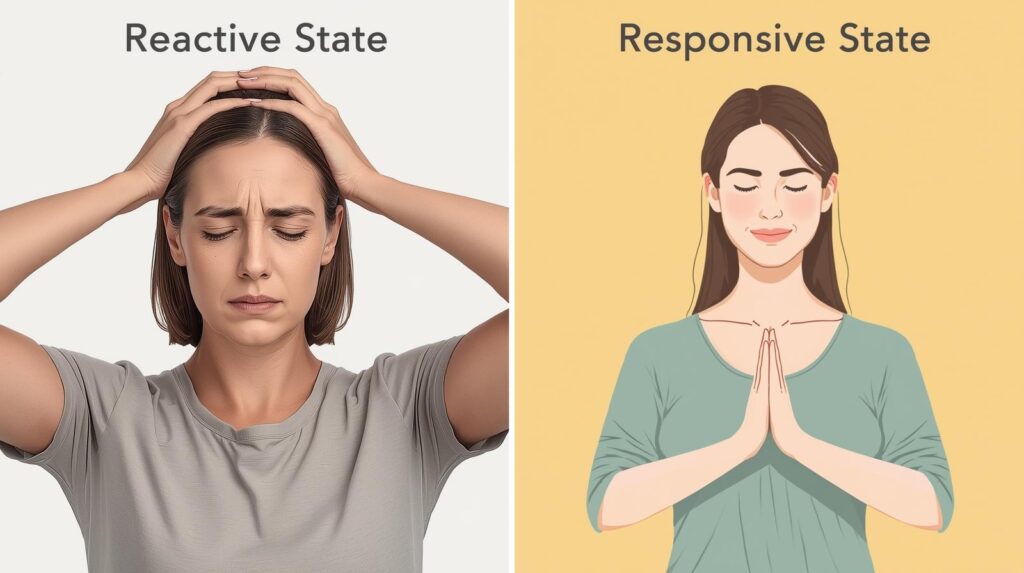
From Reactive to Responsive: The Long-Term Benefits of a Somatic Practice
Committing to a consistent somatic practice is an investment in the quality of your present and future life. The benefits extend far beyond moments of acute anxiety, seeping into the very fabric of your being and reshaping your relationship with yourself and the world. It is the journey from being a victim of your reactions to being the author of your responses.
To illustrate the profound shift, consider this comparison of the journey:
| The Reactive State (Before Somatic Practice) | The Responsive State (After Consistent Practice) |
|---|---|
| Feeling hijacked by overwhelming emotions and thoughts. | Noticing emotions and thoughts as they arise, without being controlled by them. |
| A constant, buzzing sense of dread and anxiety about the future. | A general sense of groundedness and presence in the here and now. |
| Chronic muscle tension, fatigue, and unexplained aches and pains. | Increased bodily awareness, ability to release tension, and more physical ease. |
| Difficulty sleeping due to a racing mind. | A calmer nervous system that can transition more easily into restful sleep. |
| Strained relationships due to irritability and emotional reactivity. | More patience and capacity for thoughtful, compassionate communication. |
| Feeling disconnected from your own needs and intuition. | A strong, reliable connection to your body’s wisdom and gut feelings. |
| Living on autopilot, just trying to get through the day. | Engaging with life with more intention, curiosity, and even joy. |
The ultimate benefit is the reclamation of your inner authority. You learn to trust the messages from your body more than the fearful stories from your mind. You discover that you are not broken, but have within you a deep, organic impulse toward health and balance. This is the profound gift that awaits you in Your Body as Your Guide: Trusted Somatic Practices for Life’s Transitions—the opportunity to not just manage symptoms, but to fundamentally transform your experience of life’s challenges.
Conclusion: Your Body is Your Home. Welcome Back to Calm.
The journey through anxiety and overwhelm is not a path of fighting against yourself, but one of returning home to yourself. Your body, which may have felt like the source of your distress, is in fact your greatest ally and guide. It has been speaking to you all along, using the language of sensation to signal when it needs rest, comfort, or release. Somatic exercises are the practice of learning this language—a practice of deep listening, profound compassion, and gentle action.
This is not about achieving a permanent state of perfect peace, but about building a resilient and trusting relationship with the wise, living being that you are. It’s about knowing that when the waves of life feel too big, you have an anchor within you. You have the power to ground yourself when you feel shaky, to soothe yourself when you feel scared, and to release the energy that no longer serves you. This is your birthright.
We invite you to take this understanding beyond the page. Let this be the beginning of a beautiful, lifelong conversation with your own body. To support you in deepening this practice with structure, guidance, and a supportive community, we warmly welcome you to join our free course, Your Body as Your Guide: Trusted Somatic Practices for Life’s Transitions. Your path back to calm, clarity, and a profound sense of belonging is waiting within you.
FAQ: Your Questions About Somatic Exercises for Anxiety, Answered
1. I find it hard to sit still and focus. Is somatic work still for me?
Absolutely. In fact, it may be especially for you. The agitation you feel is a signal from your nervous system, and somatic work meets you right there. You don’t have to start with a 20-minute silent meditation. Begin with the more active practices like shaking, grounding by walking barefoot on grass, or orienting. The goal is to start where you are, not where you think you “should” be.
2. What if I don’t feel anything during a body scan or other practice?
Feeling “nothing” or “numb” is a very common and valid sensation, especially when you’re beginning. It’s often a protective mechanism. The practice is simply to notice the numbness without judgment. Over time, as you gently and consistently check in, the sensitivity in those areas will often begin to return. There is no pressure to feel a certain way.
3. Is this a replacement for therapy or medication?
Somatic exercises are a powerful complement to therapy and medical care, not a replacement. They work on the physiological level of anxiety, while therapy often addresses the cognitive and narrative levels. Always consult with your healthcare provider before making any changes to your treatment plan. This work is about empowering you with more tools for your wellness toolkit.
4. I feel silly doing some of these, like shaking. Is that normal?
Yes, it’s completely normal! We live in a culture that often discourages expressive movement. Give yourself permission to feel silly. You can start in the privacy of your own home. Remember, the goal is effectiveness, not elegance. The relief you will feel often quickly outweighs the initial self-consciousness.
5. How long until I see results?
This varies for everyone. Many people feel a shift in their state of arousal immediately after a grounding or breathing practice. For more lasting changes in your baseline anxiety, consistency is key. You might notice a difference in how you handle stress within a few weeks of daily, short practices.
6. What if focusing on my body makes my anxiety worse?
This is a sign of high sensitivity, and it’s important to honor it. If this happens, pull back. Instead of focusing intensely inward, use the orienting practice to focus outward on your environment. Or, shift to a self-holding practice, which is very soothing. The course, Your Body as Your Guide, is designed to guide you at a pace that feels safe and sustainable.
7. Can I do these exercises if I have physical limitations or chronic pain?
Yes, somatic practices can be wonderfully adapted. The core principle is gentle, mindful awareness. If a movement is painful, don’t do it. You can always modify—for example, doing a body scan or self-holding while in a comfortable supported position. The focus is on working with sensation, not forcing movement.






Responses