
How to Regulate Your Nervous System: A Step-by-Step Guide to Finding Your Calm(2025)


The Symphony Inside You
Have you ever lain in bed at night, your body exhausted but your mind racing with a thousand thoughts? Or felt a sudden wave of irritability wash over you in response to a minor inconvenience, as if your internal alarm bell was stuck on “high alert”? If this feels familiar, you are not alone, and you are not broken. You are likely experiencing the effects of a dysregulated nervous system. For many women in midlife, the cumulative stress of hormonal shifts, career demands, family changes, and the pace of modern life can push our body’s built-in survival system into overdrive. We live in a state of being perpetually “wired but tired.”
The good news is that this state is not a life sentence. Learning how to regulate your nervous system is a powerful, accessible skill that allows you to move from a place of constant reaction to one of grounded response. It’s the art of shifting your internal state from survival to safety, from chaos to calm. This guide will demystify your nervous system, provide you with immediate tools to find your footing, and show you the path to building lasting resilience. For those ready for a structured, supportive journey to master this skill, our 4-week program, From Wired to Well: A Program to Regulate Your Nervous System, offers the deep dive and community support you need.
Beyond Willpower: Why You Can’t Think Your Way to a Calm Nervous System
We often believe that with enough positive thinking or mental fortitude, we can overcome our anxiety and exhaustion. We try to talk ourselves out of feeling stressed. Yet, you may have found that this rarely works in the midst of a true overwhelm. This is because your nervous system operates largely below the level of conscious thought. It is your body’s autopilot, designed to keep you alive. The autonomic nervous system (ANS) has three primary states, beautifully explained by Polyvagal Theory, that dictate how you feel and behave in any given moment. Understanding these states is the first step to learning how to regulate your nervous system.
First is the Ventral Vagal State, the state of safety and social connection. When you are here, you feel calm, engaged, curious, and compassionate. Your body can rest, digest, heal, and connect with others. This is the foundation of a regulated nervous system. Next is the Sympathetic State, your classic “fight-or-flight” response. It’s activated by perceived threats, flooding your body with adrenaline and cortisol to help you fight a danger or run from it.
This is essential for actual survival, but problems arise when it’s triggered by non-life-threatening stressors like a demanding email or a traffic jam. Finally, there is the Dorsal Vagal State, the “freeze” or “shutdown” response. This is a last-ditch survival strategy when fight or flight seems impossible. It leads to numbness, dissociation, collapse, and a feeling of being utterly disconnected from yourself and the world.
This is why willpower fails: you cannot rationally convince a primal, survival-based system that it is safe. When you’re in a sympathetic or dorsal vagal state, the prefrontal cortex—the part of your brain responsible for logic and reason—goes offline. You need to use a “bottom-up” approach, using the body to send signals of safety to the brain. This is the core of nervous system regulation. For a structured journey that guides you through recognizing and shifting these states with gentle, proven techniques, our course From Wired to Well provides a supportive 4-week framework.
Listen to the Whispers: 10 Common Signs of a Dysregulated Nervous System
Before we dive into the solutions, it’s important to recognize the signs. Your body is constantly communicating its state to you. Often, we dismiss these signals as separate issues, not realizing they are all threads connected to the same root: a nervous system struggling to find balance. Learning how to regulate your nervous system begins with learning its language. Here are 10 common whispers (and sometimes shouts) that your system may be dysregulated:
- Chronic Fatigue and Exhaustion: Your body is expending immense energy being in a constant state of high alert or shutdown, leaving you feeling drained no matter how much you sleep.
- Digestive Issues: The gut is often called the “second brain.” In a stressed state, blood flow is directed away from your digestive system, leading to bloating, IBS symptoms, or nausea.
- Muscle Tension and Pain: Your muscles are perpetually braced for action, leading to a tight jaw, stiff shoulders, back pain, and headaches.
- Emotional Reactivity or Numbness: You may find yourself crying easily, snapping in anger, or feeling emotionally flat and disconnected from your feelings.
- Sleep Problems: Falling asleep or staying asleep can be difficult because your mind is racing and your body doesn’t feel safe enough to fully rest.
- Heightened Startle Response: You jump at the smallest sounds or surprises, a clear sign your nervous system is perched on high alert.
- Brain Fog and Difficulty Concentrating: When your resources are dedicated to survival, there’s little left for higher cognitive functions like focus and memory.
- Feeling On Edge or Irritable: A general sense of unease, impatience, or irritability often pervades your day, even when nothing is demonstrably wrong.
- Shutdown or Collapse: In more severe cases, you might feel utterly drained, lethargic, and unable to motivate yourself to do even simple tasks.
- Frequent Illness: A chronically stressed nervous system suppresses the immune system, making you more susceptible to colds, infections, and other illnesses.
Recognizing these signs is not about self-judgment, but about gathering data. It’s your body’s way of asking for help and inviting you to learn the skills of regulation.
Meet Your Vagus Nerve: The Command Center for Calm
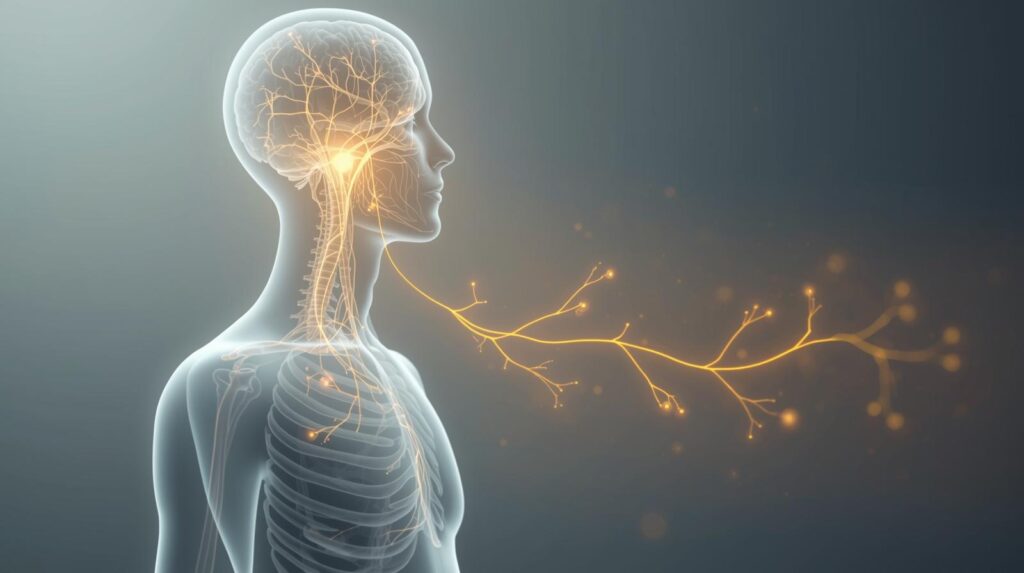
If your nervous system is the orchestra, then the vagus nerve is the conductor. This remarkable cranial nerve is the longest and most complex in your body, a vast information superhighway that wanders (its name comes from the Latin for “wandering”) from your brainstem down through your neck and into your chest and abdomen, connecting to your heart, lungs, gut, and other major organs. It is the primary component of the parasympathetic nervous system and is responsible for shifting your body into the “rest and digest” state. Understanding how to work with your vagus nerve is the single most powerful key to learning how to regulate your nervous system.
The ventral branch of the vagus nerve is specifically associated with feelings of safety, social connection, and calm. When it’s active, your heart rate slows, your breathing deepens, and your body can focus on healing, restoration, and connection. This is the state we aim to cultivate. The good news is that, like a muscle, you can “tone” your vagus nerve.
Vagus nerve toning refers to practices that strengthen its function, making it more responsive and resilient. A well-toned vagus nerve can more efficiently pull you out of a stress response and back into a state of safety, meaning you recover from life’s stressors more quickly and with less lingering damage. This isn’t a metaphorical concept; it’s a physiological process measured by something called “heart rate variability” (HRV)—a higher HRV is a key indicator of a healthy, resilient nervous system.
So, how do you tone this vital nerve? The practices are often surprisingly simple and accessible. They work by sending direct sensory input up the vagus nerve to your brain, signaling that the body is safe. This includes activities like slow, rhythmic breathing, humming or chanting, cold exposure on the face and neck, and certain social engagement behaviors. The goal is to consistently send these signals of safety, training your nervous system to default to a state of calm more readily. Learning specific, powerful vagus nerve toning exercises is a central focus of Week 2 of our From Wired to Well program, where we guide you through a sequence designed to build resilience from the inside out.
Your Foundational Toolkit: 5 Somatic Practices for Immediate Regulation
Knowledge is power, but practice is where transformation happens. This toolkit is designed to give you immediate, body-based ways to regulate your nervous system when you feel anxiety, overwhelm, or shutdown beginning to take hold. These are “bottom-up” practices, meaning they work by changing the physical state of your body first, which then calms your mind. The key is to practice them consistently, not just in moments of crisis, to build your regulatory muscle memory.
- Practice 1: The Physiological Sigh (for instant calm)
- Practice 2: Orienting for Safety (for hypervigilance)
- Practice 3: Grounding for Stability (for anxiety and overwhelm)
- Practice 4: Self-Holding for Comfort (for self-soothing)
- Practice 5: Gentle Somatic Movement (for releasing tension)
Think of these as your first-aid kit for a dysregulated nervous system. Experiment with them to discover which ones resonate most with your body in different situations. The ultimate goal is to have a variety of tools at your disposal so you can respond to your internal state with skill and compassion. Mastering these foundational tools is the first step in creating a more resilient daily life, a process we fully support you through in the From Wired to Well program.
Practice 1: The Physiological Sigh for Instant Calm
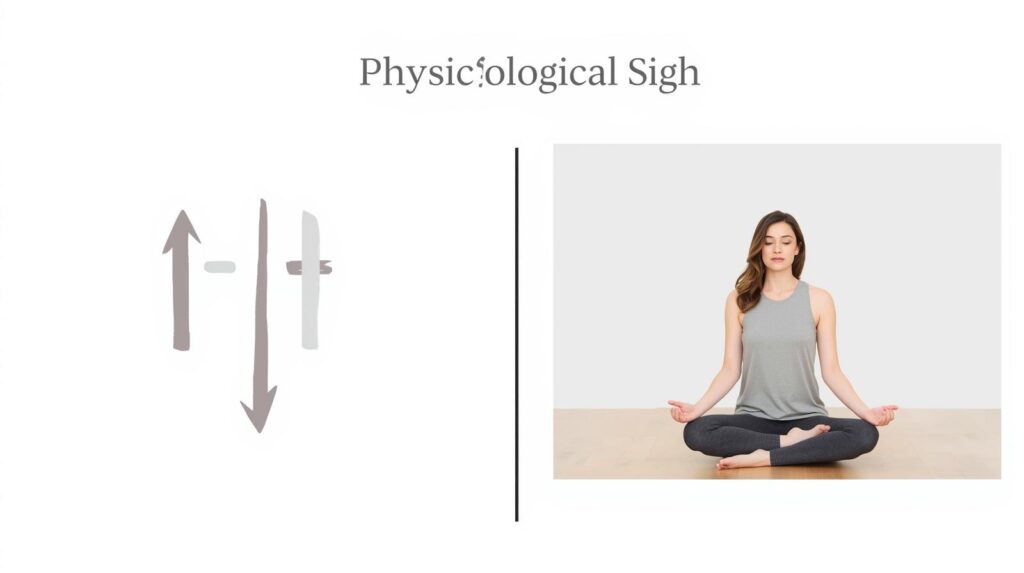
The physiological sigh is arguably the fastest and most effective hardwired breathing pattern to reduce stress and induce calm. It was popularized by Dr. Andrew Huberman and works by maximizing the rate of carbon dioxide expulsion from your body, which rapidly slows your heart rate. You can do this anytime, anywhere, without anyone noticing.
- Inhale Deeply: Take a slow, full inhale through your nose.
- Inhale Again: At the very top of that first inhale, take one more sharp, short “sip” of air in through your nose to fully expand your lungs.
- Long, Slow Exhale: Release a long, slow, and complete exhale through your mouth, as if you are fogging up a mirror. Let the exhale be longer than the combined inhales.
- Repeat: Do this for just one to three cycles. You will feel a noticeable shift toward calm almost immediately.
Practice 2: Orienting for Safety (for Hypervigilance)
When you feel jumpy, paranoid, or like you can’t settle, your nervous system is stuck in a hypervigilant loop, scanning for danger. The orienting response is a hardwired reflex that helps you assess your actual surroundings for safety, manually interrupting the panic cycle.
- Pause and Breathe: Wherever you are, pause. Take one gentle breath.
- Look Slowly: Begin to slowly and calmly look around your environment. Let your eyes land on various neutral objects—a plant, a book, a lamp. Silently name what you see without judgment.
- Listen for Sounds: Now, turn your attention to sounds. Notice the sounds closest to you, then expand your awareness to sounds in the next room, and finally to sounds outside the building.
- Check In: After a minute, bring your attention back inside. Notice if your breathing has changed or if the feeling of alarm has softened.
Practice 3: Grounding for Stability (for Anxiety and Overwhelm)
When anxiety strikes, it can feel like you’re mentally and physically untethered. Grounding is the practice of bringing your awareness firmly into the present moment and into the physical support of your body and the earth. It works by pulling your attention away from internal chaos and anchoring it in the undeniable, solid reality of the “here and now.”
- Rooted Feet: Whether sitting or standing, place your feet flat on the floor. Press down gently through all four corners—your big toe, little toe, and both sides of your heel. Imagine roots growing from your feet, deep into the center of the earth. Feel the stable energy of the earth holding you.
- 5-4-3-2-1 Sensory Grounding: Look around and silently name: 5 things you can see, 4 things you can feel (your feet on the floor, the fabric of your shirt), 3 things you can hear, 2 things you can smell, and 1 thing you can taste.
- Weight and Gravity Awareness: Bring your attention to the feeling of weight in your body. Notice the heaviness of your thighs on the chair, your shoulders against the backrest, or your entire body being held by the floor. Surrender a little bit of your weight to gravity.
Practice 4: Self-Holding for Comfort (for Self-Soothing)
In moments of overwhelm, we often crave the comfort of a hug. Self-holding allows you to provide this profound sense of safety for yourself, activating your skin’s C-tactile fibers, which send signals to the brain to release oxytocin, the “bonding and comfort” hormone.
- Find a Quiet Space: Sit or lie down comfortably.
- Place Your Hands: Gently place one hand over your heart and your other hand on your opposite arm, shoulder, or abdomen—wherever feels most comforting.
- Feel the Connection: Close your eyes. Bring your awareness to the sensation of your hands on your body. Feel the warmth. Imagine compassion flowing from your heart, through your arms, and into your hands.
- Breathe and Hold: Take several slow, deep breaths, feeling your chest or abdomen rise and fall against your hands. Stay here for one to five minutes.
Practice 5: Gentle Somatic Movement (for Releasing Tension)
Chronic stress and anxiety lead to chronic muscle tension. Gentle somatic movement, such as the classic “Cat-Cow” stretch from yoga, helps to release this deep, held tension by improving the brain-body connection and encouraging the muscles to let go.
- Start on All Fours: Come to your hands and knees with your wrists under your shoulders and knees under your hips.
- Inhale into Cow Pose: As you inhale, gently drop your belly towards the floor, lift your chin and chest, and look slightly upward. Allow your spine to gently arch.
- Exhale into Cat Pose: As you exhale, draw your belly button towards your spine, round your spine towards the ceiling, and tuck your chin to your chest.
- Flow with Your Breath: Continue moving slowly and gently between these two shapes, synchronizing each movement with your breath. Focus on the sensation of release in your spine. Continue for 1-2 minutes.
Building a Regulated Lifestyle: Daily Habits for a Resilient System
While the foundational practices are essential for moments of dysregulation, true resilience is built through the small, consistent habits woven into the fabric of your daily life. Learning how to regulate your nervous system is not about adding another major task to your to-do list; it’s about creating a rhythm of regulation where small, nourishing practices become as automatic as brushing your teeth. The principle here is consistency over intensity. A two-minute breathing practice done daily is far more powerful than a 30-minute session done once a month. It’s about sending frequent, gentle signals of safety to your nervous system throughout the day, preventing it from tipping into overwhelm in the first place.
To build this resilient lifestyle, it’s helpful to understand which common habits contribute to dysregulation and which ones actively promote regulation. The modern world is full of dysregulating inputs, from constant digital notifications to poor sleep hygiene and rushed meals. By consciously choosing regulating habits, you create a buffer against this constant stress.
| Dysregulating Habits (Move Away From) | Regulating Habits (Move Towards) |
|---|---|
| Doomscrolling on your phone first thing in the morning or before bed | 5 minutes of morning sunlight and a gentle body scan |
| Rushing through meals while working or watching stressful news | Mindful eating, chewing slowly, without screens |
| Staying sedentary for long periods throughout the day | Incorporating “movement snacks” – short walks, stretching |
| Consuming caffeine late in the day or on an empty stomach | Herbal teas (chamomile, lavender) and staying hydrated with water |
| Poor sleep routine (bright lights, screens before bed) | A consistent wind-down routine: dim lights, reading, self-holding |
Turning these habits into a sustainable, personalized routine is the core focus of our 4-week program, From Wired to Well. We provide the structure, guidance, and community support to help you make these shifts feel natural and effortless, transforming your daily life from one of reactivity to one of grounded resilience.

Breath as Your Anchor: A Guide to Nervous System Breathing Techniques
Your breath is the most direct and powerful remote control you have for your nervous system. Unlike your heartbeat, which is mostly automatic, your breathing exists at the beautiful intersection of voluntary and involuntary control. This means you can consciously use it to send immediate, potent signals of safety to your brain. When you feel anxious, your breath becomes shallow and rapid, located high in your chest. This pattern reinforces the “fight-or-flight” state. By consciously shifting to a slow, deep, diaphragmatic breathing pattern, you directly stimulate the vagus nerve and activate the parasympathetic “rest-and-digest” response. Mastering a few simple breathing techniques is a cornerstone of learning how to regulate your nervous system.
One of the most effective and well-researched patterns is Coherent Breathing, also known as resonance frequency breathing. The goal is to breathe at a rate of about five breaths per minute, which typically means inhaling for five seconds and exhaling for five seconds. This specific rhythm has been shown to create coherence between your heart rate and your breathing, maximizing Heart Rate Variability (HRV) and optimizing the function of your cardiovascular and nervous systems. It’s like tuning an instrument to its perfect pitch; you are tuning your body to its most resilient and calm state. This practice is incredibly accessible and can be done anywhere, making it a perfect daily habit for building resilience.
Another profoundly calming technique is the 4-7-8 Breath, developed by Dr. Andrew Weil. This practice acts as a natural tranquilizer for the nervous system. The extended exhale is key, as it directly stimulates the vagus nerve more than the inhale, powerfully applying the “brakes” to your stress response. For moments when you need to find focus and composure amidst chaos, Box Breathing (also known as square breathing) is an excellent tool. Its equal, measured parts create a sense of control and stability, making it a favorite among first responders and military personnel for staying calm under pressure. The following table provides a clear guide to these essential techniques:
| Technique | Rhythm (Inhale-Hold-Exhale-Hold) | Primary Use | How it Works |
|---|---|---|---|
| Coherent Breathing | 5-0-5-0 (5 seconds in, 5 seconds out) | Daily practice for resilience, pre-empting stress | Synchronizes heart & lungs to maximize HRV and vagal tone. |
| 4-7-8 Breathing | 4-0-7-0 (Inhale 4, Exhale 8) | For immediate calm, especially before sleep | Long exhale activates parasympathetic nervous system more strongly. |
| Box Breathing | 4-4-4-4 (Inhale 4, Hold 4, Exhale 4, Hold 4) | For focus & composure in stressful moments | Creates mental focus & a sense of control, regulating the stress response. |
The Role of Nutrition and Hydration in Nervous System Health
The food and drink you consume provide the fundamental building blocks for your neurotransmitters, the chemical messengers that govern your mood, sleep, and stress response. Learning how to regulate your nervous system must include looking at what you’re feeding it. The goal is not a restrictive diet, but rather a nourishing one that provides steady energy and the specific nutrients your overworked system craves for repair and balance. The connection between your gut and your brain, known as the gut-brain axis, is a direct line of communication. An inflamed, unhappy gut can send constant distress signals to your brain, contributing to anxiety and mood disorders.
Key to this is blood sugar balance. When you skip meals or consume high-sugar foods, your blood sugar spikes and then crashes. This crash is a significant physiological stressor, triggering the release of cortisol and adrenaline, which jolts your nervous system. To avoid this, focus on meals that combine protein, healthy fats, and fiber, which provide a slow, steady release of energy.
Specific nutrients are also crucial allies. Magnesium is nature’s relaxant, essential for muscle relaxation and calming the nervous system. B Vitamins, especially B6, B9 (folate), and B12, are critical for the production of calming neurotransmitters like GABA and serotonin. Omega-3 Fatty Acids, found in fatty fish and flaxseeds, are powerful anti-inflammatories that support brain health and cognitive function.
Perhaps the simplest yet most overlooked factor is hydration. Your brain is approximately 75% water, and even mild dehydration can increase cortisol levels, making you more susceptible to stress. Dehydration can mimic symptoms of anxiety, such as dizziness, heart palpitations, and fatigue. Making a conscious effort to drink water consistently throughout the day is one of the easiest and most effective ways to support your nervous system’s baseline function. Think of it as providing a smooth, flowing river for your neural communication, rather than a sluggish, muddy creek.
Creating Safety in Your Environment for Lasting Regulation
Your nervous system is constantly assessing your environment for safety or danger, a process called neuroception. This happens subconsciously, based on sensory input. Therefore, one of the most powerful ways to support a regulated state is to consciously curate an environment that signals “safety” to your brain. This goes beyond decluttering (though that can help) and into the realm of your sensory experience—what you see, hear, and feel. In a world filled with overstimulation, creating pockets of sensory calm can be a profound act of self-care and a critical component of how to regulate your nervous system long-term.
Start with your visual and auditory space. The constant pings and notifications from our devices are a major source of micro-stressors that keep the nervous system on alert. Implement digital boundaries, such as turning off non-essential notifications, having phone-free periods, and creating a calming phone lock screen. For sound, consider incorporating periods of silence or using calming background noise like nature sounds or binaural beats instead of talk radio or stressful news. Your physical touch environment also matters. Surround yourself with soft, comforting textures—a cozy blanket on your chair, comfortable clothing, a pleasant-weighted blanket for sleep. These tactile inputs can be deeply soothing to a frazzled system.
Finally, never underestimate the power of co-regulation. As social creatures, our nervous systems are designed to be calmed by the presence of other safe, regulated nervous systems. This is the biological basis of connection. Seeking out positive social interactions, whether a deep conversation with a friend, a hug from a loved one, or even participating in a supportive group like the From Wired to Well community, can provide a powerful external resource for regulation. When you feel dysregulated, connecting with a calm, safe person can help your own system downshift. Your environment and your community are not separate from you; they are the ecosystem in which your nervous system either thrives or merely survives.
Navigating Setbacks: What to Do When You Feel Dysregulated Again
It is vital to understand that the journey of learning how to regulate your nervous system is not a linear path upward toward permanent calm. It is a spiral. There will be days, or even moments within a day, when you feel yourself slipping back into old patterns of anxiety, irritability, or shutdown.
A difficult conversation, a stressful work deadline, or even just a poor night’s sleep can trigger a dysregulation spike. This is not a sign of failure; it is a sign that you are human and that your nervous system is doing its job, based on its lifelong training. The goal is not to avoid these moments entirely, but to change your relationship with them—to meet them with compassion and a clear plan, rather than panic and self-judgment.
The first and most crucial skill is learning to spot the early warning signs of dysregulation. Before you’re in full-blown fight-or-flight or collapse, your body sends subtle signals. It might be a slight tightness in your jaw, a feeling of restlessness in your legs, a desire to scroll mindlessly on your phone, or a shallow quality to your breath. Catching the wave when it’s still small is infinitely easier than trying to calm a tsunami.
This is where your daily practice of interoception (internal awareness) pays off. When you notice an early sign, you can deploy a micro-practice—a single physiological sigh, 30 seconds of grounding, or a quick orienting glance around the room—to gently guide your system back.
This is why having a personal “Nervous System First-Aid Kit” is so empowering. This is a mental or physical list of the specific practices you know work for you when you’re in different states of dysregulation. For example, your kit might include:
- For rising anxiety (Sympathetic activation): The physiological sigh, cold water on the wrists, and a brisk walk.
- For feeling overwhelmed and scattered (Sympathetic overwhelm): Grounding techniques and box breathing.
- For numbness and shutdown (Dorsal vagal): Gentle somatic movement like cat-cow, humming or singing, and self-holding.
Having this plan removes the need to think clearly when you can’t. You simply refer to your kit and take one small action. Having a community for support during these inevitable setbacks is invaluable. In the From Wired to Well program, you learn and grow with others who understand this journey, providing a powerful source of co-regulation and shared wisdom that reminds you that you are not alone in this process.
The Journey from Survival to Thriving: What to Expect
Committing to the practices of nervous system regulation is an investment in the very quality of your life. While the initial motivation might be to relieve the acute distress of anxiety and overwhelm, the long-term benefits ripple out into every corner of your being. This is the journey from merely surviving your days to actively thriving within them. It is a shift from being at the mercy of your external circumstances to having an internal anchor that holds you steady, no matter what storms may come.
The physical changes are often the first to be noticed. As your nervous system spends more time in the safe and social state, your body can finally attend to the tasks of restoration. You will likely experience improved sleep, waking up feeling more refreshed. Your digestion will become more regular and comfortable as the gut-brain axis calms down.
You may find you get sick less often because your immune system is no longer being chronically suppressed by stress hormones. The mental and emotional shifts are equally profound. The constant static of “brain fog” lifts, replaced by greater mental clarity, focus, and creativity. Emotional reactivity gives way to emotional resilience—you still feel the full spectrum of human emotion, but you are no longer hijacked by it. You can feel sadness without collapsing, or anger without exploding.
Perhaps the most beautiful outcome is the rediscovery of joy, curiosity, and a sense of connection. When your system is no longer preoccupied with survival, energy is freed up for play, for learning, and for deep, meaningful engagement with the people and activities you love. You begin to respond to life from a place of choice, not a place of fear. This is the promise of a regulated nervous system: not a life without challenge, but a life lived with the capacity to meet those challenges from your fullest, most authentic, and resilient self.
Conclusion: You Hold the Key to Your Calm
The journey you have just explored is one of the most empowering you can ever undertake. Learning how to regulate your nervous system is the process of coming home to yourself—of reclaiming the authority over your own inner state. It is the understanding that while you cannot control the winds of life, you can absolutely learn to adjust your sails. The constant buzz of anxiety, the heavy weight of exhaustion, the feeling of being perpetually on edge—these are not your destiny. They are signals from a wise body that has been doing its best to protect you, and it is now asking for you to partner with it in a new way.
You have been introduced to the map: the science of your nervous system, the power of your vagus nerve, and a toolkit of practical, accessible practices. This knowledge is your compass. The practices are your vehicle. But you are the one who must take the wheel. It begins with a single breath, a moment of feeling your feet on the floor, a gentle hand on your heart. It begins with the radical decision to believe that you are worthy of your own care and that calm is your birthright.
This path is one of profound self-compassion. There is no finish line, only the gentle, daily practice of returning, again and again, to the safety and wisdom of your own body. You have everything you need within you. We invite you to take the next step with guided support and a compassionate community. Ready to move from knowledge to embodied practice? Join our supportive 4-week program, From Wired to Well: A Program to Regulate Your Nervous System, and finally find your way back to well. Your calm, clear, and vibrant life is waiting.
FAQ: Your Questions About Nervous System Regulation, Answered
1. How long does it take to regulate my nervous system?
This varies greatly depending on your individual history, consistency with practice, and the level of support you have. Many people feel a shift after a single session of coherent breathing or a body scan. For lasting changes to your baseline state, a committed practice of 3-6 months is a realistic timeframe to rewire deeply ingrained patterns. Consistency with small daily practices is far more important than occasional long sessions.
2. Is learning how to regulate my nervous system the same as treating anxiety or depression?
It is a powerful and essential component, but it is not always a full replacement for professional treatment. Somatic practices address the physiological root of these conditions. For many, this brings profound relief. However, if you have a clinical diagnosis, this work should be seen as a complementary approach used in conjunction with therapy and/or medical care. Always consult your healthcare provider.
3. What if the exercises make me feel worse or more anxious?
This is a common experience, especially if you have a history of trauma. It’s a sign that your system is highly sensitive. If this happens, stop the inward-focused practice (like a body scan) immediately. Shift to an outward-focused practice like orienting, or a very simple grounding technique. The goal is always to build tolerance slowly and gently. A trained facilitator, like those in our From Wired to Well program, can be invaluable in guiding you safely.
4. Can I do this if I have a history of trauma?
Yes, but with care. Trauma is stored in the body, and somatic practices can bring up stored survival energy. It is highly recommended to undertake this work with the support of a trauma-informed therapist or a somatic experiencing practitioner. The course is designed to be gentle and is an excellent adjunct to therapy, providing a toolkit for building safety and resilience.
5. I’m very busy. How can I possibly fit this in?
The beauty of this work is that many of the most effective tools are “micro-practices” that take 60 seconds or less. A physiological sigh, a quick grounding check, or one minute of coherent breathing can be done between tasks, at a stoplight, or while waiting for your coffee. Weaving these tiny anchors into your existing routine is the secret to sustainability for a busy life.
6. Do I need to be flexible or athletic to do the movements?
Not at all. Somatic movement is about internal awareness and gentle release, not performance or flexibility. Practices like cat-cow can be modified to be done seated in a chair. The focus is always on the sensation, not the shape.






Responses